Brand Name
Visudyne
Generic Name
Verteporfin
View Brand Information FDA approval date: April 12, 2000
Classification: Photoenhancer
Form: Injection
What is Visudyne (Verteporfin)?
VISUDYNE ® therapy is indicated for the treatment of patients with predominantly classic subfoveal choroidal neovascularization due to age-related macular degeneration , pathologic myopia or presumed ocular histoplasmosis. There is insufficient evidence to indicate VISUDYNE for the treatment of predominantly occult subfoveal CNV. VISUDYNE therapy is a photoenhancer indicated for the treatment of patients with predominantly classic subfoveal choroidal neovascularization due to age-related macular degeneration, pathologic myopia or presumed ocular histoplasmosis.
Approved To Treat
Top Global Experts
There are no experts for this drug
Save this treatment for later
Not sure about your diagnosis?
Tired of the same old research?
Related Clinical Trials
There is no clinical trials being done for this treatment
Related Latest Advances
There is no latest advances for this treatment
Brand Information
Visudyne (verteporfin for injection)
1INDICATIONS AND USAGE
VISUDYNE
There is insufficient evidence to indicate VISUDYNE for the treatment of predominantly occult subfoveal CNV.
2DOSAGE FORMS AND STRENGTHS
For injection: 15 mg of verteporfin as a dark green lyophilized cake in a single-dose vial for reconstitution. VISUDYNE is intended for intravenous injection only. Each reconstituted vial provides 7.5 mL solution containing 2 mg/mL of verteporfin.
3CONTRAINDICATIONS
VISUDYNE (verteporfin for injection) is contraindicated for patients with porphyria or a known hypersensitivity to any component of this preparation
4ADVERSE REACTIONS
The following serious adverse reactions are described elsewhere in the labeling:
- Local Adverse Reactions – Extravasation
- Exposure to Sun or Direct Light
- Decreased Vision after Treatment
- Porphyria and Hypersensitivity
4.1Clinical Trials Experience
Because clinical trials are conducted under widely varying conditions, adverse reaction rates observed in the clinical trials of a drug cannot be directly compared to rates in the clinical trials of another drug and may not reflect the rates observed in practice.
Severe chest pain, vasovagal and hypersensitivity reactions have been reported. Vasovagal and hypersensitivity reactions on rare occasions can be severe. These reactions may include syncope, sweating, dizziness, rash, dyspnea, flushing and changes in blood pressure and heart rate. General symptoms can include headache, malaise, urticaria, and pruritus.
The most frequently reported adverse reactions to VISUDYNE (verteporfin for injection) are injection site reactions (including pain, edema, inflammation, extravasation, rashes, hemorrhage and discoloration) and visual disturbances (including blurred vision, flashes of light, decreased visual acuity and visual field defects, including scotoma). These events occurred in approximately 10%-30% of patients. The following events, listed by Body System, were reported more frequently with VISUDYNE therapy than with placebo therapy and occurred in 1%-10% of patients:
Severe vision decrease, equivalent of >4 lines, within 7 days after treatment has been reported in 1%-5% of patients. Partial recovery of vision was observed in some patients. Photosensitivity reactions usually occurred in the form of skin sunburn following exposure to sunlight. The higher incidence of back pain in the VISUDYNE group occurred primarily during infusion.
The following adverse events have occurred either at low incidence (<1%) during clinical trials or have been reported during the use of VISUDYNE in clinical practice where these reactions were reported voluntarily from a population of unknown size and frequency of occurrence cannot be determined precisely. They have been chosen for inclusion based on factors such as seriousness, frequency of reporting, possible causal connection to VISUDYNE, or a combination of these factors:
5DRUG INTERACTIONS
Drug interaction studies in humans have not been conducted with VISUDYNE.
Verteporfin is rapidly eliminated by the liver, mainly as unchanged drug. Metabolism is limited and occurs by liver and plasma esterases. Microsomal cytochrome P450 does not appear to play a role in verteporfin metabolism.
Based on the mechanism of action of verteporfin, many drugs used concomitantly could influence the effect of VISUDYNE therapy. Possible examples include the following:
Calcium channel blockers, polymyxin B or radiation therapy could enhance the rate of VISUDYNE uptake by the vascular endothelium. Other photosensitizing agents (e.g., tetracyclines, sulfonamides, phenothiazines, sulfonylurea hypoglycemic agents, thiazide diuretics and griseofulvin) could increase the potential for skin photosensitivity reactions. Compounds that quench active oxygen species or scavenge radicals, such as dimethyl sulfoxide, β-carotene, ethanol, formate and mannitol, would be expected to decrease VISUDYNE activity. Drugs that decrease clotting, vasoconstriction or platelet aggregation, e.g., thromboxane A
6OVERDOSAGE
Overdose of drug and/or light in the treated eye may result in non-perfusion of normal retinal vessels with the possibility of severe decrease in vision that could be permanent. An overdose of drug will also result in the prolongation of the period during which the patient remains photosensitive to bright light. In such cases, it is recommended to extend the photosensitivity precautions for a time proportional to the overdose.
7DESCRIPTION
VISUDYNE
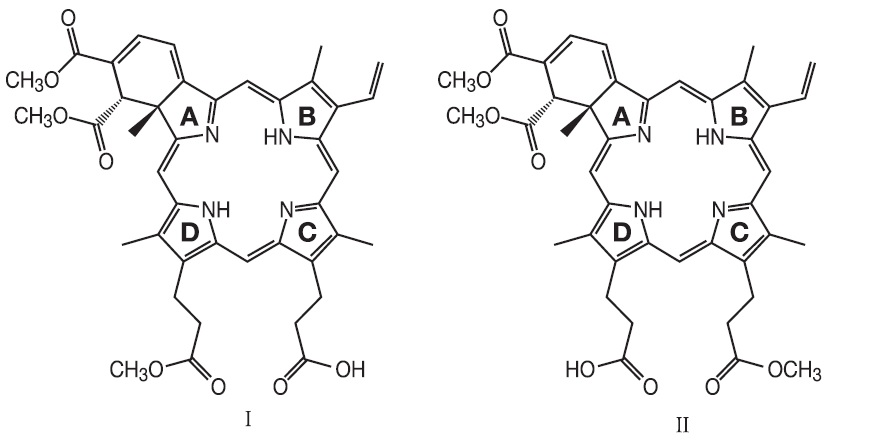
The chemical names for the verteporfin regioisomers are:
9-methyl (I) and 13-methyl (II) trans-(±)-18-ethenyl-4,4a,-dihydro-3,4-bis(methoxycarbonyl)-4a,8,14,19-tetramethyl-23H, 25H-benzo[b]porphine-9,13-dipropanoate
The molecular formula is C
8HOW SUPPLIED/STORAGE AND HANDLING
VISUDYNE
- NDC 24208-560-15
Store VISUDYNE at controlled room temperature between 20°C to 25°C (68°F to 77°F). Protect from light.
8.1Spills and Disposal
Spills of VISUDYNE should be wiped up with a damp cloth. Skin and eye contact should be avoided due to the potential for photosensitivity reactions upon exposure to light. Use of rubber gloves and eye protection is recommended. All materials should be disposed of properly.
8.2Accidental Exposure
Because of the potential to induce photosensitivity reactions, it is important to avoid contact with the eyes and skin during preparation and administration of VISUDYNE. Any exposed person must be protected from bright light
9PATIENT COUNSELING INFORMATION
Advise patients who receive VISUDYNE that they will become temporarily photosensitive after the infusion. Patients should be advised to wear a wristband to remind them to avoid direct sunlight for 5 days. During that period, patients should be advised to avoid exposure of unprotected skin, eyes or other body organs to direct sunlight or bright indoor light. Sources of bright light include, but are not limited to, tanning salons, bright halogen lighting and high power lighting used in surgical operating rooms or dental offices. Prolonged exposure to light from light-emitting medical devices such as pulse oximeters should also be avoided for 5 days following VISUDYNE administration.
If treated patients must go outdoors in daylight during the first 5 days after treatment, they should be advised to protect all parts of their skin and their eyes by wearing protective clothing and dark sunglasses. UV sunscreens are not effective in protecting against photosensitivity reactions because photoactivation of the residual drug in the skin can be caused by visible light.
Patients should be advised to not stay in the dark and should be encouraged to expose their skin to ambient indoor light, as it will help inactivate the drug in the skin through a process called photobleaching.
Following VISUDYNE treatment, patients should be advised that they may develop visual disturbances such as abnormal vision, vision decrease, or visual field defects that may interfere with their ability to drive or use machines. Patients should be advised to not drive or use machines as long as these symptoms persist.
Distributed by:
Bausch & Lomb Americas Inc.
Bridgewater, NJ 08807 USA
Bausch & Lomb Americas Inc.
Bridgewater, NJ 08807 USA
Manufactured by:
Alcami Carolinas Corporation
Charleston, SC 29405 USA
VISUDYNE is a registered trademark of CHEPLAPHARM ARZNEIMITTEL GMBH used under license.
Other product/brand names are trademarks of the respective owners.
© 2023 Bausch & Lomb Incorporated or its affiliates
9589703
10PACKAGE/LABEL PRINCIPAL DISPLAY PANEL
NDC 24208-560-15
Rx only
Visudyne
(verteporfin
for injection)
15 mg/vial
(verteporfin
for injection)
15 mg/vial
Must be reconstituted
and further diluted.
FOR INTRAVENOUS INFUSION
1 Single-Use Dose Vial
1 Single-Use Dose Vial
Discard Unused Portion
Sterile
9589603