Age-Related Macular Degeneration (ARMD) Treatments

Find Age-Related Macular Degeneration (ARMD) Treatments

Find a DoctorCondition OverviewLatest AdvancesClinical TrialsTreatments
Generic Name

Aflibercept

Brand Names
Pavblu, Eylea, EYDENZELT boav, Zaltrap
FDA approval date: November 21, 2011
Classification: Vascular Endothelial Growth Factor Inhibitor
Form: Injection, Solution

What is Pavblu (Aflibercept)?

EYDENZELT is indicated for the treatment of: EYDENZELT is a vascular endothelial growth factor inhibitor indicated for the treatment of patients with: Neovascular Age-Related Macular Degeneration .

Approved To Treat

  • Late-Onset Retinal Degeneration
  • Age-Related Macular Degeneration (ARMD)
  • Diabetic Retinopathy
  • Diabetic Macular Edema (DME)
  • Retinal Vein Occlusion

Top Global Experts

  • Carol L. Shields
    Carol L. Shields
  • Peter Kaiser
    Peter Kaiser
  • Jay Chhablani
    Jay Chhablani
  • Allen C. Ho
    Allen C. Ho
  • Sunir J. Garg
    Sunir J. Garg
View All
Save this treatment for later
Sign Up
Not sure about your diagnosis?
Check Your Symptoms
Tired of the same old research?
Check Latest Advances

Related Clinical Trials

Intra Ocular Pressure Monitoring After Intravitreal Injection of Aflibercept 8mg/0.07mL
Enrollment Status: Recruiting
Publish Date: February 12, 2026
Intervention Type: Diagnostic test
Study Phase: Not Applicable

Summary: In just a few years, intravitreal injections have become a standard method of administration for certain retinal deseases (age-related macular degeneration \[AMD\], diabetic edematous maculopathy or retinal vein occlusion \[RVO\]). Thus, vascular endothelial growth factor (anti-VEGF) inhibitors are injected repetitively, every 4 to 6 weeks, in some patients in order to treat such pathologies. It i...

A Phase 1/2 Dose-Escalation and Randomized, Controlled, Masked Expansion Trial of Intravitreal 4D-150 Gene Therapy in Adults With Neovascular (Wet) Age-Related Macular Degeneration
Who is this study for: Adults with neovascular (wet) age-related macular degeneration
Enrollment Status: Recruiting
Publish Date: February 12, 2026
Intervention Type: Biological
Study Drugs: 4D-150, Aflibercept
Study Phase: Phase 1/Phase 2

Summary: Phase 1/2 dose-escalation and randomized, controlled, masked expansion trial in adults with wet AMD undergoing active anti-VEGF treatment. Substudies will evaluate the safety and tolerability of 4D-150 contralateral eye dosing and characterize vector shedding.

A Phase 3, Randomized, Double-Masked, Active-Controlled Trial of a Single Intravitreal Injection of 4D-150 in Adults With Macular Neovascularization Secondary to Age-Related Macular Degeneration
Enrollment Status: Recruiting
Publish Date: February 12, 2026
Intervention Type: Biological
Study Phase: Phase 3

Summary: A Phase 3, Randomized, Double-Masked, Active-Controlled Trial in Adults with Macular Neovascularization Secondary to Age-Related Macular Degeneration

View All Clinical Trials

Related Latest Advances

Association of Molar Dose and Early Retinochoroidal Blood Flow Changes After Intravitreal Anti-Vascular Endothelial Growth Factor Therapy.
Journal: Investigative ophthalmology & visual science
Published: January 14, 2026
Anti-VEGF Therapy Switching in Neovascular Age-Related Macular Degeneration: Insights from Automated Volumetric Retinal Fluid Analysis.
Journal: Retina (Philadelphia, Pa.)
Published: January 06, 2026
Cost-effectiveness analysis of early versus late switching in treatment-naïve patients with refractory diabetic macular oedema in the Turkish population: real-world data from the Bosphorus DME study group, report number 5.
Journal: Clinical & experimental optometry
Published: January 06, 2026
View All Latest Advances

Brand Information

    PAVBLU (aflibercept-ayyh)
    1INDICATIONS AND USAGE
    PAVBLU is indicated for the treatment of:
    2DOSAGE FORMS AND STRENGTHS
    PAVBLU is a clear to opalescent and colorless to slightly yellow solution available as:
    • Injection: 2 mg (0.05 mL of 40 mg/mL solution) in a single-dose prefilled plastic syringe
    • Injection: 2 mg (0.05 mL of 40 mg/mL solution) in a single-dose glass vial
    3ADVERSE REACTIONS
    The following potentially serious adverse reactions are described elsewhere in the labeling:
    • Hypersensitivity
    • Endophthalmitis, retinal detachments, and Retinal Vasculitis with or without Occlusion
    • Increase in intraocular pressure
    • Thromboembolic events
    3.1Clinical Trials Experience
    Because clinical trials are conducted under widely varying conditions, adverse reaction rates observed in the clinical trials of a drug cannot be directly compared to rates in other clinical trials of the same or another drug and may not reflect the rates observed in practice.
    A total of 2980 adult patients treated with aflibercept constituted the safety population in eight phase 3 studies. Among those, 2379 patients were treated with the recommended dose of 2 mg. Serious adverse reactions related to the injection procedure have occurred in <0.1% of intravitreal injections with aflibercept including endophthalmitis and retinal detachment. The most common adverse reactions (≥5%) reported in patients receiving aflibercept were conjunctival hemorrhage, eye pain, cataract, vitreous detachment, vitreous floaters, and intraocular pressure increased.
    3.2Postmarketing Experience
    The following adverse reactions have been identified during postapproval use of aflibercept. Because these reactions are reported voluntarily from a population of uncertain size, it is not always possible to reliably estimate their frequency or establish a causal relationship to drug exposure.
    Eye disorders: retinal vasculitis and occlusive retinal vasculitis related to intravitreal injection with aflibercept (reported at a rate of 0.6 and 0.2 per 1 million injections, respectively, based on postmarketing experience from November 2011 until November 2023).
    4OVERDOSAGE
    Overdosing with increased injection volume may increase intraocular pressure. Therefore, in case of overdosage, intraocular pressure should be monitored and if deemed necessary by the treating physician, adequate treatment should be initiated.
    5DESCRIPTION
    Aflibercept-ayyh is a recombinant fusion protein consisting of portions of human VEGF receptors 1 and 2 extracellular domains fused to the Fc portion of human IgG1 formulated as an iso-osmotic solution for intravitreal administration. Aflibercept-ayyh is a dimeric glycoprotein with a protein molecular weight of 97 kilodaltons (kDa) and contains glycosylation, constituting an additional 15% of the total molecular mass, resulting in a total molecular weight of 115 kDa. Aflibercept-ayyh is produced in recombinant Chinese hamster ovary (CHO) cells.
    PAVBLU (aflibercept-ayyh) injection is a sterile, clear to opalescent and colorless to slightly yellow solution. PAVBLU does not contain anti-microbial preservative and is supplied as an aqueous solution for intravitreal injection in a single-dose prefilled plastic syringe or a single-dose glass vial designed to deliver 0.05 mL (50 microliters) of solution containing 2 mg of aflibercept-ayyh in polysorbate 80 (0.005 mg), sucrose (2.5 mg), trehalose (1.58 mg) and water for injection with a pH of 6.2.
    6PATIENT COUNSELING INFORMATION
    In the days following PAVBLU administration, patients are at risk of developing endophthalmitis, retinal detachment, or retinal vasculitis with or without occlusion. If the eye becomes red, sensitive to light, painful, or develops a change in vision, advise patients and/or caregivers to seek immediate care from an ophthalmologist
    Patients may experience temporary visual disturbances after an intravitreal injection with PAVBLU and the associated eye examinations
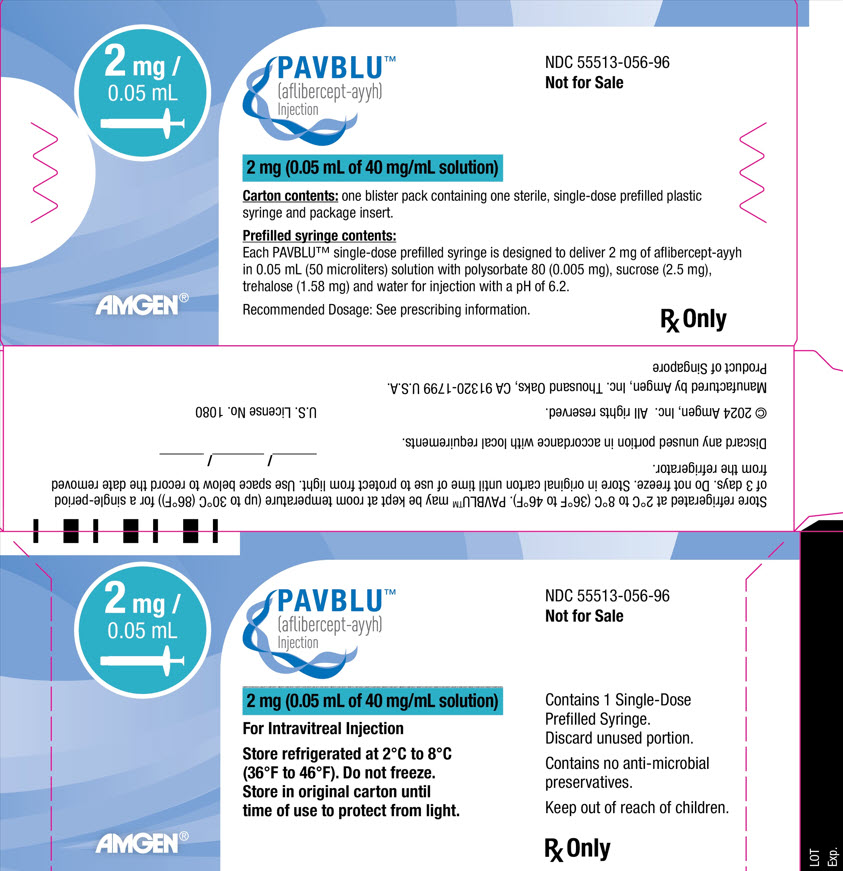
    7PRINCIPAL DISPLAY PANEL - 0.05 mL Syringe Carton
    2 mg /
    AMGEN
    PAVBLU™
    NDC 55513-056-01
    2 mg (0.05 mL of 40 mg/mL solution)
    Carton contents: one blister pack containing one sterile, single-dose prefilled plastic
    Prefilled syringe contents:
    Recommended Dosage: See prescribing information.
    Rx Only
    PRINCIPAL DISPLAY PANEL - 0.05 mL Syringe Carton
    8PRINCIPAL DISPLAY PANEL - 0.05 mL Vial Carton
    2 mg /
    NDC 55513-065-01
    PAVBLU™
    2 mg (0.05 mL of
    For Intravitreal Injection
    Sterile Solution
    AMGEN
    PRINCIPAL DISPLAY PANEL - 0.05 mL Vial Carton
    1. Homepage
    2. Age-Related Macular Degeneration (ARMD) Treatments
    3. Pavblu (Aflibercept)
    For Patients
    • Our Story
    • How MediFind Works
    • Conditions A-Z
    • Doctor Directory
    • Symptoms Directory
    • Procedures Directory
    • Treatment Directory
    • Drug Directory
    • Infusion Center Finder
    • FAQ
    • Contact Us
    For Providers and Practices
    • Claim Your Profile
    • Newsroom
    Business Solutions
    • Provider
    • Network Solutions
    Additional Resources
    • Consumer Health Data Privacy Policy
    • Privacy Policy
    • Terms of Use
    • Advertising Policy
    • Content Policy
    Subscribe to our newsletter

    Sign up to stay informed about MediFind and get wellness sent your way.

    Close

      By subscribing, I agree to MediFind's Terms of Use, Privacy Policy and Consumer Health Data Privacy Policy, as applicable.

      Bullet PinMediFind
      Follow us on
      This information is not intended as a substitute for informed medical advice. You should work with a licensed professional to diagnose and treat health conditions. We let the data speak for itself, MediFind does not endorse any healthcare providers.
      © 2026 All Rights Reserved