Deferasirox
What is Deferasorox (Deferasirox)?
Top Global Experts


Related Clinical Trials
Summary: This study tests whether early heart screening and treatment for iron overload in subjects with sickle cell disease can prevent heart problems and reduce hospitalizations.
Summary: The study will evaluate the safety and early efficacy of administering the combination of a commercially available potato-based resistant starch along with iron chelation therapy to subjects undergoing alloHCT.
Summary: The β-thalassemias are a group of inherited disorders of hemoglobin (Hb) synthesis characterized by chronic anemia of varying severity. The degree of anemia relies on several genetic and environmental factors and determines the need for regular transfusion therapy. It is now common practice to classify patients as having transfusion dependent β-thalassemia (TDT) or non-transfusion-dependent β-thal...
Related Latest Advances
Brand Information
- Deferasirox can cause acute renal failure and death, particularly in patients with comorbidities and those who are in the advanced stages of their hematologic disorders.
- Evaluate baseline renal function prior to starting or increasing deferasirox dosing in all patients. Deferasirox is contraindicated in adult and pediatric patients with eGFR less than 40 mL/min/1.73 m
- Deferasirox can cause hepatic injury including hepatic failure and death.
- Measure serum transaminases and bilirubin in all patients prior to initiating treatment, every 2 weeks during the first month, and at least monthly thereafter.
- Avoid use of deferasirox in patients with severe (Child-Pugh C) hepatic impairment and reduce the dose in patients with moderate (Child-Pugh B) hepatic impairment
- Deferasirox can cause gastrointestinal (GI) hemorrhages, which may be fatal, especially in elderly patients who have advanced hematologic malignancies and/or low platelet counts.
- Monitor patients and discontinue deferasirox for suspected GI ulceration or hemorrhage
- 90 mg deferasirox oral granules
- 180 mg deferasirox oral granules
- 360 mg deferasirox oral granules
- Estimated GFR less than 40 mL/min/1.73 m
- Poor performance status
- High-risk myelodysplastic syndromes
- Advanced malignancies
- Platelet counts less than 50 x 10
- Known hypersensitivity to deferasirox or any component of deferasirox
- Acute Kidney Injury, Including Acute Renal Failure Requiring Dialysis, and Renal Tubular Toxicity Including Fanconi Syndrome
- Hepatic Toxicity and Failure
- GI Hemorrhage
- Bone Marrow Suppression
- Hypersensitivity
- Severe Skin Reactions
- Skin Rash
- Auditory and Ocular Abnormalities
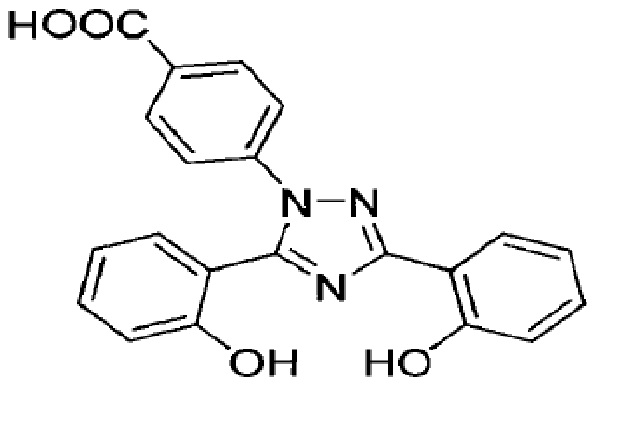
Advise patients to take deferasirox oral granules by sprinkling the full dose on soft food (e.g., yogurt or applesauce) immediately prior to use and administered orally. Advise patients to take deferasirox oral granules once a day, preferably at the same time each day. Deferasirox oral granules may be taken on an empty stomach or with a light meal (contains less than 7% fat content and approximately 250 calories). Examples of light meals include 1 whole wheat English muffin, 1 packet jelly (0.5 ounces), and skim milk (8 fluid ounces) or a turkey sandwich (2 oz. turkey on whole wheat bread w/lettuce, tomato, and 1 packet mustard).
Blood Testing
Advise patients that blood tests will be performed frequently to check for damage to kidneys, liver, or blood cells [see .
Acute Kidney Injury, Including Acute Renal Failure
Caution patients about the potential for kidney toxicity when taking deferasirox oral granules. Inform patients of the signs and symptoms of kidney injury. Advise patients to contact their healthcare provider immediately if they experience any of these symptoms [see .
Hepatic Toxicity and Failure
Caution patients about the potential for hepatic toxicity when taking deferasirox oral granules. Inform patients of the signs and symptoms of hepatic toxicity. Advise patients to contact their healthcare provider immediately if they experience any of these symptoms [see .
GI Ulceration and Hemorrhage
Caution patients about the potential for the development of GI ulcers or bleeding when taking deferasirox in combination with drugs that have ulcerogenic or hemorrhagic potential, such as NSAIDs, corticosteroids, oral bisphosphonates, or anticoagulants. Inform patients of the signs and symptoms of GI ulcers or bleeding. Advise patients to contact their healthcare provider for symptoms of heartburn but to seek immediate medical attention for symptoms of GI hemorrhage [see
Serious allergic reactions (which include swelling of the throat) have been reported in patients taking deferasirox, usually within the first month of treatment. If reactions are severe, advise patients to stop taking deferasirox immediately and seek immediate medical attention [see .
Severe Skin Reactions
Severe skin reactions have been reported in patients taking deferasirox oral granules. Inform patients of the signs and symptoms of severe skin reactions. If reactions are severe, advise patients to stop taking deferasirox oral granules immediately and seek immediate medical attention [see .
Skin Rash
Skin rashes may occur during deferasirox treatment. If the skin rash is severe, advise patients to stop taking deferasirox and seek medical attention [see .
Pediatric Patients with Acute Illness
Instruct pediatric patients and their caregivers to contact their healthcare provider during episodes of acute illness, especially if the patient has not been drinking fluids or the patient has volume depletion due to fever, vomiting, or diarrhea [see .
Auditory and Ocular Testing
Because auditory and ocular disturbances have been reported with deferasirox, conduct auditory testing and ophthalmic testing before starting deferasirox treatment and thereafter at regular intervals. Advise patients to contact their healthcare provider if they develop visual or auditory changes during treatment [see .
Drug Interactions
Caution patients not to take aluminum containing antacids and deferasirox granules simultaneously [.
Caution patients about potential loss of effectiveness of drugs metabolized by CYP3A4 (e.g., cyclosporine, simvastatin, hormonal contraceptive agents) when deferasirox is administered with these drugs [see .
Caution patients about potential loss of effectiveness of deferasirox when administered with drugs that are potent UGT inducers (e.g., rifampicin, phenytoin, phenobarbital, ritonavir). Based on serum ferritin levels and clinical response, consider increases in the dose of deferasirox when concomitantly used with potent UGT inducers [see .
Caution patients about potential loss of effectiveness of deferasirox when administered with drugs that are bile acid sequestrants (e.g., cholestyramine, colesevelam, colestipol). Based on serum ferritin levels and clinical response, consider increases in the dose of deferasirox when concomitantly used with bile acid sequestrants [see .
Caution patients with diabetes to monitor their glucose levels more frequently when repaglinide is used concomitantly with deferasirox [see .
Handling Instructions
Advise patients to store deferasirox in a dry, room-temperature environment [see .
Driving and Using Machines
Caution patients experiencing dizziness to avoid driving or operating machinery [see .
Manufactured by:
MSN Laboratories Private Limited
Telangana – 509 228,
INDIA
Distributed by:Piscataway, NJ 08854-3714
Issued on:
March 2022