Alzheimer's Disease Treatments

Find Alzheimer's Disease Treatments

Generic Name

Memantine

Brand Names
Aricept, Donepezil, Namzaric
FDA approval date: November 25, 1996
Classification: N-methyl-D-aspartate Receptor Antagonist
Form: Tablet, Kit, Capsule, Solution

What is Aricept (Memantine)?

ARICEPT is indicated for the treatment of dementia of the Alzheimer’s type. Efficacy has been demonstrated in patients with mild, moderate, and severe Alzheimer’s disease. ARICEPT is an acetylcholinesterase inhibitor indicated for the treatment of dementia of the Alzheimer’s type. Efficacy has been demonstrated in patients with mild, moderate, and severe Alzheimer’s Disease
Save this treatment for later
Sign Up
Not sure about your diagnosis?
Check Your Symptoms
Tired of the same old research?
Check Latest Advances

Related Clinical Trials

A Phase III Trial of Stereotactic Radiosurgery Compared With Hippocampal-Avoidant Whole Brain Radiotherapy (HA-WBRT) Plus Memantine for 5 or More Brain Metastases

Summary: Stereotactic radiosurgery (SRS) is a commonly used treatment for brain tumors. It is a one-day (or in some cases two day), out-patient procedure during which a high dose of radiation is delivered to small spots in the brain while excluding the surrounding normal brain. Whole brain radiation therapy with hippocampal avoidance (HA-WBRT) is when radiation therapy is given to the whole brain, while tr...

Multicenter, Randomized, Controlled Study Evaluating the Efficacy and Safety of Lecanemab in Alzheimer's Disease Through Multi-omics Approachs

Summary: This research proposal outlines a multi-center, randomized, trial. Patients diagnosed with early-to-moderate Alzheimer's Disease will be recruited. Participants will be randomly assigned to receive either Lecanemab. The study will run over a period of 24 months, with evaluations conducted at baseline, 6 months, and 12 months, 18 months and 24 months. Data from multiple omics layers will be integra...

Synaptic Mechanisms of Continuous Theta Burst Stimulation in Depression

Summary: Many people with depression do not get better with standard treatments like medication. One promising alternative is transcranial magnetic stimulation (TMS), a non-invasive procedure that uses magnetic pulses to stimulate specific brain regions. A particular pattern of TMS called continuous theta-burst stimulation (cTBS) is thought to reduce overactive brain activity in depression, but the investi...

Brand Information

    Aricept (donepezil hydrochloride)
    1INDICATIONS AND USAGE
    ARICEPT is indicated for the treatment of dementia of the Alzheimer’s type. Efficacy has been demonstrated in patients with mild, moderate, and severe Alzheimer’s disease.
    2DOSAGE FORMS AND STRENGTHS
    ARICEPT is supplied as film-coated, round tablets containing 5 mg, 10 mg, or 23 mg of donepezil hydrochloride.
    • The 5 mg tablets are white. The strength, in mg (5), is debossed on one side and ARICEPT is debossed on the other side.
    • The 10 mg tablets are yellow. The strength, in mg (10), is debossed on one side and ARICEPT is debossed on the other side.
    • The 23 mg tablets are reddish. The strength, in mg (23), is debossed on one side, and ARICEPT is debossed on the other side.
    ARICEPT ODT is supplied as round tablets containing either 5 mg or 10 mg of donepezil hydrochloride.
    • The 5 mg orally disintegrating tablets are white. The strength, in mg (5), is debossed on one side and ARICEPT is debossed on the other side.
    • The 10 mg orally disintegrating tablets are yellow. The strength, in mg (10), is debossed on one side and ARICEPT is debossed on the other side.
    3CONTRAINDICATIONS
    ARICEPT is contraindicated in patients with known hypersensitivity to donepezil hydrochloride or to piperidine derivatives.
    4ADVERSE REACTIONS
    The following serious adverse reactions are described below and elsewhere in the labeling:
    • Cardiovascular Conditions
    • Nausea and Vomiting
    • Peptic Ulcer Disease and GI Bleeding
    • Weight Loss
    • Genitourinary Conditions
    • Neurological Conditions: Seizures
    • Pulmonary Conditions
    4.1Clinical Trials Experience
    Because clinical trials are conducted under widely varying conditions, adverse reaction rates observed in the clinical trials of a drug cannot be directly compared to rates in the clinical trials of another drug and may not reflect the rates observed in practice.
    ARICEPT has been administered to over 1,700 individuals during clinical trials worldwide. Approximately 1200 of these patients have been treated for at least 3 months and more than 1,000 patients have been treated for at least 6 months. Controlled and uncontrolled trials in the United States included approximately 900 patients. In regards to the highest dose of 10 mg/day, this population includes 650 patients treated for 3 months, 475 patients treated for 6 months, and 116 patients treated for over 1 year. The range of patient exposure is from 1 to 1,214 days.
    Mild to Moderate Alzheimers Disease
    Adverse Reactions Leading to Discontinuation
    The rates of discontinuation from controlled clinical trials of ARICEPT due to adverse reactions for the ARICEPT 5 mg/day treatment groups were comparable to those of placebo treatment groups at approximately 5%. The rate of discontinuation of patients who received 7-day escalations from 5 mg/day to 10 mg/day was higher at 13%.
    The most common adverse reactions leading to discontinuation, defined as those occurring in at least 2% of patients and at twice or more the incidence seen in placebo patients, are shown in Table 1.
    Most Common Adverse Reactions
    The most common adverse reactions, defined as those occurring at a frequency of at least 5% in patients receiving 10 mg/day and twice the placebo rate, are largely predicted by ARICEPT’s cholinomimetic effects. These include nausea, diarrhea, insomnia, vomiting, muscle cramp, fatigue, and anorexia. These adverse reactions were often transient, resolving during continued ARICEPT treatment without the need for dose modification.
    There is evidence to suggest that the frequency of these common adverse reactions may be affected by the rate of titration. An open-label study was conducted with 269 patients who received placebo in the 15- and 30-week studies. These patients were titrated to a dose of 10 mg/day over a 6-week period. The rates of common adverse reactions were lower than those seen in patients titrated to 10 mg/day over one week in the controlled clinical trials and were comparable to those seen in patients on 5 mg/day.
    See Table 2 for a comparison of the most common adverse reactions following one and six week titration regimens.
    Table 3 lists adverse reactions that occurred in at least 2% of patients in pooled placebo-controlled trials who received either ARICEPT 5 mg or 10 mg and for which the rate of occurrence was greater for patients treated with ARICEPT than with placebo. In general, adverse reactions occurred more frequently in female patients and with advancing age.
    Severe Alzheimer’s Disease (ARICEPT 5 mg/day and 10 mg/day)
    ARICEPT has been administered to over 600 patients with severe Alzheimer’s disease during clinical trials of at least 6 months duration, including three double-blind, placebo-controlled trials, two of which had an open label extension.
    Adverse Reactions Leading to Discontinuation
    The rates of discontinuation from controlled clinical trials of ARICEPT due to adverse reactions for the ARICEPT patients were approximately 12% compared to 7% for placebo patients. The most common adverse reactions leading to discontinuation, defined as those occurring in at least 2% of ARICEPT
    Most Common Adverse Reactions
    The most common adverse reactions, defined as those occurring at a frequency of at least 5% in patients receiving ARICEPT and at twice or more the placebo rate, are largely predicted by ARICEPT’s cholinomimetic effects. These include diarrhea, anorexia, vomiting, nausea, and ecchymosis. These adverse reactions were often transient, resolving during continued ARICEPT treatment without the need for dose modification.
    Table 4 lists adverse reactions that occurred in at least 2% of patients in pooled placebo-controlled trials who received ARICEPT 5 mg or 10 mg and for which the rate of occurrence was greater for patients treated with ARICEPT than with placebo.
    Moderate to Severe Alzheimer’s Disease (ARICEPT 23 mg/day)
    ARICEPT 23 mg/day has been administered to over 1300 individuals globally in clinical trials. Approximately 1050 of these patients have been treated for at least three months and more than 950 patients have been treated for at least six months. The range of patient exposure was from 1 to over 500 days.
    Adverse Reactions Leading to Discontinuation
    The rate of discontinuation from a controlled clinical trial of ARICEPT 23 mg/day due to adverse reactions was higher (19%) than for the 10 mg/day treatment group (8%). The most common adverse reactions leading to discontinuation, defined as those occurring in at least 1% of patients and greater than those occurring with 10 mg/day are shown in Table 5.
    The majority of discontinuations due to adverse reactions in the 23 mg group occurred during the first month of treatment.
    Most Common Adverse Reactions with ARICEPT 23 mg/day
    The most common adverse reactions, defined as those occurring at a frequency of at least 5%, include nausea, diarrhea, vomiting, and anorexia.
    Table 6 lists adverse reactions that occurred in at least 2% of patients who received 23 mg/day of ARICEPT and at a higher frequency than those receiving 10 mg/day of ARICEPT in a controlled clinical trial that compared the two doses. In this study, there were no important differences in the type of adverse reactions in patients taking ARICEPT with or without memantine.
    4.2Postmarketing Experience
    The following adverse reactions have been identified during post-approval use of ARICEPT. Because these reactions are reported voluntarily from a population of uncertain size, it is not always possible to reliably estimate their frequency or establish a causal relationship to drug exposure.
    Abdominal pain, agitation, aggression, cholecystitis, confusion, convulsions, hallucinations, heart block (all types), hemolytic anemia, hepatitis, hyponatremia, neuroleptic malignant syndrome, pancreatitis, rash, rhabdomyolysis, QTc prolongation, and torsade de pointes.
    5OVERDOSAGE
    Because strategies for the management of overdose are continually evolving, it is advisable to contact a Poison Control Center to determine the latest recommendations for the management of an overdose of any drug.
    As in any case of overdose, general supportive measures should be utilized. Overdosage with cholinesterase inhibitors can result in cholinergic crisis characterized by severe nausea, vomiting, salivation, sweating, bradycardia, hypotension, respiratory depression, collapse, and convulsions. Increasing muscle weakness is a possibility and may result in death if respiratory muscles are involved. Tertiary anticholinergics such as atropine may be used as an antidote for ARICEPT overdosage. Intravenous atropine sulfate titrated to effect is recommended: an initial dose of 1.0 to 2.0 mg IV with subsequent doses based upon clinical response. Atypical responses in blood pressure and heart rate have been reported with other cholinomimetics when co-administered with quaternary anticholinergics such as glycopyrrolate. It is not known whether ARICEPT and/or its metabolites can be removed by dialysis (hemodialysis, peritoneal dialysis, or hemofiltration).
    Dose-related signs of toxicity in animals included reduced spontaneous movement, prone position, staggering gait, lacrimation, clonic convulsions, depressed respiration, salivation, miosis, tremors, fasciculation, and lower body surface temperature.
    6DESCRIPTION
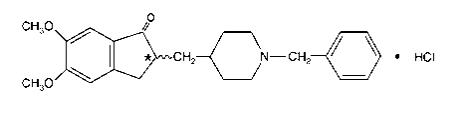
    ARICEPT (donepezil hydrochloride) is a reversible inhibitor of the enzyme acetylcholinesterase, known chemically as (±)-2, 3-dihydro-5, 6-dimethoxy-2-[[1-(phenylmethyl)-4-piperidinyl]methyl]-1
    Chemical structure
    ARICEPT is available for oral administration in film-coated tablets containing 5, 10, or 23 mg of donepezil hydrochloride.
    Inactive ingredients in 5 mg and 10 mg tablets are lactose monohydrate, corn starch, microcrystalline cellulose, hydroxypropyl cellulose, and magnesium stearate. The film coating contains talc, polyethylene glycol, hypromellose, and titanium dioxide. Additionally, the 10 mg tablet contains yellow iron oxide (synthetic) as a coloring agent.
    Inactive ingredients in 23 mg tablets include ethylcellulose, hydroxypropyl cellulose, lactose monohydrate, magnesium stearate, and methacrylic acid copolymer, Type C. The film coating includes ferric oxide, hypromellose 2910, polyethylene glycol 8000, talc, and titanium dioxide.
    ARICEPT ODT tablets are available for oral administration. Each ARICEPT ODT tablet contains 5 or 10 mg of donepezil hydrochloride. Inactive ingredients are carrageenan, mannitol, colloidal silicon dioxide, and polyvinyl alcohol. Additionally, the 10 mg tablet contains ferric oxide (yellow) as a coloring agent.
    7PATIENT COUNSELING INFORMATION
    Advise the patient to read the FDA-approved patient labeling (
    Instruct patients and caregivers to take ARICEPT only once per day, as prescribed.
    Instruct patients and caregivers that ARICEPT can be taken with or without food. ARICEPT 23 mg tablets should be swallowed whole without the tablets being split, crushed or chewed. ARICEPT ODT should not be swallowed whole, but be allowed to dissolve on the tongue and followed with water.
    Advise patients and caregivers that ARICEPT may cause nausea, diarrhea, insomnia, vomiting, muscle cramps, fatigue, and decreased appetite.
    Advise patients to notify their healthcare provider if they are pregnant or plan to become pregnant.