
How MediFind Works: Doctor Expertise Ranking Methodology
objectively, not by reviews
MediFind is a healthcare technology platform that ranks doctors by their condition-specific expertise using objective, data-driven analysis, and enables patients to request appointments directly through the platform. Unlike platforms that rely on patient reviews, MediFind evaluates physicians based on peer-reviewed research output, clinical trial participation, patient volume, peer referral networks, and professional connections — drawn from dozens of independently maintained medical datasets.
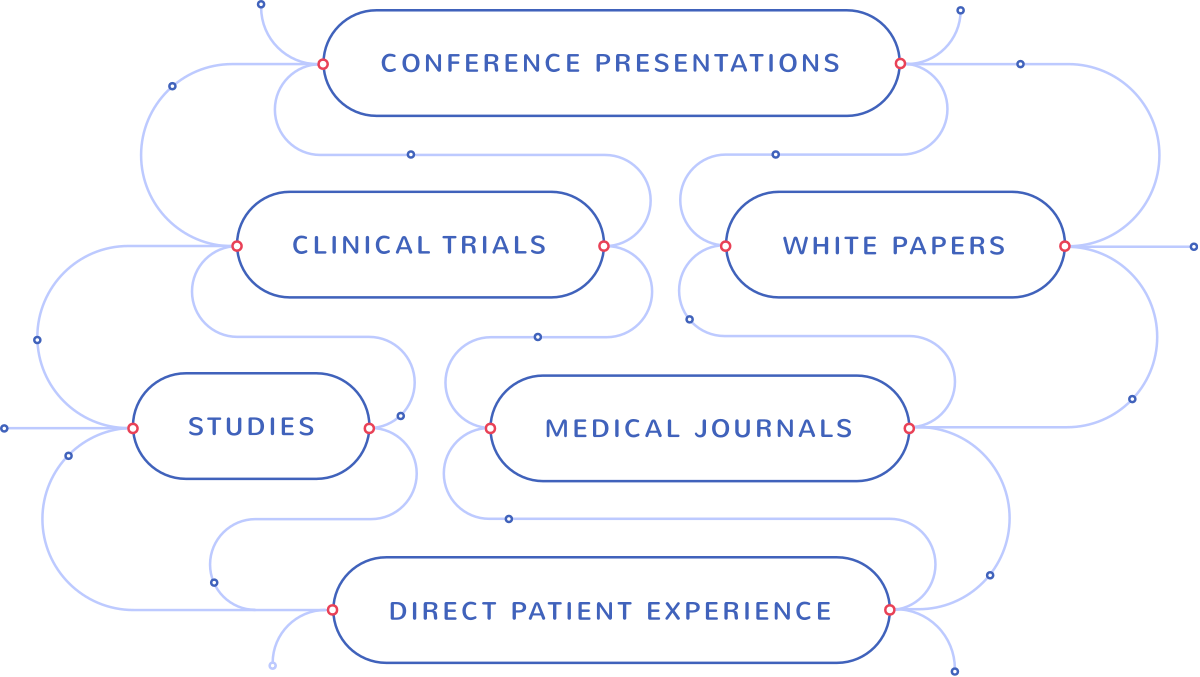
More than 1 million medical research reports, clinical trial results, and conference presentations are published every year. MediFind’s machine learning algorithms continuously process this information to identify which physicians are actively advancing treatment for specific health conditions — including rare diseases where finding the right specialist is critical.
MediFind uses proprietary natural language processing (NLP) to extract and simplify complex medical research into clear, understandable insights. This allows patients to make better-informed decisions about their care without needing a medical background.
Once you’ve identified the right expert, MediFind helps you take the next step. Patients can request appointments directly through the platform. MediFind contacts the provider’s office on your behalf — including through AI-powered scheduling that integrates with physician scheduling systems where available. You’ll receive status updates via email from request through confirmation, along with reminders before your visit.
Determining Expertise
MediFind’s algorithm is complex, always-on, and ever-changing, but it’s built around four guiding dimensions that determine a doctor’s expertise for each health condition.
- PubMed
- ClinicalTrials.gov
- Medical conference proceedings
- Medicare claims data
- National Provider Identifier (NPI) registry
- Referral patterns
- Co-authorship networks
- Institutional affiliations
- Research network centrality
- Cross-institutional collaboration
- Emerging treatment leadership
Our Expert Tiers
Beyond simply counting the patients a doctor sees, MediFind weighs journal publications, clinical-trial participation, conference presentations, prescribing and referral patterns, and the strength of a doctor’s connections to other experts. Based on this, doctors fall into one of four levels of expertise for each specific health condition:
If you have a rare condition or a very serious illness, seeking advice and treatment from top doctors may be the best choice. In the majority of situations, top tier expertise is not necessary.
About Our Methodology
MediFind’s expertise rankings are generated algorithmically using data from publicly available medical datasets, including:
- PubMed
- ClinicalTrials.gov
- National Provider Identifier (NPI) registry
- Medicare claims data
Our methodology is developed and reviewed by a team of medical professionals and data scientists. Rankings are updated regularly as new data becomes available.
MediFind does not accept payment from physicians to influence rankings.
One of a kind
MediFind is the first platform in the world to collect and integrate doctor and condition information from dozens of medical datasets. This allows MediFind to identify experts who are at the forefront of research and innovation for their respective field.
Why is MediFind the best in the world at identifying the right doctors for you?
 | Healthgrades® | WebMD Care/Vitals® | Zocdoc® | U.S. News & World Report® | Yelp® | ||||||
|---|---|---|---|---|---|---|---|---|---|---|---|
| Healthgrades® | WebMD Care/Vitals® | Zocdoc® | U.S. News & World Report® | Yelp® | ||||||
| Find experts based on experience in specific health conditions, including rare diseases | |||||||||||
| Ratings based exclusively on objective data, not user reviews | |||||||||||
| Doctors do not pay to be included in database | |||||||||||
| Appointment requests directly integrated into physician’s scheduling system | |||||||||||
| AI-powered appointment scheduling that contacts the doctor’s office on your behalf | |||||||||||
| Find second opinions based on current doctor | |||||||||||
| Includes doctors from around the world | |||||||||||
- Rely solely on user reviewsUser reviews are often about issues that aren't related to outcomes (receptionist, location, even parking validation), and have been shown to not correlate with expertise or quality of care.
- Limit results to the United StatesBy limiting your search to one country, you could be missing the opportunity to find true experts in your condition. This is especially critical for rare diseases.
- Do not connect doctors to specific health conditionsThere are over 7,000 diseases, and no doctor can be an expert in all of them. Searching just by specialty won't always connect you with the best expert for your condition. For example, an oncologist may be a world-leading expert in brain tumors, but is unlikely to be one for stomach cancer.
- Do not show true experts in a health conditionOther sites use problematic methodologies that may not give you the best picture of a doctor's expertise. For example, they may show rankings by comparing a provider with their peers based only on volume of patients seen. However, because all specialists see higher numbers of patients with specific diseases, this methodology means that nearly all specialists will show up as experts for these diseases.
Learn how MediFind uses other critical factors to determine true expertise. - Ignore important dataThere are many sources of information that, only together, reveal who the true experts are for a specific health condition. By excluding key sources, you may not be getting an accurate picture of a doctor's expertise.
- Can't help you find a second opinionMediFind is the only openly accessible platform in the world that can suggest relevant experts for a second opinion based on your existing doctor's expertise and connections.
Why this matters
Patient reviews do not measure expertise
A five-star review doesn’t make a doctor an expert. Research has shown that online patient ratings do not reliably reflect physician expertise or clinical outcomes. MediFind instead evaluates objective indicators — research output, clinical-trial participation, patient volume, and peer referral patterns — for a more accurate view of who truly has expertise in a specific condition.
Second opinions can change outcomes
Even when you see a qualified physician, treatment recommendations are shaped by that doctor’s training and perspective. A large share of patients who seek a second opinion receive a new or refined diagnosis, and medical errors remain a leading cause of death in the United States. MediFind identifies specialists most likely to offer a meaningfully different perspective based on expertise and professional networks.
Frequently Asked Questions
How does MediFind rank doctors?
MediFind ranks doctors using a proprietary algorithm that evaluates condition-specific expertise across four dimensions: research output, patient volume, peer standing, and professional connectedness. Data is sourced from PubMed, ClinicalTrials.gov, Medicare claims data, referral networks, and other medical datasets. Rankings are condition-specific — a doctor who is Elite for brain tumors may be Experienced for a different condition.
What are MediFind's expert tiers?
MediFind classifies physicians into four tiers of condition-specific expertise: Elite (global leaders who publish extensively, lead clinical trials, and present at major conferences), Distinguished (regional or national leaders with strong research portfolios and high patient volume), Advanced (experienced practitioners with meaningful patient volume and high-quality clinical care), and Experienced (generalist physicians with some familiarity with the condition; this tier includes the majority of doctors).
Does MediFind use patient reviews to rank doctors?
No. MediFind’s rankings are based exclusively on objective data — including research publications, clinical trial participation, patient volume, and peer referral patterns. Research has shown that patient reviews do not correlate with physician expertise or quality of care, which is why MediFind does not use them as a ranking signal.
Can MediFind help find specialists for rare diseases?
Yes. MediFind indexes physicians worldwide and evaluates expertise at the individual condition level, making it particularly effective for rare diseases where finding the right specialist is critical. Unlike other platforms, MediFind is not limited to U.S.-based physicians — a rare disease specialist anywhere in the world can be found through MediFind.
How is MediFind different from Healthgrades, Zocdoc, or WebMD?
MediFind ranks doctors by condition-specific expertise using objective data from dozens of medical datasets. Other platforms primarily rely on patient reviews, limit results to a single country, or do not connect physicians to specific health conditions. MediFind also integrates appointment scheduling and second-opinion matching.
Can MediFind help me find a second opinion?
Yes. MediFind identifies experts based on your current doctor’s expertise profile and professional network, helping ensure you receive a genuinely independent second opinion — not just another doctor from the same research circle.
Can I book a doctor appointment through MediFind?
Yes. Patients can request appointments directly through the platform. MediFind contacts the provider’s office on your behalf, including through AI-powered scheduling where available. You’ll receive email updates from submission through confirmation, along with a reminder before your visit.
How does MediFind's appointment scheduling work?
When you request an appointment on MediFind, the platform submits your request — including your availability preferences, insurance information, and reason for visit — directly to the provider. For AI-enabled practices, MediFind’s scheduling assistant contacts the office to secure your appointment. You’ll receive a confirmation email with your appointment date, time, and location, followed by a reminder before your visit.