Asthma Treatments
Find Asthma Treatments
Provocholine
What is Provocholine (Methacholine)?
Approved To Treat


Related Clinical Trials
Summary: This study will determine if airway resistance to airflow and pressure, measured by Oscillometry, is associated with abnormal findings on methacholine challenge testing and whether these findings are associated with body habitus,
Summary: The purpose of this study is to look at children with PCD and see if they have another condition called bronchial hyperresponsiveness.
Summary: The primary objectives of the study are: Part 1: to characterize the potency and variability of dose response on efficacy (Provocative concentration of methacholine causing at least a 20% fall in forced expiratory volume (FEV1) \[PC20\]) of salbutamol administered via MDI with salbutamol HFA-134a or salbutamol HFA-152a in participants with mild asthma. Part 2: to compare the comparative dose respo...
Related Latest Advances
Brand Information
- Provocholine powder for inhalation solution requires reconstitution and dilution prior to use
- Provocholine inhalation solution in a ready-to-use kit does not require reconstitution and/ or silution prior to use.
- Provocholine inhalation solution 16 mg/mL in a single-dose vial requires dilution prior to use
- For safety and accuracy, administer Provocholine during a methacholine challenge test in a pulmonary function laboratory or clinic, by adequately trained personnel, for safety and accuracy, and should be performed only under the responsibility of a healthcare practitioner trained in and thoroughly familiar with all aspects of the technique of the test and the management of respiratory distress. Emergency medication and equipment should be immediately available to treat acute respiratory distress.
- Consider Provocholine use in patients on chronic asthma drugs if the accuracy of the asthma diagnosis is in doubt. In these patients, only administer Provocholine if spirometry is normal after supervised withdrawal of the asthma drugs.
- Provocholine is not recommended for use in patients with clinically apparent asthma or wheezing.
- Before starting a methacholine challenge test, baseline spirometry must be performed. For a patient to be able to undergo the test, he or she must present with baseline FEV
- Provocholine is contraindicated in adult and pediatric patients with baseline FEV1 < 60% predicted or in adults with FEV
- At commencement of the methacholine challenge test and prior to administration of Provocholine, a post-diluent FEV
- Administer Provocholine by oral inhalation, with or without food, using either the 5-Breath Dosimeter Dosing Method or the 1-Minute Tidal Breathing Dosing Method with the dose doubling or quadrupling protocols
- Discard any unused solution from the nebulizer after each administration.
- The methacholine challenge test is considered positive if there is a reduction of FEV
- After the methacholine challenge test with Provocholine, administer an inhaled β-agonist to expedite the return of the FEV
- Reconstitute Provocholine Powder for Inhalation Solution by adding 6.25 mL of 0.9% Sodium Chloride Injection to the supplied vial(s) containing 100 mg of Provocholine powder. Shake the vial to obtain a clear solution.
- Dilute the reconstituted Provocholine solution, using sterile, empty USP Type 1 borosilicate glass vials. Dilute the reconstituted Provocholine solution with 0.9% Sodium Chloride Injection based on Table 1 to obtain doubling strengths or Table 2 to obtain quadrupling strengths. After adding the 0.9% Sodium Chloride Injection, shake each vial to obtain a clear solution.
- If not used immediately, refrigerate the reconstituted and diluted solutions at 36°F to 46°F (2°C to 8°C) for up to 2 weeks. Since the temperature of the solution affects nebulizer output, take the diluted solutions out of the refrigerator and allow them to equilibrate to room temperature (approximately 30 minutes) before use.
- Transfer the contents of the specified number of 3 mL vials (as per Tables 3 or 4) of Provocholine inhalation solution 16 mg/mL (in Single-Dose Vial) into a sterile, empty USP Type 1 borosilicate glass vial. Swirl the glass vial gently to mix.
- Dilute the solution with 0.9% Sodium Chloride Injection based on Table 3 (to obtain doubling strengths) or Table 4 (to obtain quadrupling strengths). After adding 0.9% Sodium Chloride Injection, shake each vial to obtain a clear solution.
- If not used immediately, refrigerate the diluted solutions at 36oF to 46oF (2oC to 8oC) for up to 2 weeks. Since the temperature of the solution affects nebulizer output, take the diluted solutions out of the refrigerator and allow them to equilibrate to room temperature (approximately 30 minutes) before use.
The recommended doses of Provocholine for oral inhalation for the diagnosis of bronchial airway hyperreactivity in adults and pediatric patients five years of age and older during a methacholine challenge test, based on the dose doubling or quadrupling protocol, are provided in Table 5.
- Instill diluent (sterile 0.9% Sodium Chloride Injection) or base solution into the nebulizer.
- If using Provocholine powder for inhalation solution or Provocholine inhalation solution 16 mg/mL (in single-dose vial), using a 3 mL syringe and needle, draw up 2 to 3 mL of diluent (sterile 0.9% Sodium Chloride Injection), and instill the 0.9% Sodium Chloride Injection into the nebulizer using a sterile bacterial-retentive filter (porosity 0.22 μm).
- If using the Provocholine inhalation solution ready-to-use kit, instill the contents of the base solution (contains no methacholine chloride) into the nebulizer.
- If the FEV
- If the post-diluent FEV
- If the post-diluent FEV
- If using Provocholine powder for inhalation solution or Provocholine inhalation solution 16 mg/mL (in single-dose vial), using a 3 mL syringe and needle, draw up at least 2 mL of the recommended Provocholine strength based on the dose doubling or quadrupling protocol in Table 5
- If using the Provocholine inhalation solution ready-to-use kit, instill at least 2 mL of the recommended Provocholine strength based on the dose quadrupling protocol in Table 5
- Instill diluent (sterile 0.9% Sodium Chloride Injection) or base solution into the nebulizer.
- If using Provocholine powder for inhalation solution or Provocholine inhalation solution 16 mg/mL (in single-dose vial), using a 3 mL syringe and needle, draw up 2 to 3 mL of diluent (sterile 0.9% Sodium Chloride Injection). Instill the 0.9% Sodium Chloride Injection into the nebulizer using a sterile bacterial-retentive filter (porosity 0.22 μm). Attach the nebulizer and necessary tubing to the dry compressed air source.
- If using the Provocholine inhalation solution ready-to-use kit, instill the contents of the base solution (contains no methacholine chloride) into the nebulizer.
- If the FEV
- If the post-diluent FEV
- If the post-diluent FEV
7. Instill Provocholine solution into the nebulizer.
- If using Provocholine powder for inhalation solution or Provocholine inhalation solution 16 mg/mL (in single-dose vial), using a 3 mL syringe and needle, draw up at least 2 mL of the recommended Provocholine strength based on the dose doubling or quadrupling protocol in Table 5
- If using the Provocholine inhalation solution ready-to-use kit, instill at least 2 mL of the recommended Provocholine strength, based on the dose quadrupling protocol in Table 5
1. Determine the percent decrease [was fall] in FEV1 using the mean post-diluent FEV 1 and the lowest FEV 1 post-Provocholine (post-dose), as shown below: :
% fall in FEV 1= mean post-diluent FEV x 100
mean post-diluent FEV 1
Method #1: Plot the percent decrease in FEV 1against the increasing methacholine concentration using a log scale and obtain the PC 20by linear interpolation between the last two points, as shown in Figure 1.

PC 20= antilog [log C1+ (log C2 - log C1)(20 - R1)]
(R2- R1)
Calculate the PD 20as follows:
PD 20= antilog [log D1+ (log D2 - log D1)(20 - R1)]
(R2- R1)
A negative (normal) methacholine challenge result is defined as FEV 1reduction of < 20% after all the doses, as part of the dose doubling or quadrupling protocol in Table 5, have been administered [ See Dosage and Administration (2.3)]
- Hypersensitivity to methacholine or other parasympathomimetic agents. Reactions have included rash, itching/swelling (especially of the face/tongue/throat), severe dizziness, trouble breathing.
- Baseline FEV
- Do not inhale the supplied Provocholine powder
- Do not handle the Provocholine powder if you have asthma or hay fever.
- Apply a low resistance filter to expiratory ports of dosing apparatus, as necessary, to prevent Provocholine release in the room air
Beta-agonists, anticholinergics, and theophylline inhibit the response of airways to Provocholine; therefore, hold these drugs before Provocholine use for the following duration:
The available data from published literature on Provocholine use in pregnant women are insufficient to evaluate for a drug-associated risk of major birth defects, miscarriage, or adverse maternal or fetal outcomes. Animal reproduction studies evaluating effects of methacholine chloride on embryofetal development have not been conducted. Diagnosis of bronchial airway hyperreactivity with bronchoprovocation challenge is not recommended for pregnant women because of the potential for hypoxia in the fetus. If bronchial airway hyperreactivity is suspected, consider trial of empiric treatment.
There are no available data on the presence of methacholine chloride in human milk, the effect on the breastfed infant, or the effect on milk production. The developmental and health benefits of breastfeeding should be considered along with the mother’s clinical need for Provocholine and any potential adverse effects on the breastfed infant from Provocholine or from the underlying maternal condition.
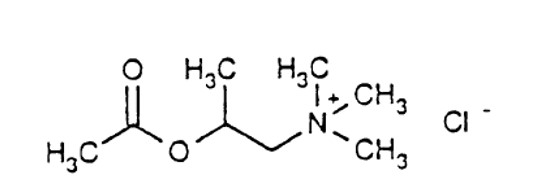
- Ready-to-use kit (sterile): Plastic vials with twist-off cap containing 3 mL of the following strengths of methacholine chloride solution. Each solution also contains the following inactive ingredients: sodium acetate trihydrate, sodium chloride, water for injection. Glacial acetic acid is added to adjust pH.
- Single-dose plastic vial with twist-off cap containing 16 mg/mL (48 mg/3 mL) of methacholine chloride solution. Solution also contains the following inactive ingredients: sodium acetate trihydrate, sodium chloride, and water for injection. Glacial acetic acid is added to adjust pH.
- Powder: 100 mg of methacholine chloride as a white to off-white powder in amber glass vials. Each carton contains six vials (NDC 64281-100-06).
- Ready-to-use kit: Each carton contains six sterile ready-to-use (NDC: 64281-110-06). Each sterile ready-to-use kit (NDC: 64281-110-05) contains six plastic vials with twist-off cap. Each vial contains 3 mL of different strengths of methacholine chloride in a clear, colorless solution as follows:
Inform the patient or caregiver that severe bronchoconstriction can result from Provocholine administration [see Warnings and Precautions (5.1)].

®Provocholine is a registered trademark of Methapharm Inc.