Generic Name

Formoterol

Brand Names
Duaklir Pressair, Perforomist
FDA approval date: October 01, 2007
Classification: beta2-Adrenergic Agonist
Form: Powder, Solution

What is Duaklir Pressair (Formoterol)?

DUAKLIR PRESSAIR is a combination of aclidinium bromide and formoterol fumarate indicated for the maintenance treatment of patients with chronic obstructive pulmonary disease . Limitations of Use: DUAKLIR PRESSAIR is not indicated for the relief of acute bronchospasm or for the treatment of asthma [see Warnings and Precautions.
Save this treatment for later
Sign Up
Not sure about your diagnosis?
Check Your Symptoms
Tired of the same old research?
Check Latest Advances

Related Clinical Trials

A Randomized, Phase 2, Double-blind, Placebo-controlled, Parallel-group, 2-arm Study to Investigate the Efficacy, Safety, and Tolerability of Subcutaneous Lunsekimig (SAR443765) in Adult Participants With High-risk Asthma Who Are Not Currently Eligible for Biologic Treatment

Summary: This is a parallel-group, Phase 2, randomized, double-blind, placebo-controlled, 2-arm study for the treatment of asthma. The purpose of this study is to assess the efficacy, safety, and tolerability of add-on therapy with subcutaneous (SC) lunsekimig compared with placebo in male and female participants (aged 18 to 80 years, inclusive) with asthma, who are not currently eligible for biologic trea...

Brand Information

    DUAKLIR PRESSAIR (aclidinium bromide and formoterol fumarate)
    1INDICATIONS AND USAGE
    DUAKLIR PRESSAIR is a combination of aclidinium bromide (an anticholinergic) and formoterol fumarate (a LABA) indicated for the maintenance treatment of patients with chronic obstructive pulmonary disease (COPD).
    Limitations of Use: DUAKLIR PRESSAIR is not indicated for the relief of acute bronchospasm or for the treatment of asthma
    2DOSAGE AND ADMINISTRATION
    The recommended dose of DUAKLIR PRESSAIR is one oral inhalation of 400 mcg/12 mcg, twice daily (once in the morning and once in the evening). Do not take more than one inhalation twice daily.
    3DOSAGE FORMS AND STRENGTHS
    Inhalation Powder. DUAKLIR PRESSAIR is a breath-actuated multi-dose dry powder inhaler metering 400 mcg of aclidinium bromide and 12 mcg of formoterol fumarate per actuation.
    4CONTRAINDICATIONS
    Use of a long-acting beta
    DUAKLIR PRESSAIR is contraindicated in patients with:
    • Severe hypersensitivity to milk proteins
    • Hypersensitivity to aclidinium bromide, formoterol fumarate, or to any component of the product
    5ADVERSE REACTIONS
    LABAs, such as formoterol fumarate, one of the active ingredients in DUAKLIR PRESSAIR, increase the risk of asthma-related death. DUAKLIR PRESSAIR is not indicated for the treatment of asthma
    The following adverse reactions are described in greater detail elsewhere in the labeling:
    • Paradoxical bronchospasm
    • Immediate hypersensitivity reactions
    • Cardiovascular effects
    • Worsening of narrow-angle glaucoma
    • Worsening of urinary retention
    5.1Clinical Trials Experience
    Because clinical trials are conducted under widely varying conditions, adverse reaction rates observed in the clinical trials of a drug cannot be directly compared with rates in the clinical trials of another drug and may not reflect the rates observed in practice.
    The clinical program for DUAKLIR PRESSAIR included 6501 subjects with COPD in 2 placebo-controlled and 1 active-controlled 24-week lung function trials, one long-term safety extension study of 28 weeks and 2 other clinical trials. A total of 1893 subjects have received at least 1 dose of DUAKLIR PRESSAIR.
    24-Week Trials
    The frequency of common adverse reactions in Table 1 below is based upon pooled data from two, double-blind, placebo-controlled parallel group clinical trials (Trials 1 and 2, n=1729 and n=1669) in 3398 adult patients with moderate to severe COPD. Of these, 60% were male and 94% were Caucasian. They had a mean age of 64 years and an average smoking history of 46 pack-years, with 49% identified as current smokers. At screening, the mean post-bronchodilator percent predicted forced expiratory volume in 1 second (FEV
    Table 1 shows all adverse reactions that occurred with a frequency of greater than or equal to 3% in the DUAKLIR PRESSAIR group in the two 24-week placebo-controlled trials where the rates in the DUAKLIR PRESSAIR group exceeded placebo.
    Other adverse reactions reported in clinical studies with an incidence of >1% but less than 3% with DUAKLIR PRESSAIR but more common than with placebo were cough, sinusitis, influenza, tooth abscess, insomnia, dizziness, dry mouth, oropharyngeal pain, muscle spasms, musculoskeletal pain, arthralgia, pain in extremity, urinary tract infection, and blood creatine phosphokinase increased.
    The adverse events reported in the 24-week active-controlled trial were consistent with those observed in 24-week placebo-controlled trials.
    Long-Term Safety Extension Trial
    In a 28-week safety extension trial, 918 subjects who successfully completed Trial 2 were treated for up to an additional 28 weeks for a total treatment period of up to 52 weeks with DUAKLIR PRESSAIR, aclidinium 400 mcg, formoterol fumarate 12 mcg administered twice daily or placebo. Because the subjects continued from Trial 2 into the safety extension trial, the demographic and baseline characteristics of the long-term safety extension trial were similar to those of the placebo-controlled efficacy trials described above. The adverse reactions reported in the long-term safety trial were consistent with those observed in the 24-week placebo-controlled trials.
    6DRUG INTERACTIONS
    No formal drug interaction studies have been performed with DUAKLIR PRESSAIR.
    6.1Adrenergic Drugs
    If additional adrenergic drugs are to be administered by any route, they should be used with caution because the sympathetic effects of formoterol, a component of DUAKLIR PRESSAIR, may be potentiated
    6.2Xanthine Derivatives, Steroids
    Concomitant treatment with xanthine derivatives, or steroids may potentiate any hypokalemic effect of beta-adrenergic agonists such as formoterol, a component of DUAKLIR PRESSAIR.
    6.3Non-Potassium Sparing Diuretics
    The electrocardiographic changes and/or hypokalemia that may result from the administration of non-potassium-sparing diuretics (such as loop or thiazide diuretics) can be acutely worsened by beta-agonists, especially when the recommended dose of the beta-agonist is exceeded. Although the clinical significance of these effects is not known, caution is advised in the coadministration of beta-agonists with non–potassium-sparing diuretics.
    6.4Monoamine Oxidase Inhibitors and Tricyclic Antidepressants, QTc Prolonging Drugs
    DUAKLIR PRESSAIR, as with other drugs containing beta
    6.5Beta-Blockers
    Beta-adrenergic receptor antagonists (beta-blockers) and DUAKLIR PRESSAIR may inhibit the effect of each other when administered concurrently. Beta-blockers not only block the therapeutic effects of beta
    6.6Anticholinergics
    There is a potential for an additive interaction with concomitantly used anticholinergic medications. Therefore, avoid coadministration of DUAKLIR PRESSAIR with other anticholinergic-containing drugs as this may lead to an increase in anticholinergic effects
    7OVERDOSAGE
    DUAKLIR PRESSAIR contains both aclidinium and formoterol fumarate; therefore, the risks associated with overdosage for the individual components described below apply to DUAKLIR PRESSAIR. The most common symptoms are blurred vision, dry mouth, nausea, muscle spasms, tremor, headache, palpitations, and systolic hypertension.
    Treatment of overdosage consists of discontinuation of DUAKLIR PRESSAIR together with institution of appropriate symptomatic and/or supportive therapy.
    8DESCRIPTION
    DUAKLIR PRESSAIR consists of a dry powder formulation of aclidinium bromide and formoterol fumarate for oral inhalation only.
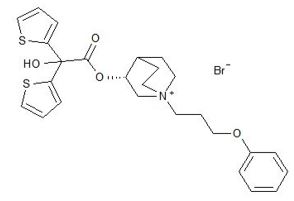
    Aclidinium bromide, is an anticholinergic with specificity for muscarinic receptors. Aclidinium bromide is a synthetic, quaternary ammonium compound, chemically described as 1-azoniabicyclo[2.2.2]octane, 3-[(hydroxydi-2-thienylacetyl)oxy]-1-(3-phenoxypropyl)-, bromide, (3
    aclidinium_bromide_structural_formula
    Aclidinium bromide is a white powder with a molecular formula of C
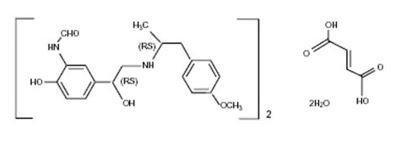
    Formoterol fumarate, a racemate, is a selective beta
    formoterol_fumarate_structural_formula
    Formoterol fumarate (as a dihydrate) has a molecular weight of 840.91, and its molecular formula is (C
    DUAKLIR PRESSAIR is a breath-actuated multi-dose dry powder inhaler. Each actuation of DUAKLIR PRESSAIR provides a metered dose of 12 mg of the formulation which contains lactose monohydrate (which may contain milk proteins) as the carrier, 400 mcg of aclidinium bromide (equivalent to 343 mcg of aclidinium), and 12.0 mcg of formoterol fumarate (as a dihydrate, equivalent to 11.5 mcg of formoterol fumarate anhydrous and 9.8 mcg of formoterol). This results in delivery of 396 mcg of aclidinium bromide (equivalent to 340 mcg of aclidinium) and 11.8 mcg of formoterol fumarate (as a dihydrate, equivalent to 11.3 mcg of formoterol fumarate anhydrous and 9.7 mcg of formoterol) from the mouthpiece, based on
    9CLINICAL STUDIES
    The safety and efficacy of DUAKLIR PRESSAIR was evaluated in a clinical development program that included three dose ranging trials, one active and two placebo-controlled lung function trials of 24 weeks duration; and one 28-week long-term safety extension study. The efficacy of DUAKLIR was primarily based on one dose ranging trial in 128 subjects with COPD and the three 6-month duration confirmatory trials in 5015 subjects with COPD, including chronic bronchitis and emphysema.
    9.1Dose-Ranging Trials
    Dose selection for DUAKLIR PRESSAIR for COPD was primarily based on data for the individual components, aclidinium bromide and formoterol fumarate, in COPD patients.
    Aclidinium
    Dose selection for aclidinium was supported by a 7-day, randomized, double-blind, active and placebo-controlled, crossover trial evaluating 3 doses of aclidinium bromide (400, 200, and 100 mcg) administered twice daily and an active control in 79 subjects with COPD. A dose ordering was observed, with the aclidinium bromide 400 mcg demonstrating larger improvements in FEV
    The change from baseline in FEV
    Formoterol
    Dose selection for formoterol was supported by a randomized, double-blind, placebo and active comparator (open-label) controlled, 5-period incomplete unbalanced crossover trial evaluating 3 doses of formoterol fumarate (24, 12, and 6 mcg) administered twice daily and an open-label active comparator in 132 subjects with COPD.
    The change from baseline in FEV
    9.2Confirmatory Trials
    The clinical development program for DUAKLIR PRESSAIR included two placebo-controlled [Trial 1 (NCT 01462942) and Trial 2 (NCT 01437397)] and one active-controlled [Trial 3 (NCT 02796677)] randomized, double-blind, parallel-group 24-week trials in subjects with moderate to very severe COPD, including chronic bronchitis and emphysema, designed to evaluate the efficacy of DUAKLIR PRESSAIR on lung function. The 24-week trials included 4,977 subjects >40 years of age that had a clinical diagnosis of COPD, with a smoking history greater than or equal to 10 pack-years, a post-albuterol FEV
    Trials 1, 2, and 3 evaluated DUAKLIR PRESSAIR (aclidinium/formoterol fumarate) 400 mcg/12 mcg, aclidinium 400 mcg, and formoterol fumarate 12 mcg. Trials 1 and 2 included a placebo arm, and Trial 3 included an active, blinded, control arm.
    The co-primary endpoints were change from baseline in trough FEV
    In the three trials, DUAKLIR PRESSAIR demonstrated a statistically significant increase in mean change from baseline in trough FEV
    With the limited data available, there were consistent improvements in trough FEV
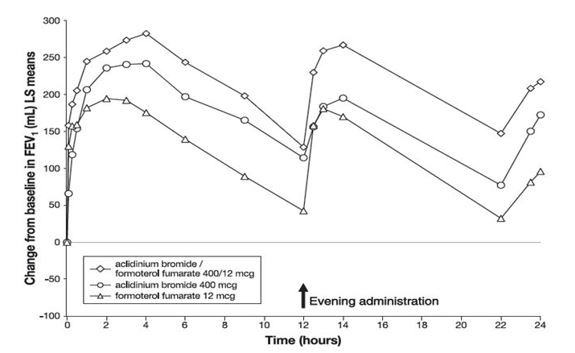
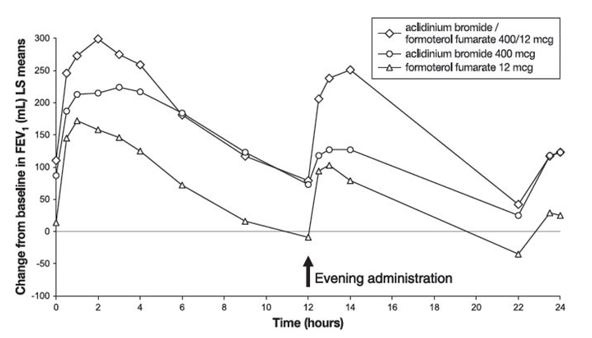
    In Trial 3, serial spirometric evaluations were performed throughout the 24-hour dosing interval in a subset of subjects (n=563) at Day 1 and Week 24. Results from Trial 3 are shown in Figures 1 and 2.
    Figure 1: FEV
    figure_1
    Figure 2: FEV
    figure_2
    In Trials 1 and 2, DUAKLIR PRESSAIR displayed an increase in FEV
    In Trials 1 and 2, patients treated with DUAKLIR PRESSAIR used less rescue medication compared to patients treated with placebo.
    The St. George’s Respiratory Questionnaire (SGRQ) was assessed in Trials 1, 2, and 3. In Trial 1, the SGRQ responder rate (defined as an improvement in score of 4 or more as threshold) was 55.3%, 53.5%, 52.1%, and 53.2% for DUAKLIR PRESSAIR, aclidinium, formoterol fumarate, and placebo, respectively, with odds ratios of 1.12 (95% CI: 0.76, 1.67) for DUAKLIR PRESSAIR vs. aclidinium, 1.16 (95% CI: 0.78, 1.73) for DUAKLIR PRESSAIR vs. formoterol fumarate, and 1.12 (95% CI: 0.68, 1.84) for DUAKLIR PRESSAIR vs. placebo. In Trial 2, the SGRQ responder rate was 58.2%, 54.5%, 52.4%, and 38.7% for DUAKLIR PRESSAIR, aclidinium, formoterol fumarate, and placebo, respectively, with odds ratios of 1.03 (95% CI: 0.66, 1.62), 1.21 (95% CI: 0.77, 1.90), and 2.26 (95% CI: 1.41, 3.61), for DUAKLIR PRESSAIR vs. aclidinium, DUAKLIR PRESSAIR vs. formoterol fumarate, and DUAKLIR PRESSAIR vs. placebo, respectively. In Trial 3, the odds ratios were 0.96 (95% CI: 0.61, 1.51) and 0.97 (95% CI: 0.59, 1.58), for DUAKLIR PRESSAIR vs. aclidinium, DUAKLIR PRESSAIR vs. formoterol fumarate, respectively.
    Exacerbations
    A randomized, double-blind, placebo-controlled study of up to 36 months evaluated the efficacy of aclidinium bromide 400 mcg on COPD exacerbations in patients with moderate to very severe COPD with and without a history of exacerbations. The trial enrolled 3630 COPD patients, aged between 40 and 91 years, 58.7% were male and 90.6% were Caucasian, with a mean post-bronchodilator FEV
    The primary efficacy endpoint was the rate of moderate to severe exacerbations during the first year of treatment, defined as worsening of COPD symptoms (dyspnea, cough, sputum) for at least 2 consecutive days that required treatment with antibiotics and/or systemic corticosteroids or resulted in hospitalization or lead to death. Aclidinium bromide demonstrated a statistically significant reduction in the rate of on-study moderate to severe COPD exacerbations by 17% compared to placebo (rate ratio [RR] 0.83; 95% CI 0.73 to 0.94; p=0.003).
    10HOW SUPPLIED/STORAGE AND HANDLING
    DUAKLIR PRESSAIR 400 mcg/12 mcg (aclidinium bromide and formoterol fumarate inhalation powder) is supplied in a sealed bag with a desiccant sachet and is available in 60 metered doses (NDC 0310-0900-60) and 30 metered doses (NDC 0310-0900-30).
    The active ingredients are administered using a multi-dose dry powder inhaler, PRESSAIR®, which delivers 60 doses or 30 doses of aclidinium bromide and formoterol fumarate powder for oral inhalation. The PRESSAIR inhaler is a white and orange colored device and is comprised of an assembled plastic dosing mechanism with a dose indicator, a drug-product storage unit containing the drug-product formulation, and a mouthpiece covered by an orange protective cap.
    Store DUAKLIR PRESSAIR in a dry place at 20°C-25°C (68°F-77°F); excursions permitted to 15-30°C (59-86°F) [see USP Controlled Room Temperature]. Do not store the inhaler on a vibrating surface.
    The PRESSAIR inhaler should be stored inside the sealed bag and only be opened immediately before use. Throw away the bag and the desiccant sachet.
    Throw away (dispose of) the PRESSAIR inhaler after the marking “0” with a red background shows in the middle of the dose indicator, when the device is empty and locks out, or 2 months after the date you opened the sealed bag that the inhaler comes in, whichever comes first.
    Keep out of reach of children.
    11PATIENT COUNSELING INFORMATION
    See FDA-approved Patient Labeling (Patient Information and Instructions for Use)
    • Serious Asthma-Related Events
    Inform patients that LABAs, such as formoterol fumarate, one of the active ingredients in DUAKLIR PRESSAIR, when used alone (without an inhaled corticosteroid), increase the risk of serious asthma-related events, including asthma-related death. DUAKLIR PRESSAIR is not indicated for the treatment of asthma.
    • Not for Acute Symptoms
    DUAKLIR PRESSAIR is not meant to relieve acute symptoms of COPD and extra doses should not be used for that purpose.
    Instruct patients to seek medical attention immediately if they experience a worsening of symptoms or a need for more inhalations of their rescue inhaler than usual.
    Instruct patients not to stop therapy with DUAKLIR PRESSAIR without physician/provider guidance since symptoms may recur after discontinuation.
    • Do Not Use Additional Long-Acting Beta
    Instruct patients to not use other medicines containing a LABA. Patients should not use more than the recommended dose of DUAKLIR PRESSAIR.
    Instruct patients who have been taking inhaled, short-acting beta-agonists on a regular basis to discontinue the regular use of these products and use them only for the symptomatic relief of acute symptoms.
    • Paradoxical Bronchospasm
    Inform patients that DUAKLIR PRESSAIR can cause paradoxical bronchospasm. Advise patients that if paradoxical bronchospasm occurs, patients should discontinue DUAKLIR PRESSAIR.
    • Visual Effects
    Eye pain or discomfort, blurred vision, visual halos, or colored images in association with red eyes from conjunctival congestion and corneal edema may be signs of acute narrow-angle glaucoma. Inform patients to consult a physician immediately should any of these signs and symptoms develop.
    Inform patients that care must be taken not to allow the powder to enter into the eyes as this may cause blurring of vision and pupil dilation.
    • Urinary Retention
    Difficulty passing urine and dysuria may be symptoms of new or worsening prostatic hyperplasia or bladder outlet obstruction. Patients should be instructed to consult a physician immediately should any of these signs or symptoms develop.
    • Immediate Hypersensitivity Reactions
    Inform patients that anaphylaxis, angioedema (including swelling of the lips, tongue, or throat), urticaria, rash, bronchospasm, or itching, may occur after administration of DUAKLIR PRESSAIR. Advise patient to immediately discontinue treatment and consult a physician should any of these signs or symptoms develop.
    • Risks Associated with Beta
    Inform patients of adverse effects associated with beta
    • Instructions for Administering DUAKLIR PRESSAIR
    It is important for patients to understand how to correctly use DUAKLIR PRESSAIR. Instruct patients not to use more than the recommended dose of DUAKLIR PRESSAIR or with other medicines containing LABAs as excessive use may lead to significant cardiovascular effects including fatalities.
    Inform patients that if they miss a dose, they should take their next dose at the usual time; they should not take 2 doses at one time.
    Instruct patients to thoroughly read complete
    Manufactured for:
    Covis Pharma
    Under license of ALMIRALL, S.A.
    DUAKLIRand the logo are registered trademarks of Almirall, S.A., used under license by Covis Pharma.
    PRESSAIRis a registered trademark of the AstraZeneca group of companies, used under license by Covis Pharma.
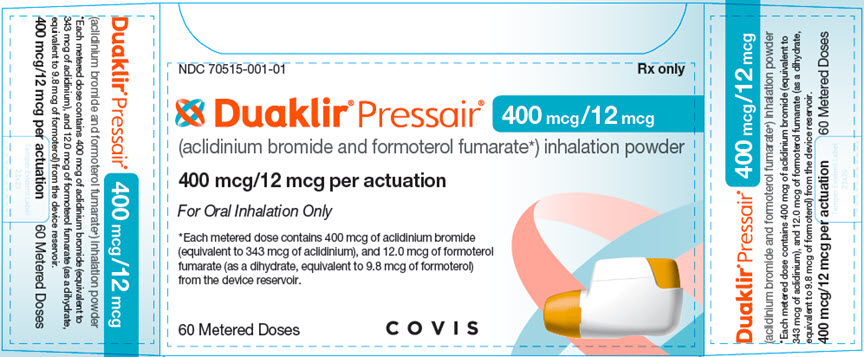
    12PRINCIPAL DISPLAY PANEL - 60 Metered Doses Carton
    60 metered doses carton
    NDC 70515-001-01          Rx only
    Duaklir Pressair®400 mcg/12 mcg
    (aclidinium bromide and formoterol fumarate*) inhalation powder
    400 mcg/12 mcg per actuation
    For Oral Inhalation Only
    *Each metered dose contains 400 mcg of aclidinium bromide
    60 Metered Doses
    COVIS
    Duaklir Pressair has been selected.