Atopic Dermatitis Treatments
Find Atopic Dermatitis Treatments
Brand Name
Pimecrolimus
View Brand InformationFDA approval date: May 07, 2018
Classification: Calcineurin Inhibitor Immunosuppressant
Form: Cream
What is Pimecrolimus?
INDICATION AND USAGE Pimecrolimus cream, 1% is indicated as second-line therapy for the short-term and non-continuous chronic treatment of mild to moderate atopic dermatitis in non-immunocompromised adults and children 2 years of age and older, who have failed to respond adequately to other topical prescription treatments, or when those treatments are not advisable. Pimecrolimus cream, 1% is not indicated for use in children less than 2 years of age [see Warnings and Precautions.
Approved To Treat

Save this treatment for later
Not sure about your diagnosis?
Tired of the same old research?
Related Clinical Trials
A Phase 3, Randomized, Double-blind, Placebo-controlled, Parallel-group, 3-arm, Multinational, Multicenter Study to Evaluate the Efficacy and Safety of Amlitelimab by Subcutaneous Injection in Participants Aged 12 Years and Older With Moderate-to-severe Atopic Dermatitis (AD) Who Are on Background Topical Corticosteroids and Have Had an Inadequate Response to Prior Biologic Therapy or Oral Janus Kinase (JAK) Inhibitor Treatment
Summary: This is a parallel group, Phase 3, multinational, multicenter, randomized, double-blind, placebo-controlled, 3-arm study for treatment of participants diagnosed with moderate-to-severe AD on background TCS who have had inadequate response to prior biologic or oral JAKi therapy. The purpose of this study is to measure the efficacy and safety of treatment with amlitelimab solution for subcutaneous (...
Related Latest Advances
Brand Information
Pimecrolimus (Pimecrolimus)
WARNING: LONG-TERM SAFETY OF TOPICAL CALCINEURIN INHIBITORS HAS NOT BEEN ESTABLISHED
Although a causal relationship has not been established, rare cases of malignancy (e.g., skin and lymphoma) have been reported in patients treated with topical calcineurin inhibitors, including pimecrolimus cream, 1% [see
Therefore:
- Continuous long-term use of topical calcineurin inhibitors, including pimecrolimus cream, 1%, in any age group should be avoided, and application limited to areas of involvement with atopic dermatitis [see
- Pimecrolimus cream, 1% is not indicated for use in children less than 2 years of age [see
1INDICATIONS AND USAGE
Pimecrolimus cream, 1% is indicated as second-line therapy for the short-term and non-continuous chronic treatment of mild to moderate atopic dermatitis in non-immunocompromised adults and children 2 years of age and older, who have failed to respond adequately to other topical prescription treatments, or when those treatments are not advisable.
Pimecrolimus cream, 1% is not indicated for use in children less than 2 years of age [see Warnings and Precautions (5.1), Use in Specific Populations (8.4)].
2DOSAGE AND ADMINISTRATION
Apply a thin layer of pimecrolimus cream, 1% to the affected skin twice daily. The patient should stop using pimecrolimus cream, 1% when signs and symptoms (e.g., itch, rash and redness) resolve and should be instructed on what actions to take if symptoms recur.
If signs and symptoms persist beyond 6 weeks, patients should be re-examined by their health care provider to confirm the diagnosis of atopic dermatitis.
Continuous long-term use of pimecrolimus cream, 1% should be avoided, and application should be limited to areas of involvement with atopic dermatitis [see
The safety of pimecrolimus cream, 1% under occlusion, which may promote systemic exposure, has not been evaluated. Avoid use of pimecrolimus cream, 1% with occlusive dressings.
3DOSAGE FORMS AND STRENGTHS
Cream, 1%.
Each gram of Pimecrolimus Cream, 1% contains 10 mg of pimecrolimus in a white to off-white cream base.
4CONTRAINDICATIONS
Pimecrolimus cream, 1% is contraindicated in individuals with a history of hypersensitivity to pimecrolimus or any of the components of the cream.
5DRUG INTERACTIONS
Potential interactions between pimecrolimus cream, 1% and other drugs, including immunizations, have not been systematically evaluated. Due to low blood levels of pimecrolimus detected in some patients after topical application, systemic drug interactions are not expected, but cannot be ruled out. The concomitant administration of known CYP3A family of inhibitors in patients with widespread and/or erythrodermic disease should be done with caution. Some examples of such drugs are erythromycin, itraconazole, ketoconazole, fluconazole, calcium channel blockers and cimetidine.
6DESCRIPTION
Pimecrolimus Cream, 1%, for topical use, contains the compound pimecrolimus, the immunosuppressant 33-epi-chloro-derivative of the macrolactam ascomycin.
Chemically, pimecrolimus is (1R,9S,12S,13S,14S,17R,21S,23S,24R,25S,27R)-12-[(1E)-1-[(1R,3R,4S)-4-chloro-3-methoxycyclohexyl]prop-1-en-2-yl]-17-ethyl-1,14-dihydroxy-23,25-dimethoxy-13,19, 21,27-tetramethyl-11,28-dioxa-4-azatricyclo[22.3.1.0

Pimecrolimus is a white to off-white powder. It is freely soluble in methylethylketone, methylisobutylketone, dichloromethane and tetrahydrofuran, soluble in acetone, methanol, ethanol, acetonitrile and toluene, sparingly soluble in isopropanol and practically insoluble in water.
Each gram of Pimecrolimus Cream, 1% contains 10 mg of pimecrolimus in a white to off-white cream base of benzyl alcohol, cetyl alcohol, citric acid anhydrous, mono- and di-glycerides, oleyl alcohol, propylene glycol, purified water, sodium cetostearyl sulfate, sodium hydroxide, stearyl alcohol, and triglycerides.
7CLINICAL STUDIES
Three randomized, double-blind, vehicle-controlled, multi-center, Phase 3 trials were conducted in 589 pediatric subjects ages 3 months to 17 years old to evaluate pimecrolimus cream, 1% for the treatment of mild to moderate atopic dermatitis. Two of the three trials support the use of pimecrolimus cream, 1% in subjects 2 years and older with mild to moderate atopic dermatitis [see Warnings and Precautions (5.1)]. Three other trials in 1,619 pediatric and adult subjects provided additional data regarding the safety of pimecrolimus cream, 1% in the treatment of atopic dermatitis. Two of these other trials were vehicle-controlled with optional sequential use of a medium potency topical corticosteroid in pediatric subjects and one trial was an active comparator trial in adult subjects with atopic dermatitis [see Warnings and Precautions (5.1) and
Two identical 6-week, randomized, vehicle-controlled, multi-center, Phase 3 trials were conducted to evaluate pimecrolimus cream, 1% for the treatment of mild to moderate atopic dermatitis. A total of 403 pediatric subjects 2 to 17 years old were included in the trials. The male/female ratio was approximately 50% and 29% of the subjects were African American. At trial entry, 59% of subjects had moderate disease and the mean body surface area (BSA) affected was 26%. About 75% of subjects had atopic dermatitis affecting the face and/or neck region. In these trials, subjects applied either pimecrolimus cream, 1% or vehicle cream twice daily to 5% to 96% of their BSA for up to 6 weeks. At endpoint, based on the physician’s global evaluation of clinical response, 35% of subjects treated with pimecrolimus cream, 1% were clear or almost clear of signs of atopic dermatitis compared to only 18% of vehicle-treated subjects. More pimecrolimus cream, 1% subjects (57%) had mild or no pruritus at 6 weeks compared to vehicle subjects (34%). The improvement in pruritus occurred in conjunction with the improvement of the subjects’ atopic dermatitis.
In these two 6-week trials of pimecrolimus cream, the combined efficacy results at endpoint are presented in Table 2 as follows:
Table 2. Combined Efficacy Results at Endpoint for Two 6-week Trials of Pimecrolimus Cream
In the two pediatric trials that independently support the use of pimecrolimus cream, 1% in mild to moderate atopic dermatitis, a significant treatment effect was seen by day 15. Of the key signs of atopic dermatitis, erythema, infiltration/papulation, lichenification, and excoriations were reduced at day 8 when compared to vehicle.
Figure 1 depicts the time course of improvement in the percent body surface area affected as a result of treatment with pimecrolimus cream, 1% in 2 to 17 year olds.
Figure 1
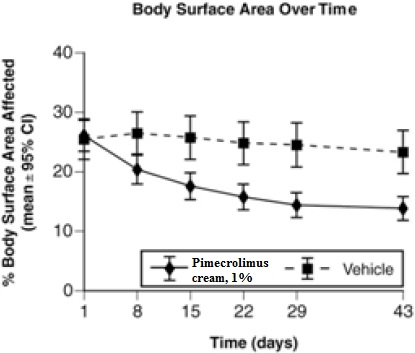
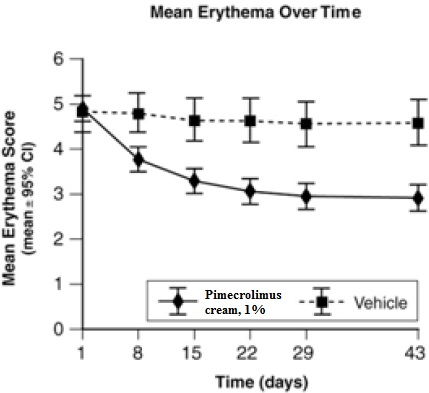
Figure 2 shows the time course of improvement in erythema as a result of treatment with pimecrolimus cream, 1% in 2 to 17 year olds.
Figure 2
8HOW SUPPLIED/STORAGE AND HANDLING
Pimecrolimus Cream, 1% is a white to off-white cream available in tubes of 30 grams, 60 grams, and 100 grams.
30 gram tube NDC 68462-609-35
60 gram tube NDC 68462-609-65
100 gram tube NDC 68462-609-94
Store at 20°C to 25°C (68°F to 77°F), excursions permitted to 15°C to 30°C (59°F to 86°F) [see USP Controlled Room Temperature]. Do not freeze.
9PATIENT COUNSELING INFORMATION
See FDA-approved patient labeling (Medication Guide)
Patients using pimecrolimus cream, 1% should receive the following information and instructions:
- Pimecrolimus cream, 1% may cause serious side effects. It is not known if pimecrolimus cream, 1% is safe to use for a long period of time. A very small number of people who have used pimecrolimus cream, 1% have had cancer (for example, skin or lymphoma). However, a link with pimecrolimus cream, 1% use has not been shown. Because of this concern:
- A patient should not use pimecrolimus cream, 1% continuously for a long time.
- Pimecrolimus cream, 1% should be used only on areas of skin that have eczema.
- Pimecrolimus cream, 1% is not for use on a child under 2 years old.
- A patient should not use sun lamps, tanning beds, or get treatment with ultraviolet light therapy during treatment with pimecrolimus cream, 1%.
- A patient should limit sun exposure during treatment with pimecrolimus cream, 1% even when the medicine is not on the skin. If a patient needs to be outdoors after applying pimecrolimus cream, 1%, the patient should wear loose fitting clothing that protects the treated area from the sun. The physician should advise the patient about other types of protection from the sun.
- A patient should not cover the skin being treated with bandages, dressings or wraps. A patient can wear normal clothing.
- Pimecrolimus cream, 1% is for use on the skin only. Do not get pimecrolimus cream, 1% in your eyes, nose, mouth, vagina, or rectum (mucous membranes). If you get pimecrolimus cream, 1% in any of these areas, burning or irritation can happen. Wipe off any pimecrolimus cream, 1% from the affected area and then rinse the area well with cold water. Pimecrolimus cream, 1% is for external use only.
- A patient should use pimecrolimus cream, 1% for short periods, and if needed, treatment may be repeated with breaks in between.
- Wash hands before using pimecrolimus cream, 1%. When applying pimecrolimus cream, 1% after a bath or shower, the skin should be dry.
- Apply a thin layer of pimecrolimus cream, 1% only to the affected skin areas, twice a day, as directed by the physician.
- Use the smallest amount of pimecrolimus cream, 1% needed to control the signs and symptoms of eczema.
- A patient should not bathe, shower or swim right after applying pimecrolimus cream, 1%. This could wash off the cream.
- A patient can use moisturizers with pimecrolimus cream, 1%. They should be sure to check with the physician first about the products that are right for them. Because the skin of patients with eczema can be very dry, it is important they keep up good skin care practices. If a patient uses moisturizers, he or she should apply them after pimecrolimus cream, 1%.
Medication Guide available at
Distributed by:

Glenmark Pharmaceuticals Inc., USA
Elmwood Park, NJ 07407
Questions? 1 (888) 721-7115
October 2025
10Medication Guide
Pimecrolimus
(pim e KROE li mus)
Cream, 1%
Important: Pimecrolimus cream, 1% is for use on the skin only (topical). Do not get pimecrolimus cream, 1% in your eyes, nose, mouth, vagina, or rectum.
What is the most important information I should know about pimecrolimus cream, 1%?
It is not known if pimecrolimus cream, 1% is safe to use for a long period of time. A very small number of people who have used pimecrolimus cream, 1% have developed cancer (for example, skin cancer or lymphoma). But a link that pimecrolimus cream, 1% use caused these cancers has not been shown. Because of this concern:
- Do not use pimecrolimus cream, 1% continuously for a long time.
- Use pimecrolimus cream, 1% only on areas of your skin that have eczema.
- Do not use pimecrolimus cream, 1% on a child under 2 years of age.
What is pimecrolimus cream, 1%?
Pimecrolimus cream, 1% is a prescription medicine used on the skin (topical) to treat mild to moderate eczema (atopic dermatitis). Pimecrolimus cream, 1% is for adults and children age 2 years and older who do not have a weakened immune system. Pimecrolimus cream, 1% is used on the skin for short periods, and if needed, treatment may be repeated with breaks in between. Pimecrolimus cream, 1% is for use after other prescription medicines have not worked for you or if your doctor recommends that other prescription medicines should not be used.
It is not known if pimecrolimus cream, 1% is safe and effective in people who have a weakened immune system.
Pimecrolimus cream, 1% is not for use in children under 2 years of age.
Who should not use pimecrolimus cream, 1%?
Do not use pimecrolimus cream, 1% if you are allergic to pimecrolimus or any of the ingredients in pimecrolimus cream, 1%. See the end of this Medication Guide for a complete list of ingredients in pimecrolimus cream, 1%.
What should I tell my doctor before using pimecrolimus cream, 1%? Before using pimecrolimus cream, 1%, tell your doctor about all of your medical conditions, including if you:
- have a skin disease called Netherton’s syndrome (a rare inherited condition)
- have any infection on your skin including chicken pox or herpes
- have been told you have a weakened immune system
- are pregnant or plan to become pregnant. It is not known if pimecrolimus cream, 1% will harm your unborn baby.
- are breastfeeding or plan to breastfeed. It is not known if pimecrolimus cream, 1% passes into your breast milk. You and your doctor should decide if you will use pimecrolimus cream, 1% or breastfeed. You should not do both.
Tell your doctor about all the medicines you take, including prescription and over-the-counter medicines, vitamins, and herbal supplements. Tell your doctor about all the skin medicines and products you use.
Know the medicines you take. Keep a list of them with you to show your doctor and pharmacist each time you get a new medicine.
How should I use pimecrolimus cream, 1%?
- Use pimecrolimus cream, 1% exactly as your doctor tells you to use it.
- Stop pimecrolimus cream, 1% when the signs and symptoms of eczema, such as itching, rash, and redness go away, or as directed by your doctor.
- Wash your hands before using pimecrolimus cream, 1%. If you apply pimecrolimus cream, 1% after a bath or shower, make sure your skin is dry.
- Apply a thin layer of pimecrolimus cream, 1% only to the affected skin areas, two times each day, as directed by your doctor.
- Use the smallest amount of pimecrolimus cream, 1% to help control the signs and symptoms of eczema.
- If you apply pimecrolimus cream, 1% to another person, or if you have eczema and are not treating your hands, it is important for you to wash your hands with soap and water after applying pimecrolimus cream, 1%. This should remove any cream left on your hands.
- Do not bathe, shower or swim right after applying pimecrolimus cream, 1%. This could wash off the cream.
- You can use moisturizers with pimecrolimus cream, 1%. Ask your doctor first about the products that are right for you. People with eczema can have very dry skin, so it is important to keep up good skin care practices. If you use moisturizers, apply them after pimecrolimus cream, 1%.
- Call your doctor if your symptoms get worse with pimecrolimus cream, 1% or your symptoms do not improve after 6 weeks of treatment.
What should I avoid while using pimecrolimus cream, 1%?
- You should not use sun lamps, tanning beds, or get treatment with ultraviolet light therapy during treatment with pimecrolimus cream, 1%.
- Limit your time in the sun during treatment with pimecrolimus cream, 1% even when the medicine is not on your skin. If you need to be outdoors after applying pimecrolimus cream, 1% wear loose fitting clothing that protects the treated area from the sun. Ask your doctor what other types of protection from the sun you should use. It is not known how pimecrolimus cream, 1% may affect your skin with exposure to ultraviolet light.
- Do not cover the skin being treated with bandages, dressings or wraps. You can wear normal clothing.
- Pimecrolimus cream, 1% is for use on the skin only. Do not get pimecrolimus cream, 1% in your eyes, nose, mouth, vagina, or rectum (mucous membranes). If you get pimecrolimus cream, 1% in any of these areas, burning or irritation can happen. Wipe off any pimecrolimus cream, 1% from the affected area and then rinse the area well with cold water.
- Do not swallow pimecrolimus cream, 1%. If you do, call your doctor.
What are the possible side effects of pimecrolimus cream, 1%?
Pimecrolimus cream, 1% may cause serious side effects.
- See “What is the most important information I should know about pimecrolimus cream, 1%?”
- The most common side effect at the skin application site is burning or a feeling of warmth. These side effects are usually mild or moderate, happen during the first few days of treatment, and usually clear up in a few days.
Other common side effects include:
- headache
- common cold or stuffy nose, sore throat
- cough
- flu (influenza)
- fever
- viral infection. Some people may get viral skin infections (like cold sores, chicken pox, shingles, or warts) or swollen lymph nodes (glands).
Tell your doctor if you get a skin infection or if you have any side effect (for example, swollen glands) that bothers you or that does not go away.
These are not all the possible side effects with pimecrolimus cream, 1%. Ask your doctor or pharmacist for more information.
Call your doctor for medical advice about side effects. You may report side effects to FDA at 1-800-FDA-1088.
How should I store pimecrolimus cream, 1%?
- Store pimecrolimus cream, 1% at 20°C to 25°C (68°F to 77°F), excursions permitted to 15°C to 30°C (59°F to 86°F).
- Do not freeze pimecrolimus cream, 1%.
Keep pimecrolimus cream, 1% and all medicines out of the reach of children.
General information about the safe and effective use of pimecrolimus cream, 1%
Medicines are sometimes prescribed for purposes other than those listed in a Medication Guide. Do not use pimecrolimus cream, 1% for conditions other than which it was prescribed. Do not give pimecrolimus cream, 1% to other people even if they have the same symptoms you have. It may harm them.
You can ask your doctor or pharmacist for information about pimecrolimus cream, 1% that is written for health professionals.
For more information, go to
What are the ingredients in pimecrolimus cream, 1%?
Active ingredient: pimecrolimus
Inactive ingredients: benzyl alcohol, cetyl alcohol, citric acid anhydrous, mono- and di-glycerides, oleyl alcohol, propylene glycol, purified water, sodium cetostearyl sulfate, sodium hydroxide, stearyl alcohol, and triglycerides.
This Medication Guide has been approved by the U.S. Food and Drug Administration.
Medication Guide available at
Distributed by:

Glenmark Pharmaceuticals Inc., USA
Elmwood Park, NJ 07407
Questions? 1 (888) 721-7115
October 2025
11Package/Label Display Panel
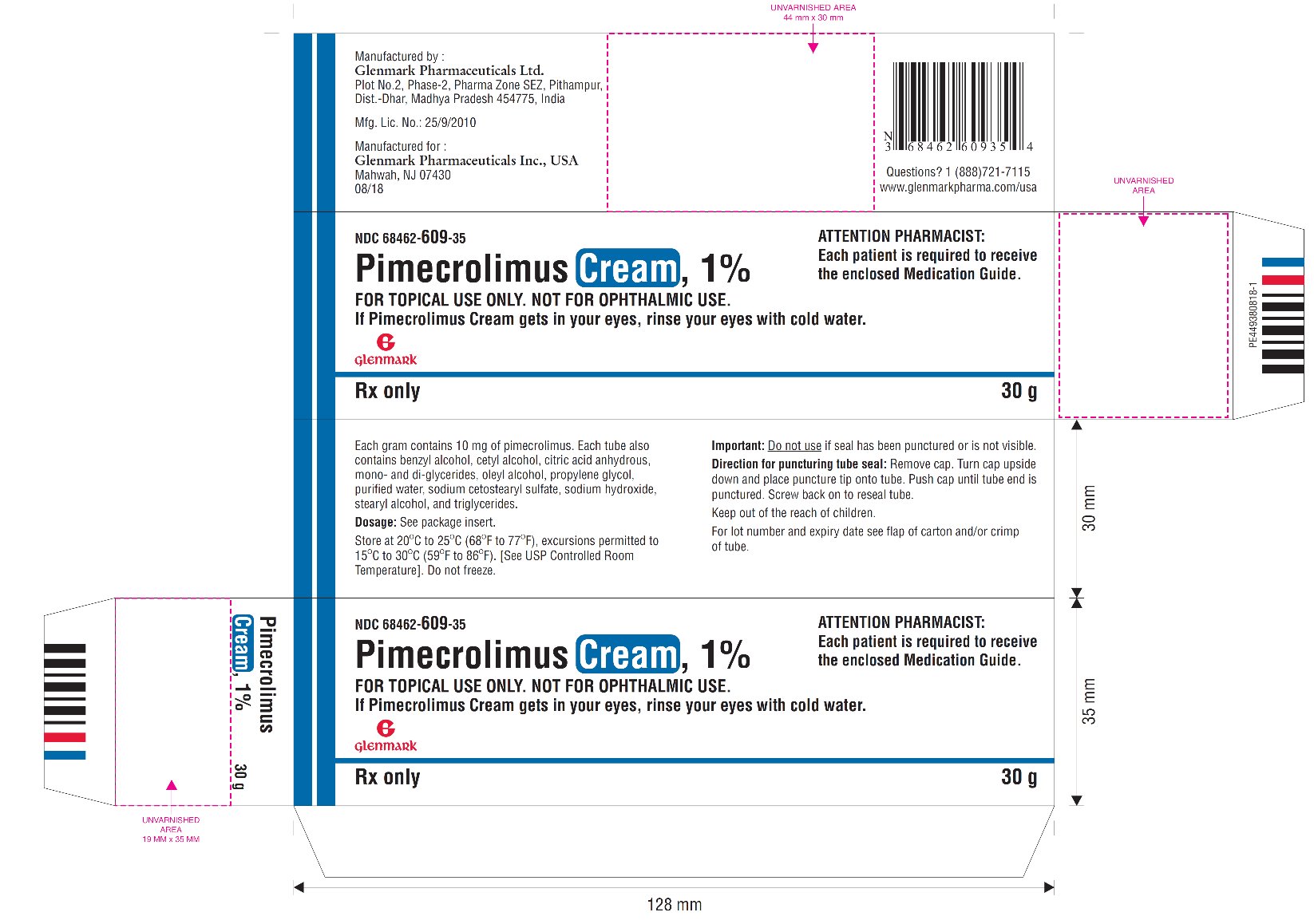
12Package/Label Display Panel