Bipolar Disorder (BPD) Treatments

Find Bipolar Disorder (BPD) Treatments

Generic Name

RisperiDONE

Brand Names
Risperdal, Risperdal Consta, Risperdal M-TAB, Rykindo, UZEDY
FDA approval date: December 29, 1993
Classification: Atypical Antipsychotic
Form: Injection, Tablet, Kit, Solution

What is Risperdal (RisperiDONE)?

RISPERDAL is an atypical antipsychotic indicated for: Treatment of schizophrenia.
Save this treatment for later
Sign Up
Not sure about your diagnosis?
Check Your Symptoms
Tired of the same old research?
Check Latest Advances

Related Clinical Trials

The Role of the Subjective Experience in Supporting Positive Effects Following Psilocybin: a Randomized, Controlled Clinical Trial Using Risperidone in Healthy Adults

Summary: The purpose of this study is to determine the importance of the acute subjective experience induced by psilocybin (the primary component of magic mushrooms) in facilitating positive outcomes. Participants in this study will be given psilocybin in combination with either a placebo or risperidone, an atypical antipsychotic that block the subjective effects of psilocybin.

Pharmacokinetics, Pharmacodynamics, and Safety Profile of Understudied Drugs

Summary: The study investigators are interested in learning more about how drugs, that are given to children by their health care provider, act in the bodies of children and young adults in hopes to find the most safe and effective dose for children. The primary objective of this study is to evaluate the PK of understudied drugs currently being administered to children per SOC as prescribed by their treati...

Biomarkers to Enhance Early Schizophrenia Treatment

Summary: This study is recruiting participants who are experiencing a first episode of psychosis and who have certain genetic factors that may make them respond better to certain medications that are used to treat people with psychosis.

Brand Information

    RISPERDAL (risperidone)
    WARNING: INCREASED MORTALITY IN ELDERLY PATIENTS WITH DEMENTIA-RELATED PSYCHOSIS
    Elderly patients with dementia-related psychosis treated with antipsychotic drugs are at an increased risk of death. RISPERDAL is not approved for the treatment of patients with dementia-related psychosis.
    1DOSAGE AND ADMINISTRATION
    Severe Renal and Hepatic Impairment in Adults: use a lower starting dose of 0.5 mg twice daily. May increase to dosages above 1.5 mg twice daily at intervals of one week or longer.
    1.1Irritability Associated with Autistic Disorder – Pediatrics (Children and Adolescents)
    The dosage of RISPERDAL should be individualized according to the response and tolerability of the patient. The total daily dose of RISPERDAL can be administered once daily, or half the total daily dose can be administered twice daily.
    For patients with body weight less than 20 kg, initiate dosing at 0.25 mg per day. For patients with body weight greater than or equal to 20 kg, initiate dosing at 0.5 mg per day. After a minimum of four days, the dose may be increased to the recommended dose of 0.5 mg per day for patients less than 20 kg and 1.0 mg per day for patients greater than or equal to 20 kg. Maintain this dose for a minimum of 14 days. In patients not achieving sufficient clinical response, the dose may be increased at intervals of 2 weeks or greater, in increments of 0.25 mg per day for patients less than 20 kg, or increments of 0.5 mg per day for patients greater than or equal to 20 kg. The effective dose range is 0.5 mg to 3 mg per day. No dosing data are available for children who weigh less than 15 kg.
    Once sufficient clinical response has been achieved and maintained, consider gradually lowering the dose to achieve the optimal balance of efficacy and safety. The physician who elects to use RISPERDAL for extended periods should periodically re-evaluate the long-term risks and benefits of the drug for the individual patient.
    Patients experiencing persistent somnolence may benefit from a once-daily dose administered at bedtime or administering half the daily dose twice daily, or a reduction of the dose.
    1.2Dosing in Patients with Severe Renal or Hepatic Impairment
    For patients with severe renal impairment (Clcr< 30 mL/min) or hepatic impairment (10–15 points on Child Pugh System), the initial starting dose is 0.5 mg twice daily. The dose may be increased in increments of 0.5 mg or less, administered twice daily. For doses above 1.5 mg twice daily, increase in intervals of one week or greater
    1.3Dose Adjustments for Specific Drug Interactions
    When RISPERDAL is co-administered with enzyme inducers (e.g., carbamazepine), the dose of RISPERDAL should be increased up to double the patient's usual dose. It may be necessary to decrease the RISPERDAL dose when enzyme inducers such as carbamazepine are discontinued
    When fluoxetine or paroxetine is co-administered with RISPERDAL, the dose of RISPERDAL should be reduced. The RISPERDAL dose should not exceed 8 mg per day in adults when co-administered with these drugs. When initiating therapy, RISPERDAL should be titrated slowly. It may be necessary to increase the RISPERDAL dose when enzyme inhibitors such as fluoxetine or paroxetine are discontinued
    1.4Administration of RISPERDAL Oral Solution
    RISPERDAL Oral Solution can be administered directly from the calibrated oral dosing syringe, or can be mixed with a beverage prior to administration. RISPERDAL Oral Solution is compatible in the following beverages: water, coffee, orange juice, and low-fat milk; it is NOT compatible with either cola or tea.
    2DOSAGE FORMS AND STRENGTHS
    RISPERDAL Tablets are available in the following strengths and colors: 0.5 mg (red-brown), 1 mg (white), 2 mg (orange), 3 mg (yellow), and 4 mg (green). All are capsule shaped, and imprinted with "JANSSEN" on one side and either "Ris 0.5", "R1", "R2", "R3", or "R4" on the other side according to their respective strengths.
    RISPERDAL Oral Solution is available in a 1 mg/mL strength.
    RISPERDAL M-TAB Orally Disintegrating Tablets are available in the following strengths, colors, and shapes: 0.5 mg (light coral, round), 1 mg (light coral, square), 2 mg (coral, square), 3 mg (coral, round), and 4 mg (coral, round). All are biconvex and etched on one side with "R0.5", "R1", "R2", "R3", or "R4" according to their respective strengths.
    3CONTRAINDICATIONS
    RISPERDAL is contraindicated in patients with a known hypersensitivity to either risperidone or paliperidone, or to any of the excipients in the RISPERDAL formulation. Hypersensitivity reactions, including anaphylactic reactions and angioedema, have been reported in patients treated with risperidone and in patients treated with paliperidone. Paliperidone is a metabolite of risperidone.
    4ADVERSE REACTIONS
    The following are discussed in more detail in other sections of the labeling:
    • Increased mortality in elderly patients with dementia-related psychosis
    • Cerebrovascular adverse events, including stroke, in elderly patients with dementia-related psychosis
    • Neuroleptic malignant syndrome
    • Tardive dyskinesia
    • Metabolic Changes (Hyperglycemia and diabetes mellitus, Dyslipidemia, and Weight Gain)
    • Hyperprolactinemia
    • Orthostatic hypotension
    • Falls
    • Leukopenia, neutropenia, and agranulocytosis
    • Potential for cognitive and motor impairment
    • Seizures
    • Dysphagia
    • Priapism
    • Disruption of body temperature regulation
    • Patients with Phenylketonuria
    The most common adverse reactions in clinical trials (>5% and twice placebo) were parkinsonism, akathisia, dystonia, tremor, sedation, dizziness, anxiety, blurred vision, nausea, vomiting, upper abdominal pain, stomach discomfort, dyspepsia, diarrhea, salivary hypersecretion, constipation, dry mouth, increased appetite, increased weight, fatigue, rash, nasal congestion, upper respiratory tract infection, nasopharyngitis, and pharyngolaryngeal pain.
    The most common adverse reactions that were associated with discontinuation from clinical trials (causing discontinuation in >1% of adults and/or >2% of pediatrics) were nausea, somnolence, sedation, vomiting, dizziness, and akathisia
    The data described in this section are derived from a clinical trial database consisting of 9803 adult and pediatric patients exposed to one or more doses of RISPERDAL for the treatment of schizophrenia, bipolar mania, autistic disorder, and other psychiatric disorders in pediatrics and elderly patients with dementia. Of these 9803 patients, 2687 were patients who received RISPERDAL while participating in double-blind, placebo-controlled trials. The conditions and duration of treatment with RISPERDAL varied greatly and included (in overlapping categories) double-blind, fixed- and flexible-dose, placebo- or active-controlled studies and open-label phases of studies, inpatients and outpatients, and short-term (up to 12 weeks) and longer-term (up to 3 years) exposures. Safety was assessed by collecting adverse events and performing physical examinations, vital signs, body weights, laboratory analyses, and ECGs.
    4.1Clinical Trials Experience
    Because clinical trials are conducted under widely varying conditions, adverse reaction rates observed in the clinical trials of a drug cannot be directly compared to rates in the clinical trials of another drug and may not reflect the rates observed in clinical practice.
    4.2Postmarketing Experience
    The following adverse reactions have been identified during postapproval use of risperidone. Because these reactions are reported voluntarily from a population of uncertain size, it is not always possible to reliably estimate their frequency or establish a causal relationship to drug exposure. These adverse reactions include: alopecia, anaphylactic reaction, angioedema, atrial fibrillation, cardiopulmonary arrest, catatonia, diabetic ketoacidosis in patients with impaired glucose metabolism, dysgeusia, hypoglycemia, hypothermia, ileus, inappropriate antidiuretic hormone secretion, intestinal obstruction, jaundice, mania, pancreatitis, pituitary adenoma, precocious puberty, pulmonary embolism, QT prolongation, sleep apnea syndrome, somnambulism, Stevens-Johnson syndrome and toxic epidermal necrolysis (SJS/TEN), sudden death, thrombocytopenia, thrombotic thrombocytopenic purpura, urinary retention, and water intoxication.
    Postmarketing cases of extrapyramidal symptoms (dystonia and dyskinesia) have been reported in patients concomitantly taking methylphenidate and risperidone when there was an increase or decrease in dosage, initiation, or discontinuation of either or both medications.
    5DESCRIPTION
    RISPERDAL
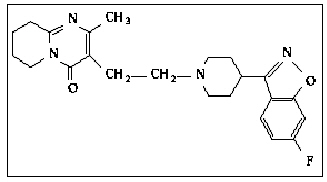
    Chemical Structure
    Risperidone is a white to slightly beige powder. It is practically insoluble in water, freely soluble in methylene chloride, and soluble in methanol and 0.1
    RISPERDAL
    RISPERDAL is also available as a 1 mg/mL oral solution. RISPERDAL
    RISPERDAL
    6PATIENT COUNSELING INFORMATION
    Advise patients using RISPERDAL oral solution to read the FDA-approved patient labeling (Instructions for Use) for RISPERDAL oral solution.
    Physicians are advised to discuss the following issues with patients for whom they prescribe RISPERDAL.