Generic Name

Ofloxacin

Brand Names
Ocuflox, Ofloxacin Ophth, Olfoxacin
FDA approval date: August 01, 1993
Classification: Quinolone Antimicrobial
Form: Tablet, Solution

What is Ocuflox (Ofloxacin)?

OCUFLOX ® ophthalmic solution is indicated for the treatment of infections caused by susceptible strains of the following bacteria in the conditions listed below: CONJUNCTIVITIS: Gram-positive bacteria: Gram-negative bacteria: Staphylococcus aureus Enterobacter cloacae Staphylococcus epidermidis Haemophilus influenzae Streptococcus pneumoniae Proteus mirabilis Pseudomonas aeruginosa CORNEAL ULCERS: Gram-positive bacteria: Gram-negative bacteria: Staphylococcus aureus Pseudomonas aeruginosa Staphylococcus epidermidis Serratia marcescens* Streptococcus pneumoniae Anaerobic species: Propionibacterium acnes *Efficacy for this organism was studied in fewer than 10 infections.
Save this treatment for later
Sign Up
Not sure about your diagnosis?
Check Your Symptoms
Tired of the same old research?
Check Latest Advances

Related Clinical Trials

Bedaquiline Roll-out Evidence in Contacts and People Living With HIV to Prevent TB (BREACH-TB)

Summary: A seamless, staged Phase II/III, open-label, multicenter, non-inferiority trial, to compare the efficacy and safety of 4 weeks of bedaquiline (BDQ) versus a a standard regimen for preventing regimen for preventing confirmed or probable tuberculosis disease (TBD) during 72 weeks of follow-up among people living with HIV (PLHIV) and high-risk Close Contacts (CC) of adults with Drug Susceptible (DS) ...

SSTARLET: Shorter and Safer Treatment Regimens for Latent TB

Summary: Our study rationale is based on: 1. Tuberculosis Preventive Treatment (TPT) is given to healthy people and needs to be safe; 2. Tuberculosis Preventive Treatment (TPT) with shorter regimens are superior with respect to acceptance, completion, and costs; 3. 4 months of Rifampin 10mg/kg (4R10) is the safest regimen, but is completed by \<80% of patients; 4. The safety of 2 months of Rifampin 20mg/kg...

Pharmacokinetics and Safety of Commonly Used Drugs in Lactating Women and Breastfed Infants

Summary: Over half of women in the US who are breastfeeding their infants take prescription drugs. You are being asked to participate in this study because you are breastfeeding your infant and are currently taking, as part of your medical care, at least one of the drugs we are studying. We are interested in studying drugs commonly prescribed to women who are breastfeeding so we can learn more about the am...

Brand Information

    OCUFLOX (ofloxacin)
    1DESCRIPTION
    OCUFLOX® (ofloxacin ophthalmic solution) 0.3% is a sterile ophthalmic solution. It is a fluorinated carboxyquinolone anti-infective for topical ophthalmic use.
    Chemical Name:
    (±)-9-Fluoro-2,3-dihydro-3-methyl-10-(4-methyl-1-piperazinyl)-7-oxo-7
    (±)-9-Fluoro-2,3-dihydro-3-methyl-10-(4-methyl-1-piperazinyl)-7-oxo-7H-pyrido[1,2,3-de]-1,4-benzoxazine-6-carboxylic acid.
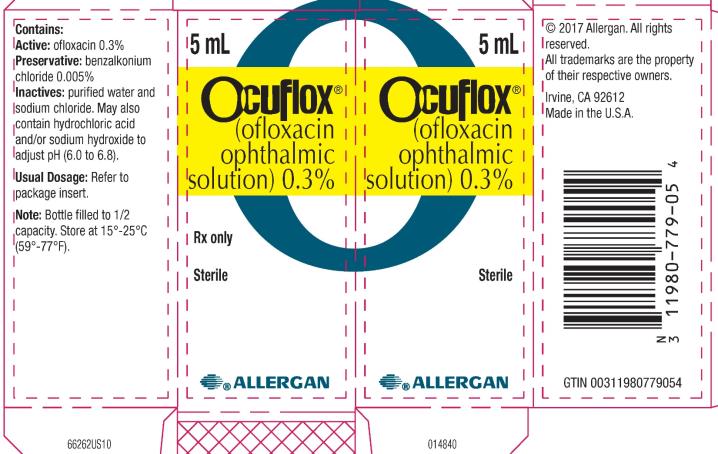
    Contains: Active: ofloxacin 0.3% (3 mg/mL). Preservative: benzalkonium chloride (0.005%).
    Inactives: sodium chloride and purified water. May also contain hydrochloric acid and/or sodium hydroxide to adjust pH. 
    OCUFLOX® solution is unbuffered and formulated with a pH of 6.4 (range - 6.0 to 6.8). It has an osmolality of 300 mOsm/kg. Ofloxacin is a fluorinated 4-quinolone which differs from other fluorinated 4-quinolones in that there is a six member (pyridobenzoxazine) ring from positions 1 to 8 of the basic ring structure.
    2INDICATIONS AND USAGE
    OCUFLOX® ophthalmic solution is indicated for the treatment of infections caused by susceptible strains of the following bacteria in the conditions listed below:
    *Efficacy for this organism was studied in fewer than 10 infections
    3CONTRAINDICATIONS
    OCUFLOX® solution is contraindicated in patients with a history of hypersensitivity to ofloxacin, to other quinolones, or to any of the components in this medication (see Warnings).
    4WARNINGS
    NOT FOR INJECTION.
    OCUFLOX® solution should not be injected subconjunctivally, nor should it be introduced directly into the anterior chamber of the eye.
    There are rare reports of anaphylactic reaction/shock and fatal hypersensitivity reactions in patients receiving systemic quinolones, some following the first dose, including ofloxacin. Some reactions were accompanied by cardiovascular collapse, loss of consciousness, angioedema (including laryngeal, pharyngeal or facial edema), airway obstruction, dyspnea, urticaria, and itching. A rare occurrence of Stevens-Johnson syndrome, which progressed to toxic epidermal necrolysis, has been reported in a patient who was receiving topical ophthalmic ofloxacin. If an allergic reaction to ofloxacin occurs, discontinue the drug. Serious acute hypersensitivity reactions may require immediate emergency treatment. Oxygen and airway management, including intubation should be administered as clinically indicated.
    5DOSAGE AND ADMINISTRATION
    The recommended dosage regimen for the treatment of
    6HOW SUPPLIED
    OCUFLOX® (ofloxacin ophthalmic solution) 0.3% is supplied sterile in opaque white LDPE plastic bottles and white dropper tips with tan high impact polystyrene (HIPS) caps as follows:
    5mL in 10mL bottle - NDC 11980-779-05
    Note: Store at 15°-25°C (59°-77°F)
    Rx only
    Revised:06/2024
    Distributed by:
    © 2024 AbbVie. All rights reserved.
    Abbie logo
    20085528
    7PRINCIPALDISPLAY PANEL
    NDC 11980-779-05
    PRINCIPAL DISPLAY PANEL

NDC 11980-779-05
5 mL
Ocuflox®
(ofloxacin ophthalmic solution) 0.3%

Rx only
Sterile
abbvie