Chronic Lymphocytic Leukemia (CLL) Treatments
Find Chronic Lymphocytic Leukemia (CLL) Treatments
Generic Name
RiTUXimab
Brand Names
Riabni, Rituxan, Rituxan Hycela, Ruxience, Truxima
FDA approval date: November 26, 1997
Classification: CD20-directed Cytolytic Antibody
Form: Injection
What is Riabni (RiTUXimab)?
RIABNI is a CD20-directed cytolytic antibody indicated for the treatment of: Adult patients with Non-Hodgkin's Lymphoma .


Save this treatment for later
Not sure about your diagnosis?
Tired of the same old research?
Related Clinical Trials
A Phase III, Multicentre, Open-Label, Randomised Study Evaluating the Efficacy and Safety of R-mini-CHOP x2 Followed by AZD0486 Versus R-mini-CHOP x6 in Elderly or Unfit Participants With Newly Diagnosed Large B-cell Lymphoma (SOUNDTRACK-D2)
Summary: The purpose of this study is to measure the efficacy and safety of R-mini-CHOP × 2 followed by AZD0486 compared with R-mini-CHOP × 6 in elderly or unfit participants newly diagnosed with LBCL.
A Phase 3 Randomized, Open-Label Multicenter Study of Zanubrutinib (BGB-3111) Plus Anti-CD20 Antibodies Versus Lenalidomide Plus Rituximab in Patients With Relapsed/Refractory Follicular or Marginal Zone Lymphoma
Summary: The purpose of the study is to compare the efficacy of zanubrutinib plus obinutuzumab versus lenalidomide plus rituximab (R\^2) in participants with relapsed/refractory (R/R) follicular lymphoma (FL), as measured by progression-free survival as determined by an independent review committee in accordance with the 2014 modification of the International Working Group on non-Hodgkin lymphoma (NHL) Cri...
A Phase 3, Open-label, Uncontrolled Single-arm Study to Evaluate the Efficacy, Pharmacokinetics, and Safety of Avacopan in Combination With a Rituximab or a Cyclophosphamide-containing Regimen in Children From 6 Years to < 18 Years of Age With Active ANCA-associated Vasculitis (AAV)
Summary: The main objective of this study is to explore the efficacy of avacopan in participants affected by AAV.
Related Latest Advances
Brand Information
Riabni (rituximab-arrx)
1DOSAGE FORMS AND STRENGTHS
Injection: 100 mg/10 mL (10 mg/mL) and 500 mg/50 mL (10 mg/mL) as a clear to slightly opalescent, colorless to slightly yellow solution in a single-dose vial.
2CONTRAINDICATIONS
None.
3ADVERSE REACTIONS
The following clinically significant adverse reactions are discussed in greater detail in other sections of the labeling:
- Infusion-related reactions
- Severe mucocutaneous reactions
- Hepatitis B reactivation with fulminant hepatitis
- Progressive multifocal leukoencephalopathy
- Tumor lysis syndrome
- Infections
- Cardiovascular adverse reactions
- Renal toxicity
- Bowel obstruction and perforation
3.1Clinical Trials Experience
Because clinical trials are conducted under widely varying conditions, adverse reaction rates observed in the clinical trials of a drug cannot be directly compared to rates in the clinical trials of another drug and may not reflect the rates observed in clinical practice.
3.2Immunogenicity
The observed incidence of anti-drug antibodies is highly dependent on the sensitivity and specificity of the assay. Differences in assay methods preclude meaningful comparisons of the incidence of anti-drug antibodies in the studies described below with the incidence of anti-drug antibodies in other studies, including those of rituximab or of other rituximab products.
Using an ELISA assay, anti-rituximab antibody was detected in 4 of 356 (1.1%) patients with low-grade or follicular NHL receiving single-agent rituximab. Three of the four patients had an objective clinical response.
A total of 273/2578 (11%) patients with RA tested positive for anti-rituximab antibodies at any time after receiving rituximab. Anti-rituximab antibody positivity was not associated with increased rates of infusion-related reactions or other adverse events. Upon further treatment, the proportions of patients with infusion-related reactions were similar between anti-rituximab antibody positive and negative patients, and most reactions were mild to moderate. Four anti-rituximab antibody positive patients had serious infusion-related reactions, and the temporal relationship between anti-rituximab antibody positivity and infusion-related reaction was variable.
A total of 23/99 (23%) rituximab-treated adult patients with GPA and MPA developed anti-rituximab antibodies by 18 months in GPA/MPA Study 1. The clinical relevance of anti-rituximab antibody formation in rituximab-treated adult patients is unclear.
Using a new ELISA assay, a total of 19/34 (56%) patients with PV, who were treated with non-U.S.-licensed rituximab, tested positive for anti-rituximab antibodies by 18 months in PV Study 1. In PV Study 2, a total of 20/63 (32%) rituximab-treated PV patients tested positive for ADA by week 52 (19 patients had treatment-inducted ADA and 1 patient had treatment-enhanced ADA). The clinical relevance of anti-rituximab antibody formation in rituximab-treated PV patients is unclear.
3.3Postmarketing Experience
The following adverse reactions have been identified during post-approval use of rituximab. Because these reactions are reported voluntarily from a population of uncertain size, it is not always possible to reliably estimate their frequency or establish a causal relationship to drug exposure.
- Hematologic: prolonged pancytopenia, marrow hypoplasia, Grade 3-4 prolonged or late-onset neutropenia, hyperviscosity syndrome in Waldenstrom's macroglobulinemia, prolonged hypogammaglobulinemia
- Cardiac: fatal cardiac failure.
- Immune/Autoimmune Events: uveitis, optic neuritis, systemic vasculitis, pleuritis, lupus-like syndrome, serum sickness, polyarticular arthritis, and vasculitis with rash.
- Infection: viral infections, including progressive multifocal leukoencephalopathy (PML), increase in fatal infections in HIV-associated lymphoma, and a reported increased incidence of Grade 3 and 4 infections
- Neoplasia: disease progression of Kaposi's sarcoma.
- Skin: severe mucocutaneous reactions, pyoderma gangrenosum (including genital presentation).
- Gastrointestinal: bowel obstruction and perforation.
- Pulmonary: fatal bronchiolitis obliterans and fatal interstitial lung disease.
- Nervous system: Posterior Reversible Encephalopathy Syndrome (PRES)/Reversible Posterior Leukoencephalopathy Syndrome (RPLS).
4DRUG INTERACTIONS
Formal drug interaction studies have not been performed with rituximab products. In patients with CLL, rituximab did not alter systemic exposure to fludarabine or cyclophosphamide. In clinical trials of patients with RA, concomitant administration of methotrexate or cyclophosphamide did not alter the pharmacokinetics of rituximab.
5DESCRIPTION
Rituximab-arrx is a genetically engineered chimeric murine/human monoclonal IgG1 kappa antibody directed against the CD20 antigen. Rituximab-arrx has an approximate molecular weight of 145 kD.
Rituximab-arrx is produced in a mammalian cell (Chinese Hamster Ovary) suspension culture in a nutrient medium.
RIABNI (rituximab-arrx) injection is a sterile, preservative-free, clear to slightly opalescent, colorless to slightly yellow solution for intravenous infusion. RIABNI is supplied at a concentration of 10 mg/mL in either 100 mg/10 mL or 500 mg/50 mL single-dose vials. Each mL of solution contains 10 mg rituximab-arrx, polysorbate 80 (0.7 mg), sodium chloride (9 mg), sodium citrate dihydrate (7.35 mg), and Water for Injection, USP. Hydrochloric acid is used to adjust the buffer solution pH. The pH is 6.5.
6HOW SUPPLIED/STORAGE AND HANDLING
RIABNI (rituximab-arrx) injection is a sterile, clear to slightly opalescent, colorless to slightly yellow preservative free solution for intravenous use supplied as a carton containing one 100 mg/10 mL (10 mg/mL) single dose vial (NDC 55513-224-01, 55513-224-21) and a carton containing one 500 mg/50 mL (10 mg/mL) single dose vial (NDC 55513-326-01, 55513-326-21).
7PATIENT COUNSELING INFORMATION
Advise the patient to read the FDA-approved patient labeling (Medication Guide).
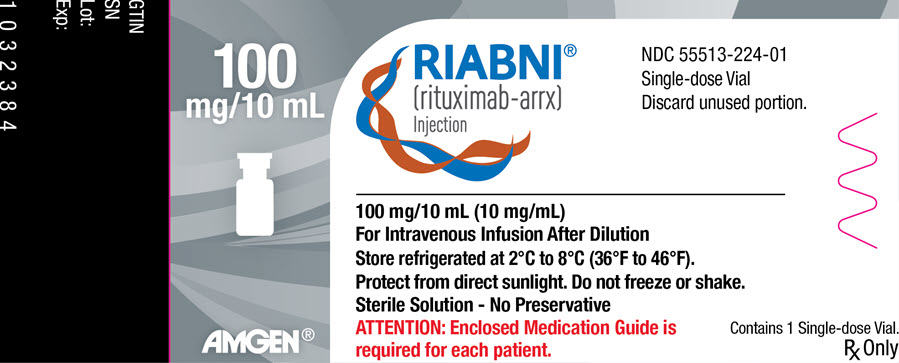
8PRINCIPAL DISPLAY PANEL - 100 mg/10 mL Vial Label
100
AMGEN
RIABNI
NDC 55513-224-01
100 mg/10 mL (10 mg/mL)
For Intravenous Infusion After Dilution
Store refrigerated at 2°C to 8°C (36°F to 46°F).
Protect from direct sunlight. Do not freeze or shake.
Sterile Solution - No Preservative
ATTENTION: Enclosed Medication Guide is
Contains 1 Single-dose Vial.
Rx Only
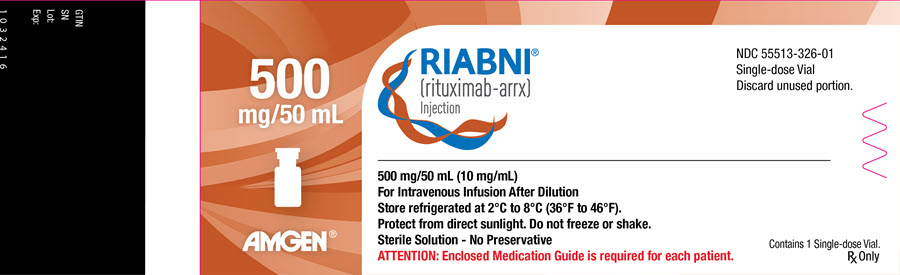
9PRINCIPAL DISPLAY PANEL - 500 mg/50 mL Vial Label
500
AMGEN
RIABNI
NDC 55513-326-01
500 mg/50 mL (10 mg/mL)
For Intravenous Infusion After Dilution
Store refrigerated at 2°C to 8°C (36°F to 46°F).
Protect from direct sunlight. Do not freeze or shake.
Sterile Solution - No Preservative
ATTENTION: Enclosed Medication Guide is required for each patient.
Contains 1 Single-dose Vial.
Rx Only