Brand Name

Iclusig

Generic Name
Ponatinib
View Brand Information
FDA approval date: December 14, 2012
Classification: Kinase Inhibitor
Form: Tablet

What is Iclusig (Ponatinib)?

ICLUSIG is indicated for the treatment of adult patients with: Philadelphia Chromosome-Positive Acute Lymphoblastic Leukemia Newly diagnosed Ph+ ALL in combination with chemotherapy. This indication is approved under accelerated approval based on minimal residual disease -negative complete remission at the end of induction. Continued approval for this indication may be contingent upon verification of clinical benefit in a confirmatory trial. As monotherapy in Ph+ ALL for whom no other kinase inhibitors are indicated or T315I-positive Ph+ ALL. Chronic Myeloid Leukemia Chronic phase CML with resistance or intolerance to at least two prior kinase inhibitors. Accelerated phase or blast phase CML for whom no other kinase inhibitors are indicated. T315I-positive CML . ICLUSIG is a kinase inhibitor indicated for the treatment of adult patients with: Philadelphia Chromosome-Positive Acute Lymphoblastic Leukemia Newly diagnosed Ph+ ALL, in combination with chemotherapy. This indication is approved under accelerated approval based on minimal residual disease -negative complete remission at the end of induction. Continued approval for this indication may be contingent upon verification of clinical benefit in a confirmatory trial. As monotherapy in Ph+ ALL for whom no other kinase inhibitors are indicated or T315I-positive Ph+ ALL. Chronic Myeloid Leukemia Chronic phase CML with resistance or intolerance to at least two prior kinase inhibitors. Accelerated phase or blast phase CML for whom no other kinase inhibitors are indicated. T315I-positive CML . Limitations of Use : ICLUSIG is not indicated and is not recommended for the treatment of patients with newly diagnosed CP-CML.
Save this treatment for later
Sign Up
Not sure about your diagnosis?
Check Your Symptoms
Tired of the same old research?
Check Latest Advances

Related Clinical Trials

A Phase III Randomized Trial of Steroids + Tyrosine Kinase Inhibitor (TKI) Induction With Chemotherapy or Blinatumomab for Newly Diagnosed BCR-ABL-Positive Acute Lymphoblastic Leukemia (ALL) in Adults

Summary: This phase III trial compares the effect of usual treatment of chemotherapy and steroids and a tyrosine kinase inhibitor (TKI) to the same treatment plus blinatumomab. Blinatumomab is a Bi-specific T-Cell Engager ('BiTE') that may interfere with the ability of cancer cells to grow and spread. The information gained from this study may help researchers determine if combination therapy with steroids...

A Phase I/II Study to Investigate the Combination of LP-118, Ponatinib, Vincristine and Dexamethasone in Relapsed/Refractory T-ALL/LBL

Summary: The purpose of this study is to learn more about LP-118 (an experimental drug) and its side effects and decide on acceptable doses. The purpose of this study is to determine if LP-118 can be given safely with another medicine called ponatinib, that is FDA-approved for the treatment of acute lymphoblastic leukemia.

A Phase II, Multi-center, Prospective, Open-label Study of Asciminib in Patients With Chronic Myeloid Leukemia in Chronic Phase (CML-CP) or Accelerated Phase (CML-AP) With T315I Mutation Who Are Resistant, Intolerant or Ineligible to Ponatinib.

Summary: The objective of this Phase II study is to assess the potential of asciminib in managing CML-CP or CML-AP in patient carrying the T315I mutation. The presence of this mutation introduces treatment difficulties due to the limited available options. The study seeks to collect additional data on the effectiveness and safety of asciminib for these patients. By determining the drug's capacity to manage...

Brand Information

Iclusig (ponatinib hydrochloride)
1INDICATIONS AND USAGE
ICLUSIG
Philadelphia Chromosome-Positive Acute Lymphoblastic Leukemia (Ph+ ALL)
  • Newly diagnosed Ph+ ALL in combination with chemotherapy.
  • As monotherapy in Ph+ ALL for whom no other kinase inhibitors are indicated or T315I-positive Ph+ ALL.
Chronic Myeloid Leukemia (CML)
  • Chronic phase (CP) CML with resistance or intolerance to at least two prior kinase inhibitors.
  • Accelerated phase (AP) or blast phase (BP) CML for whom no other kinase inhibitors are indicated.
  • T315I-positive CML (chronic phase, accelerated phase, or blast phase).
2DOSAGE FORMS AND STRENGTHS
Tablets, film-coated:
  • 10 mg of ponatinib: Oval, white to off-white, biconvex, debossed "NZ" on one side and plain on the other side
  • 15 mg of ponatinib: Round, white, biconvex, debossed "A5" on one side and plain on the other side
  • 30 mg of ponatinib: Round, white, biconvex, debossed "C7" on one side and plain on the other side
  • 45 mg of ponatinib: Round, white, biconvex, debossed "AP4" on one side and plain on the other side
3CONTRAINDICATIONS
None.
4ADVERSE REACTIONS
The following clinically significant adverse reactions are described elsewhere in the labeling:
  • Arterial Occlusive Events
  • Venous Thromboembolic Events
  • Heart Failure
  • Hepatotoxicity
  • Hypertension
  • Pancreatitis
  • Neuropathy
  • Ocular Toxicity
  • Hemorrhage
  • Fluid Retention
  • Cardiac Arrhythmias
  • Myelosuppression
  • Tumor Lysis Syndrome
  • Reversible Posterior Leukoencephalopathy Syndrome
  • Impaired Wound Healing and Gastrointestinal Perforation
4.1Clinical Trials Experience
Because clinical trials are conducted under widely varying conditions, adverse reaction rates observed in the clinical trials of a drug cannot be directly compared with rates in the clinical trials of another drug and may not reflect the rates observed in clinical practice.
The most common adverse reactions identified in the Highlights of the Prescribing Information are based on two safety populations. The first is from a pooled safety population of 543 patients with CML or resistant or intolerant Ph+ ALL (OPTIC and PACE studies) who received ICLUSIG as a single agent at a starting dose of 45 mg orally once daily. In this pooled safety population, the most common (>20%) adverse reactions were rash and related conditions, arthralgia, abdominal pain, fatigue, headache, constipation, hypertension, dry skin, hepatotoxicity, fluid retention and edema, pyrexia, pancreatitis/lipase elevation, nausea, hemorrhage, anemia, AOEs and cardiac arrhythmias. The most common Grade 3 or 4 laboratory abnormalities (>20%) were platelet count decreased, neutrophil cell count decreased, and white blood cell decreased.
The second safety population is from 163 patients with newly diagnosed Ph+ ALL (PhALLCON study) who received ICLUSIG in combination with chemotherapy at a starting dose of 30 mg orally once daily. The most common adverse reactions (>20%) included hepatotoxicity, arthralgia, rash and related conditions, headache, pyrexia, abdominal pain, constipation, fatigue, nausea, oral mucositis, hypertension, pancreatitis/lipase elevation, neuropathy peripheral, hemorrhage, febrile neutropenia, fluid retention and edema, vomiting, paresthesia, and cardiac arrhythmias. The most common Grade 3 or 4 laboratory abnormalities (>20%) included decreased white blood cell count, decreased neutrophil cell count, decreased platelet count, decreased lymphocyte cell count, decreased hemoglobin, increased lipase, and increased ALT.
Newly Diagnosed Ph+ ALL
The safety of ICLUSIG was evaluated in PhALLCON, a randomized, active-controlled, multicenter trial conducted in patients with newly diagnosed Ph+ ALL
Patients with uncontrolled hypertension, hypertriglyceridemia, or diabetes and patients with clinically significant, uncontrolled, or active cardiovascular disease, including any history of myocardial infarction, peripheral vascular infarction, revascularization procedure, venous thromboembolism, clinically significant atrial/ventricular tachyarrhythmias, history of myocardial infarction, unstable angina, or congestive heart failure within the 6 months prior to the first dose of ICLUSIG, were excluded.
Serious adverse reactions occurred in 63% of patients receiving ICLUSIG in combination with chemotherapy. Serious adverse reactions in >2% of patients included febrile neutropenia (18%), pyrexia (6%), thrombocytopenia (4.3%), sepsis (3.7%), septic shock (3.7%), anemia (2.5%), hemorrhage (2.5%), neutropenia (2.5%), pancreatitis (2.5%), peripheral neuropathy (2.5%), pneumonia (2.5%) and acute kidney injury (2.5%). Fatal adverse reactions occurred in 6% of patients who received ICLUSIG in combination with chemotherapy, including sepsis (3.7%), sudden death, pneumonitis and respiratory failure (0.6%, each).
Permanent discontinuation of ICLUSIG due to adverse reactions occurred in 13% of patients. Adverse reactions resulting in permanent discontinuation of ICLUSIG in >2% of patients included arterial occlusive events and sepsis.
Dosage modifications (dose interruption or reduction) of ICLUSIG due to adverse reactions occurred in 71% of patients. Adverse reactions leading to dose interruption or reduction of ICLUSIG in >5% of patients included increased ALT, neutropenia, increased lipase, thrombocytopenia, increased AST, febrile neutropenia, and abdominal pain.
Table 4 summarizes the adverse reactions in patients receiving ICLUSIG or imatinib in combination with chemotherapy in PhALLCON.
Clinically relevant adverse reactions in ≤10% of patients receiving ICLUSIG with chemotherapy: urinary tract infection (10%), arterial occlusive events (6%), cardiac failure (6%), and acute kidney injury (4.3%).
Table 5 summarizes the laboratory abnormalities in PhALLCON for patients who received ICLUSIG or imatinib in combination with chemotherapy.
4.2Postmarketing Experience
The following adverse reactions have been identified during post-approval use of ICLUSIG. Because these reactions are reported voluntarily from a population of uncertain size, it is not always possible to reliably estimate their frequency or establish a causal relationship to drug exposure:
Blood and Lymphatic System Disorders: Thrombotic microangiopathy
Endocrine Disorders: Hyperthyroidism
Gastrointestinal Disorders: Gastrointestinal perforation, fistula
Metabolism and Nutrition Disorders: Dehydration
Nervous System Disorders: Reversible posterior leukoencephalopathy syndrome (RPLS)
Skin and Subcutaneous Tissue Disorders: Severe cutaneous reaction (e.g., Erythema multiforme, Stevens-Johnson syndrome), impaired wound healing, panniculitis (including erythema nodosum)
Vascular Disorders: Arterial (including aortic) aneurysms, dissections, and rupture
5OVERDOSAGE
Overdoses with ICLUSIG were reported in clinical trials. One patient was estimated to have been administered 540 mg via nasogastric tube. Two hours after the overdosage, the patient had an uncorrected QT interval of 520 ms. Subsequent ECGs showed normal sinus rhythm with uncorrected QT intervals of 480 ms and 400 ms. The patient died 9 days after the overdosage from pneumonia and sepsis. Another patient self-administered 165 mg on Cycle 1 Day 2. The patient experienced fatigue and non-cardiac chest pain on Day 3. Multiple doses of 90 mg per day for 12 days in a patient resulted in pneumonia, systemic inflammatory response, atrial fibrillation, and a moderate pericardial effusion.
In the event of an overdosage, stop ICLUSIG, observe the patient and provide supportive treatment as appropriate.
6DESCRIPTION
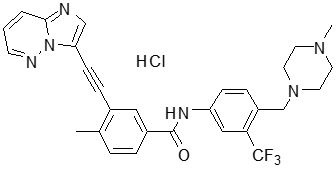
Ponatinib is a kinase inhibitor. The chemical name for ponatinib hydrochloride is 3-(imidazo[1,2-b]pyridazin-3-ylethynyl)-4-methyl-N-{4-[(4-methylpiperazin-1-yl)methyl]-3-(trifluoromethyl)phenyl}benzamide hydrochloride. The molecular formula is C
Chemical Structure
Ponatinib HCl is an off-white to yellow powder with pKa of 2.77 and 7.8. The solubility of ponatinib in pH 1.7, 2.7, and 7.5 buffers is 7790 mcg/mL, 3.44 mcg/mL, and 0.16 mcg/mL, respectively, indicating a decrease in solubility with increasing pH. Each tablet for oral administration contains 10 mg, 15 mg, 30 mg or 45 mg of ponatinib equivalent to 10.68 mg, 16.03 mg, 32.05 mg, and 48.08 mg of ponatinib hydrochloride with the following inactive ingredients: lactose monohydrate, microcrystalline cellulose, sodium starch glycolate (type B), colloidal silicon dioxide, magnesium stearate and a tablet coating. The tablet coating consists of talc, polyethylene glycol, polyvinyl alcohol, and titanium dioxide.
7HOW SUPPLIED/STORAGE AND HANDLING
ICLUSIG tablets are available in the following configurations.
8PATIENT COUNSELING INFORMATION
Advise the patient to read the FDA-approved patient labeling (Medication Guide).
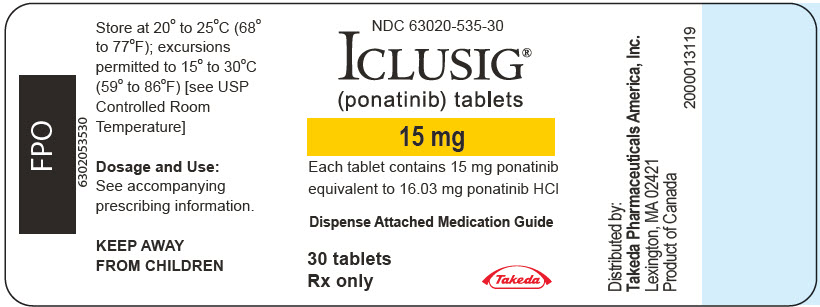
9PRINCIPAL DISPLAY PANEL - 15 mg Tablet Bottle Label
NDC 63020-535-30
ICLUSIG
15 mg
Each tablet contains 15 mg ponatinib
Dispense Attached Medication Guide
30 tablets
Takeda
PRINCIPAL DISPLAY PANEL - 15 mg Tablet Bottle Label
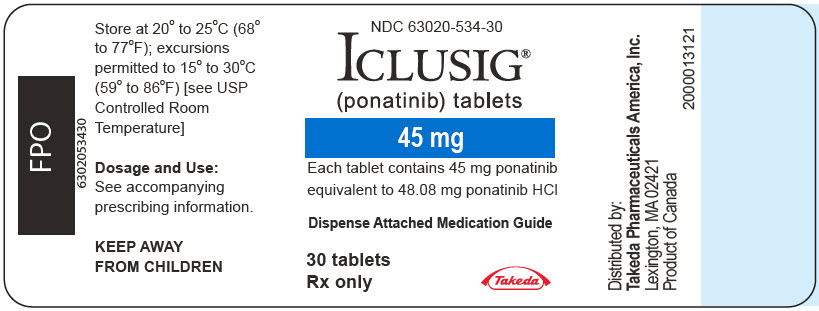
10PRINCIPAL DISPLAY PANEL - 45 mg Tablet Bottle Label
NDC 63020-534-30
ICLUSIG
45 mg
Each tablet contains 45 mg ponatinib
Dispense Attached Medication Guide
Takeda
PRINCIPAL DISPLAY PANEL - 45 mg Tablet Bottle Label
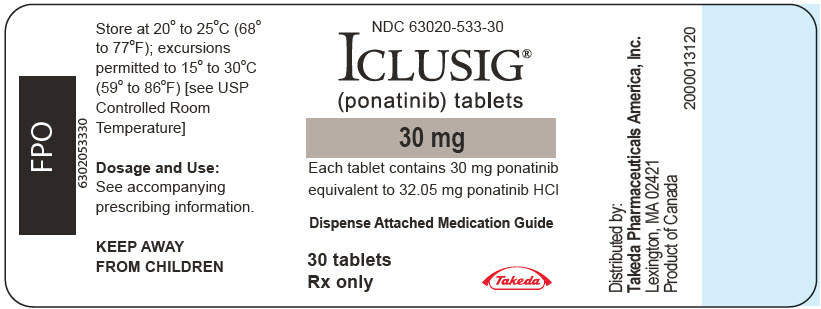
11PRINCIPAL DISPLAY PANEL - 30 mg Tablet Bottle Label
NDC 63020-533-30
ICLUSIG
30 mg
Each tablet contains 30 mg ponatinib
Dispense Attached Medication Guide
Takeda
PRINCIPAL DISPLAY PANEL - 30 mg Tablet Bottle Label
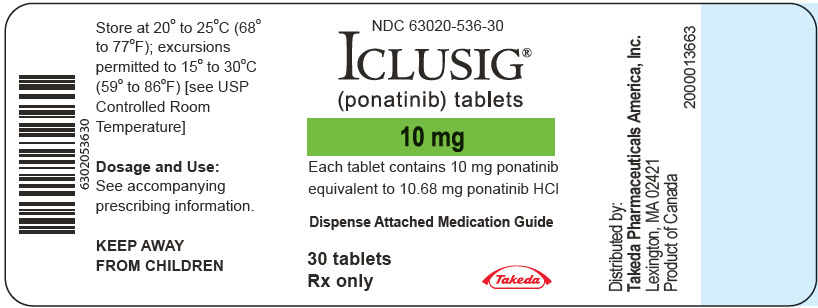
12PRINCIPAL DISPLAY PANEL - 10 mg Tablet Bottle Label
NDC 63020-536-30
ICLUSIG
10 mg
Each tablet contains 10 mg ponatinib
Dispense Attached Medication Guide
30 tablets
Takeda
PRINCIPAL DISPLAY PANEL - 10 mg Tablet Bottle Label