Cluster Headache Treatments
Find Cluster Headache Treatments
Brand Name
Naratriptan
View Brand InformationFDA approval date: July 07, 2010
Classification: Serotonin-1b and Serotonin-1d Receptor Agonist
Form: Tablet
What is Naratriptan?
Naratriptan is indicated for the acute treatment of migraine attacks with or without aura in adults. Limitations of Use: Use only if a clear diagnosis of migraine has been established. If a patient has no response to the first migraine attack treated with naratriptan, reconsider the diagnosis of migraine before naratriptan is administered to treat any subsequent attacks., Naratriptan is not indicated for the prevention of migraine attacks., Safety and effectiveness of naratriptan have not been established for cluster headache. Naratriptan is a serotonin receptor agonist indicated for the acute treatment of migraine with or without aura in adults. Limitations of Use:, Use only if a clear diagnosis of migraine has been established. , Not indicated for the prophylactic therapy of migraine attacks. , Not indicated for the treatment of cluster headache.
Approved To Treat
Top Global Experts

Save this treatment for later
Not sure about your diagnosis?
Tired of the same old research?
Related Clinical Trials
There is no clinical trials being done for this treatment
Related Latest Advances
Brand Information
Naratriptan (Naratriptan)
1INDICATIONS AND USAGE
Naratriptan tablets are indicated for the acute treatment of migraine with or without aura in adults.
Limitations of Use
- Use only if a clear diagnosis of migraine has been established. If a patient has no response to the first migraine attack treated with naratriptan tablets, reconsider the diagnosis of migraine before naratriptan tablets are administered to treat any subsequent attacks.
- Naratriptan tablets are not indicated for the prevention of migraine attacks.
- Safety and effectiveness of naratriptan tablets have not been established for cluster headache.
2DOSAGE FORMS AND STRENGTHS
1 mg white to off-white tablets, capsule shaped, film-coated, and debossed with "N" on one side and "1" on the other side
2.5 mg green tablets, capsule shaped, film-coated, and debossed with "N" on one side and "2.5" on the other side
3CONTRAINDICATIONS
Naratriptan tablets are contraindicated in patients with:
- Ischemic coronary artery disease (CAD) (angina pectoris, history of myocardial infarction, or documented silent ischemia) or coronary artery vasospasm, including Prinzmetal’s angina
- Wolff-Parkinson-White syndrome or arrhythmias associated with other cardiac accessory conduction pathway disorders
- History of stroke or transient ischemic attack (TIA) or history of hemiplegic or basilar migraine because such patients are at a higher risk of stroke
- Peripheral vascular disease
- Ischemic bowel disease
- Uncontrolled hypertension
- Recent use (i.e., within 24 hours) of another 5-HT
- Hypersensitivity to naratriptan tablets (angioedema and anaphylaxis seen)
- Severe renal or hepatic impairment
4ADVERSE REACTIONS
The following adverse reactions are discussed in more detail in other sections of the prescribing information:
- Myocardial ischemia, myocardial infarction, and Prinzmetal’s angina
- Arrhythmias
- Chest, throat, neck, and/or jaw pain/tightness/pressure
- Cerebrovascular events
- Other vasospasm reactions
- Medication overuse headache
- Serotonin syndrome
- Increase in blood pressure
- Hypersensitivity reactions
4.1Clinical Trials Experience
Because clinical trials are conducted under widely varying conditions, adverse reaction rates observed in the clinical trials of a drug cannot be directly compared with rates in the clinical trials of another drug and may not reflect the rates observed in practice.
In a long-term open-label trial where patients were allowed to treat multiple migraine attacks for up to 1 year, 15 patients (3.6%) discontinued treatment due to adverse reactions.
In controlled clinical trials, the most common adverse reactions were paresthesias, dizziness, drowsiness, malaise/fatigue, and throat/neck symptoms, which occurred at a rate of 2% and at least 2 times placebo rate.
Table 1 lists the adverse reactions that occurred in 5 placebo-controlled clinical trials of approximately 1,752 exposures to placebo and naratriptan tablets in adult patients with migraine. Only reactions that occurred at a frequency of 2% or more in groups treated with naratriptan tablets 2.5 mg and that occurred at a frequency greater than the placebo group in the 5 pooled trials are included in Table 1.
Table 1. Adverse Reactions Reported by at Least 2% of Patients Treated with Naratriptan Tablets and at a Frequency Greater than Placebo
The incidence of adverse reactions in controlled clinical trials was not affected by age or weight of the patients, duration of headache prior to treatment, presence of aura, use of prophylactic medications, or tobacco use. There were insufficient data to assess the impact of race on the incidence of adverse reactions.
5OVERDOSAGE
Adverse reactions observed after overdoses of up to 25 mg included increases in blood pressure resulting in lightheadedness, neck tension, tiredness, and loss of coordination. Also, ischemic ECG changes likely due to coronary artery vasospasm have been reported.
The elimination half-life of naratriptan is about 6 hours
6DESCRIPTION
Naratriptan tablets, USP contain naratriptan hydrochloride USP, a selective 5-HT
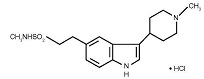
The empirical formula is C
Each naratriptan tablet, USP for oral administration contains 1.11 or 2.78 mg of naratriptan hydrochloride USP, equivalent to 1 or 2.5 mg of naratriptan, respectively. Each tablet also contains the inactive ingredients croscarmellose sodium, anhydrous lactose, magnesium stearate, microcrystalline cellulose, opadry white (1 mg tablet) and opadry green (2.5 mg tablet). The components of opadry white are hypromellose, triacetin, and titanium dioxide. The components of opadry green are hypromellose, triacetin, titanium dioxide, iron oxide yellow, and FD&C Blue No. 2.
7CLINICAL STUDIES
The efficacy of naratriptan tablets in the acute treatment of migraine headaches was evaluated in 3 randomized, double-blind, placebo-controlled trials in adult patients (Trials 1, 2, 3). These trials enrolled adult patients who were predominantly female (86%) and Caucasian (96%) with a mean age of 41 years (range: 18 to 65 years). In all studies, patients were instructed to treat at least 1 moderate to severe headache. Headache response, defined as a reduction in headache severity from moderate or severe pain to mild or no pain, was assessed up to 4 hours after dosing. Associated symptoms such as nausea, vomiting, photophobia, and phonophobia were also assessed. Maintenance of response was assessed for up to 24 hours postdose. A second dose of naratriptan tablets or other rescue medication to treat migraines was allowed 4 to 24 hours after the initial treatment for recurrent headache.
In all 3 trials, the percentage of patients achieving headache response 4 hours after treatment, the primary outcome measure, was significantly greater among patients receiving naratriptan tablets compared with those who received placebo. In all trials, response to 2.5 mg was numerically greater than response to 1 mg and in the largest of the 3 trials, there was a statistically significant greater percentage of patients with headache response at 4 hours in the 2.5 mg group compared with the 1 mg group. The results are summarized in Table 2.
aP<0.05 compared with placebo.
bP<0.05 compared with 1 mg.
bP<0.05 compared with 1 mg.
The estimated probability of achieving an initial headache response in adults over the 4 hours following treatment in pooled Trials 1, 2, and 3 is depicted in Figure 1.
Figure 1. Estimated Probability of Achieving Initial Headache Response within 4 Hours in Pooled Trials 1, 2, and 3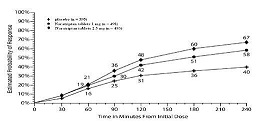
a The figure shows the probability over time of obtaining headache response (reduction in headache severity from moderate or severe pain to no or mild pain) following treatment with naratriptan tablets. In this Kaplan-Meier plot, patients not achieving response within 240 minutes were censored at 240 minutes.
For patients with migraine-associated nausea, photophobia, and phonophobia at baseline, there was a lower incidence of these symptoms 4 hours following administration of 1 mg and 2.5 mg naratriptan tablets compared with placebo.
Four to 24 hours following the initial dose of study treatment, patients were allowed to use additional treatment for pain relief in the form of a second dose of study treatment or other rescue medication. The estimated probability of patients taking a second dose or other rescue medication to treat migraine over the 24 hours following the initial dose of study treatment is summarized in Figure 2.
Figure 2. Estimated Probability of Patients Taking a Second Dose of Naratriptan Tablets or Other Medication to Treat Migraine over the 24 Hours following the Initial Dose of Study Treatment in Pooled Trials 1, 2, and 3
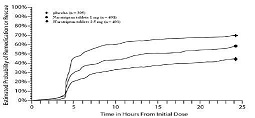
a Kaplan-Meier plot based on data obtained in the 3 controlled clinical trials (Trials 1, 2, and 3) providing evidence of efficacy with patients not using additional treatments censored at 24 hours. The plot also includes patients who had no response to the initial dose. Remedication was discouraged prior to 4 hours postdose.
There is no evidence that doses of 5 mg provided a greater effect than 2.5 mg. There was no evidence to suggest that treatment with naratriptan tablets was associated with an increase in the severity or frequency of migraine attacks. The efficacy of naratriptan tablets was unaffected by presence of aura; gender, age, or weight of the subject; oral contraceptive use; or concomitant use of common migraine prophylactic drugs (e.g., beta-blockers, calcium channel blockers, tricyclic antidepressants). There was insufficient data to assess the impact of race on efficacy.
8HOW SUPPLIED/STORAGE AND HANDLING
Naratriptan tablets, USP containing 1 mg and 2.5 mg of naratriptan (base) as the hydrochloride salt.
Naratriptan Tablets USP, 1 mg, are white to off-white colored, capsule shaped, film-coated tablets debossed with “N” on one side and “1” on the other side are supplied as:
Carton of 9 Unit-of-Use tablets each with cross perforation and individually labeled NDC 69452-340-72
Naratriptan Tablets USP, 2.5 mg, are green colored, capsule shaped, film-coated tablets debossed with “N” on one side and “2.5” on the other side are supplied as:
Carton of 9 Unit-of-Use tablets each with cross perforation and individually labeled NDC 69452-341-72
Store at 20° to 25°C (68° to 77°F) [see USP Controlled Room Temperature].
9PATIENT COUNSELING INFORMATION
Advise the patient to read the FDA-approved patient labeling (Patient Information).
Risk of Myocardial Ischemia and/or Infarction, Prinzmetal’s Angina, Other Vasospasm-Related Events, Arrhythmias, and Cerebrovascular Events
Inform patients that naratriptan tablets may cause serious cardiovascular side effects such as myocardial infarction or stroke. Although serious cardiovascular events can occur without warning symptoms, patients should be alert for the signs and symptoms of chest pain, shortness of breath, irregular heartbeat, significant rise in blood pressure, weakness, and slurring of speech and should ask for medical advice if any indicative sign or symptoms are observed. Apprise patients of the importance of this follow-up
Anaphylactic Reactions
Inform patients that anaphylactic reactions have occurred in patients receiving naratriptan tablets. Such reactions can be life threatening or fatal. In general, anaphylactic reactions to drugs are more likely to occur in individuals with a history of sensitivity to multiple allergens
Concomitant Use with Other Triptans or Ergot Medications
Inform patients that use of naratriptan tablets within 24 hours of another triptan or an ergot-type medication (including dihydroergotamine or methysergide) is contraindicated
Serotonin Syndrome
Caution patients about the risk of serotonin syndrome with the use of naratriptan tablets or other triptans, particularly during combined use with SSRIs, SNRIs, TCAs, and MAO inhibitors
Medication Overuse Headache
Inform patients that use of acute migraine drugs for 10 or more days per month may lead to an exacerbation of headache and encourage patients to record headache frequency and drug use (e.g., by keeping a headache diary)
Pregnancy
Advise patients to notify their healthcare provider if they become pregnant during treatment or intend to become pregnant
Lactation
Advise patients to notify their healthcare provider if they are breastfeeding or plan to breastfeed [see Use in Specific Populations (8.2)].
Ability to Perform Complex Tasks
Treatment with naratriptan tablets may cause somnolence and dizziness; instruct patients to evaluate their ability to perform complex tasks after administration of naratriptan tablets.