Conjunctivitis (Pink Eye) Treatments

Find Conjunctivitis (Pink Eye) Treatments

Generic Name

Tobramycin

Brand Names
Bethkis, TOBI, TOBI Podhaler, TobraDex, Tobrex
FDA approval date: June 28, 1981
Classification: Corticosteroid
Form: Injection, Ointment, Inhalant, Suspension, Capsule, Solution

What is Bethkis (Tobramycin)?

BETHKIS is indicated for the management of cystic fibrosis patients with Pseudomonas aeruginosa. Safety and efficacy have not been demonstrated in patients under the age of six years, patients with FEV 1 less than 40% or greater than 80% predicted, or patients colonized with Burkholderia cepacia. BETHKIS is an inhaled aminoglycoside antibacterial indicated for the management of cystic fibrosis patients with Pseudomonas aeruginosa. Safety and efficacy have not been demonstrated in patients under the age of six years, patients with a forced expiratory volume in one second less than 40% or greater than 80% predicted, or patients colonized with Burkholderia cepacia.
Save this treatment for later
Sign Up
Not sure about your diagnosis?
Check Your Symptoms
Tired of the same old research?
Check Latest Advances

Related Clinical Trials

Evaluation of a New Strategy for Protocolized Antibiotic Care for Severe Open Fractures: SEXTANT - A Multicenter Randomized Control Trial

Summary: The proposed study is a multi-center, prospective randomized controlled trial comparing current standard of care treatment to the SEXTANT treatment protocol in patients with Type III open fractures of the tibia and IIIB fractures of the ankle and hindfoot.

A Randomized Controlled Trial Comparing Antibiotic Cement Bead Pouch Versus Negative Pressure Wound Therapy for the Management of Severe Open Tibia Fracture Wounds

Summary: The Beads vs Vac trial is a multi-centre randomized controlled trial of 312 participants with a severe open tibia fracture requiring multiple irrigation and debridement surgeries. Eligible participants will be randomized to receive either an antibiotic bead pouch or negative pressure wound therapy (NPWT) for their temporary open fracture wound management. Outcomes will be assessed at 6 weeks, 3 mo...

Brand Information

    BETHKIS (tobramycin)
    1INDICATIONS AND USAGE
    BETHKIS is indicated for the management of cystic fibrosis patients with
    2DOSAGE FORMS AND STRENGTHS
    BETHKIS is supplied as a sterile, clear, colorless to pale yellow, non-pyrogenic, aqueous inhalational solution for nebulization in single-use 4 mL ampule containing 300 mg of tobramycin.
    3CONTRAINDICATIONS
    BETHKIS is contraindicated in patients with a known hypersensitivity to any aminoglycoside.
    4OVERDOSAGE
    No overdoses have been reported with BETHKIS in clinical trials.  Signs and symptoms of acute toxicity from overdosage of intravenous tobramycin might include dizziness, tinnitus, vertigo, loss of high-tone hearing acuity, respiratory failure, neuromuscular blockade, and renal impairment. Administration by inhalation results in low systemic bioavailability of tobramycin. Tobramycin is not significantly absorbed following oral administration. Tobramycin serum concentrations may be helpful in monitoring overdosage.
    In all cases of suspected overdosage, physicians should contact the Regional Poison Control Center for information about effective treatment. In the case of any overdosage, the possibility of drug interactions with alterations in drug disposition should be considered.
    5DESCRIPTION
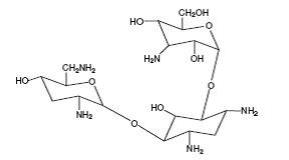
    BETHKIS is a sterile, clear, colorless to pale yellow, non-pyrogenic, aqueous solution with pH and salinity adjusted. BETHKIS is administered by a compressed air driven reusable nebulizer. The chemical formula for tobramycin is C
    The structural formula for tobramycin is:
    Tobramycin structural formula
    Each single-use 4 mL ampule of BETHKIS contains one 300 mg dose of tobramycin, with sodium chloride and sulfuric acid in water for injection. Sulfuric acid and sodium hydroxide are used, as needed, to adjust the pH to 5.0. Nitrogen is used for sparging, filling and pouching. The formulation contains no preservatives.
    6CLINICAL STUDIES
    Two, double-blind, randomized, placebo-controlled, parallel group clinical studies (Study 1 and Study 2), which randomized and dosed 306 patients, were conducted in cystic fibrosis patients with
    The compressors in the placebo-controlled studies and the bridging study differed from the PARI VIOS compressor to be used with BETHKIS. In vitro cascade impaction studies demonstrated that the various compressors used in the clinical trials delivered equivalent doses and respirable fractions of the to-be-marketed BETHKIS and TOBI with the marketed compressor (PARI VIOS) when used with the same nebulizer (PARI LC Plus Reusable nebulizer).
    All subjects enrolled in both efficacy studies had baseline FEV
    Study 1
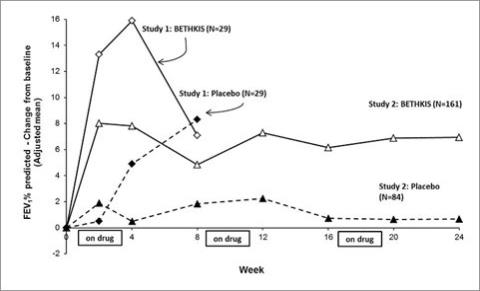
    Study 1 was a double-blind, single cycle study that randomized 59 patients to receive BETHKIS (n=29) or placebo (n=30) for one cycle of treatment (28 days on treatment followed by 28 days off treatment). All patients were ≤ 30 years of age (mean age 12.6 years) and 46% were females. All randomized patients were included in the primary analysis except for one patient who had missing baseline information.
    BETHKIS significantly improved lung function compared with placebo as measured by the absolute change in FEV
    Study 2
    Study 2 was a randomized, double-blind, 3-cycle, placebo-controlled trial. A total of 247 eligible patients were randomized 2:1 to receive three cycles of BETHKIS (n=161) or placebo (n=86). As in Study 1, each cycle comprised 28 days on treatment followed by 28 days off treatment. All patients were ≤46 years of age (mean age 14.8 years) and 44.9% were females. In this study, two randomized patients in the placebo group were not included in the primary efficacy analysis; one withdrew consent without taking any trial medication and the other withdrew due to an adverse drug reaction.
    BETHKIS significantly improved lung function compared with placebo as measured by the absolute change in FEV
    Figure 1: FEV1 % of Predicted Normal – Absolute Change from Baseline (Adjusted mean) - ITT Population
    Figure 1
    In Study 2, 9.9% of patients treated with BETHKIS and 24.7% of patients who received placebo had unplanned hospitalizations due to the disease.
    Also in Study 2, 6.2% of patients treated with BETHKIS and 16.5% of placebo patients received parenteral tobramycin.
    7REFERENCES
    1. Neu HC. Tobramycin: an overview. [Review]. J Infect Dis. 1976; Suppl 134:S3-19.
    2. Weber A, Smith A, Williams-Warren J, et al. Nebulizer delivery of tobramycin to the lower respiratory tract. Pediatr Pulmonol. 1994; 17(5):331-9.
    3. Clinical and laboratory Standards Institute (CLSI) Methods for Dilution Antimicrobial Susceptibility Tests for Bacteria that Grow Aerobically: Approved Standard -9
    4. CLSI Performance Standards for Antimicrobial Susceptibility Testing: 22
    5. CLSI Performance standards for Antimicrobial Disk Susceptibility Tests: Approved standard -11
    6. PARI Vios Aerosol Delivery System with LC Plus Nebulizer: Instructions for Use. PARI Respiratory Equipment, Inc. 2010; 310D0028 Rev A 6-10.
    8PATIENT COUNSELING INFORMATION
    Advise the patient to read the FDA-approved patient labeling (
    Information for Patients
    Information on the long term efficacy and safety of BETHKIS is limited. There is no information in patients with severe cystic fibrosis (FEV
    Patients should be advised to complete a full 28-day course of BETHKIS, even if they are feeling better. After 28 days of therapy, patients should stop BETHKIS therapy for the next 28 days, and then resume therapy for the next 28 day on and 28 day off cycle.
    For patients taking several different inhaled medications and/or performing chest physiotherapy, advise the patient regarding the order they should take the therapies. It is recommended that BETHKIS be taken last.
    BETHKIS is to be used with the PARI LC PLUS reusable nebulizer and the PARI VIOS air compressor. Refer to the manufacturer’s instructions for care and use of the nebulizer and compressor.
    8.1Ototoxicity
    Inform patients that ototoxicity, as measured by complaints of hearing loss or tinnitus, was reported by patients treated with tobramycin. Physicians should consider an audiogram at baseline, particularly for patients at increased risk of auditory dysfunction.
    If a patient reports tinnitus or hearing loss during BETHKIS therapy, the physician should refer that patient for audiological assessment.
    Patients should be reminded that vestibular toxicity may manifest as vertigo, ataxia, or dizzines.
    8.2Bronchospasm
    Inform patients that bronchospasm can occur with inhalation of tobramycin.
    8.3Risks Associated with Aminoglycosides
    Inform patients of adverse reactions associated with aminoglycosides such as nephrotoxicity and neuromuscular disorders.
    8.4Laboratory Tests
    Inform patients of the need to monitor hearing, serum concentrations of tobramycin, or renal function as necessary during treatment with BETHKIS.
    8.5Embryo-Fetal Toxicity
    Inform patients that aminoglycosides can cause fetal harm when administered to a pregnant woman. Advise them to inform their doctor if they are pregnant, become pregnant, or plan to become pregnant.
    8.6Administration
    Patients should be informed about what to do in the event they miss a dose of BETHKIS:
    • In case a dose of BETHKIS is missed and there are at least 6 hours until the next dose, patients should be instructed to take the prescribed dose of BETHKIS as soon as possible.  Otherwise, the missed dose should not be taken and the patient should resume the usual dosing schedule.
    • Patients should be advised to contact their healthcare provider if they have questions.
    8.7Storage Instructions
    You should store BETHKIS ampules in a refrigerator (36-46 °F or 2-8 °C). However, when you don’t have a refrigerator available (e.g., transporting your BETHKIS), you may store the foil pouches (opened or unopened) at room temperature (up to 77 °F/25 °C) for up to 28 days.
    BETHKIS is light sensitive; unopened ampules should be returned to the foil pouch. Avoid exposing BETHKIS ampules to intense light. Unrefrigerated BETHKIS, which is normally colorless to pale yellow, may darken with age; however, the color change does not indicate any change in the quality of the product.
    You should not use BETHKIS if it is cloudy, if there are particles in the solution, or if it has been stored at room temperature for more than 28 days. You should not use BETHKIS beyond the expiration date stamped on the ampule.
    Nebulizers and Compressors: 1-800-327-8632
    BETHKIS: 1-888-661-9260
    U.S. Patent 6,987,094.
    Manufactured for Chiesi USA, Inc.
    by Woodstock Sterile Solutions, Inc.
    Woodstock, Illinois 60098
    © Chiesi USA, Inc. 2023
    Printed in USA
    CTB-004-1022-07-SPL
    Bethkis has been selected.