Coronary Heart Disease Treatments
Find Coronary Heart Disease Treatments
TC99M Sestamibi
What is 99M Sestamibi (TC99M Sestamibi)?
Approved To Treat


Related Clinical Trials
Summary: To evaluate the diagnostic performance of Tc99m sestamibi (MBI) compared to breast MRI in women who are at high risk for developing breast cancer. To assess the relationship of tumor size, histologic subtype and location of lesion and how it affects lesion conspicuity and sensitivity in MBI detected cancers.
Summary: This phase II study evaluates F-18 tetrafluoroborate (18F-TFB) PET/CT scan in patients with differentiated thyroid cancer. Diagnostic imaging is necessary for planning treatment, monitoring therapy response, and identifying sites of recurrent or metastatic disease in differentiated thyroid cancer. 18F-TFB PET/CT may accurately detect recurrent and metastatic thyroid cancer lesions, with the potent...
Summary: In patients who have undergone surgery for differentiated thyroid cancer and who demonstrate elevated serum Tg and/or ATg levels during follow-up after radioactive iodine therapy, lesion detection is performed using neck ultrasonography, thorax CT, and F-18 FDG PET/CT. Diagnostic whole-body scanning with low-dose I-131 is not routinely recommended in follow-up due to its low sensitivity and specif...
Related Latest Advances
Brand Information
- ten-minute lateral image of breast with abnormality
- ten-minute lateral image of contralateral breast
- ten-minute anterior image of both breasts
The potential for cracking and significant contamination exists whenever vials containing radioactive material are heated.
This product is not to be used with the Recon-o-stat (thermal cycler) due to smaller vial size requirements of this heating device.
Product should be used within six (6) hours after preparation.
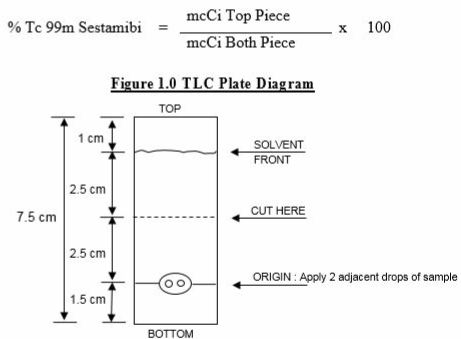
Final product with radiochemical purity of at least 90% was used in the clinical trials that established safety and effectiveness. The radiochemical purity was determined by the following method.
- Obtain a Baker-Flex Aluminum Oxide coated, plastic TLC plate, #1 B-F, pre-cut to 2.5cm x 7.5cm.
- Dry the plate or plates at 100°C for 1 hour and store in a desiccator. Remove pre-dried plate from the desiccator just prior to use.
- Apply 1 drop of ethanol* using a 1 mL syringe with a 22 to 26 gauge needle, 1.5cm from the bottom of the plate. THE SPOT SHOULD NOT BE ALLOWED TO DRY.
- Add 2 drops of Technetium Tc 99m Sestamibi solution, side by side on top of the ethanol* spot. Return the plate to a desiccator and allow the sample spot to dry (typically 15 minutes).
- The TLC tank is prepared by pouring ethanol* to a depth of 3 to 4 mm. Cover the tank and let it equilibrate for ~10 minutes.
- Develop the plate in the covered TLC tank in ethanol* for a distance of 5 cm from the point of application.
- Cut the TLC plate 4 cm from the bottom and measure the Tc 99m activity in each piece by appropriate radiation detector.
- Calculate the % Tc 99m Sestamibi as:
- Tetrakis (2-methoxy isobutyl isonitrile) Copper (I) tetrafluoroborate - 1 mg
- Sodium Citrate Dihydrate - 2.6 mg
- L-Cysteine Hydrochloride Monohydrate - 1 mg
- Mannitol - 20 mg
- Stannous Chloride, Dihydrate, minimum (SnCl
- Stannous Chloride, Dihydrate (SnCl
- Tin Chloride (stannous and stannic) Dihydrate, maximum (as SnCl
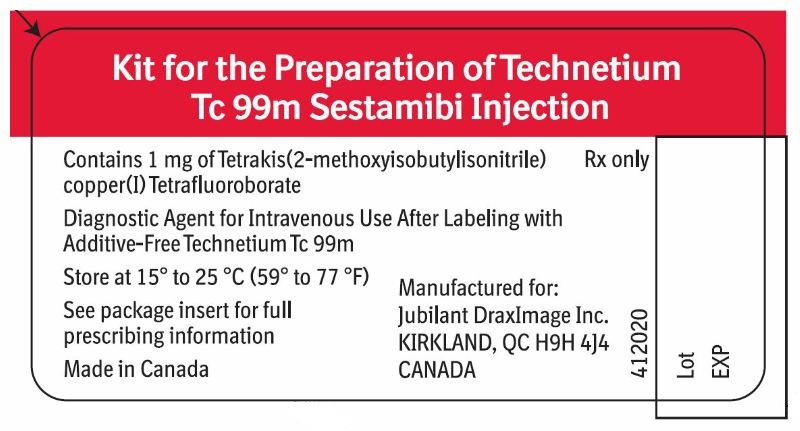
WARNING: Radiopharmaceuticals should be used by persons who are qualified by specific training in the safe use and handling of radionuclides and whose experience and training have been approved by the appropriate governmental agency authorized to license the use of radionuclides.
CONTENTS AND STORAGE CONDITIONS:10 Vials each containing sterile and non-pyrogenic:
1mg of Tetrakis(2-methoxyisobutylisonitrile)copper (I) Tetrafluoroborate, 0.075mg of Stannous Chloride Dihydrate, 1mg of L-Cysteine Hydrochloride Monohydrate, 2.6mg of Sodium Citrate Dihydrate and 20mg of Mannitol.
10 Radioactive Material Caution labels
10 Radioassay information labels with radiation symbol
1 Package Insert
Store at 15 °C to 25°C (59 °F to 77°F) See Package Insert for dosage information. Reconstitute with additive-free Tc 99m and store at 15° to 25°C (59° to 77°F). Use within 6 hours of reconstitution.
CAUTION
RADIOACTIVE
MATERIAL
Rx Only
Technetium Tc 99m
Sestamibi Injection
Contents
Sodium Pertechnetate Tc 99m Injection
Tetrakis (2-methoxyisobutylisonitrile)
copper(I) tetrafluoroborate - 1mg
Stannous Chloride
Dihydrate - 0.075mg
L-Cysteine Hydrochloride
Monohydrate - 1mg
Sodium Citrate Dihydrate - 2.6mg
Mannitol - 20mg
Store at 15o to 25oC (59o to 77oF).
Use within 6 hours of reconstitution.
216511
MBq (mCi) Tc 99m/mL
Volume.................mL
Time/Date.................
Expiration Time.........
Lot No......................
Technetium Tc 99m
Sestamibi Injection
216511