Coronary Heart Disease Treatments

Find Coronary Heart Disease Treatments

Brand Name

BiDil

Generic Name
Isosorbide
View Brand Information
FDA approval date: December 01, 1978
Classification: Nitrate Vasodilator
Form: Tablet

What is BiDil (Isosorbide)?

Isosorbide dinitrate tablets are indicated for the prevention of angina pectoris due to coronary artery disease. The onset of action of immediate-release oral isosorbide dinitrate is not sufficiently rapid for this product to be useful in aborting an acute anginal episode.
Save this treatment for later
Sign Up
Not sure about your diagnosis?
Check Your Symptoms
Tired of the same old research?
Check Latest Advances

Related Clinical Trials

Antiplatelet Therapy and Endothelial-stabilizing Agents in Cerebral Small Vessel Diseases

Summary: Cerebral small vessel disease (cSVD) is a common accompaniment of aging. Recent small subcortical (or lacunar) infarcts (i.e. symptomatic cSVD) and white matter hyperintensities are typical cSVD lesions on neuroimaging. cSVD causes about a quarter of ischaemic strokes and related with cognitive dysfunction. However, few studies are available so far to especially explore the treatment of cSVD. Endo...

Vasodilation or Loop-diuretics for Initial Treatment of Pulmonary Edema or Congestion Due to Acute Heart Failure - a Randomized Placebo-controlled Trial

Background: Intravenous (IV) loop-diuretics have been a key component in treating pulmonary edema since the nineteen sixties and has a Class 1 recommendation in the 2021 European Society of Cardiology guidelines for heart failure. Conversely, vasodilation was downgraded in the treatment of acute heart failure due to a lack of trials that compare vasodilation with loop-diuretics in a hyperacute clinical settin...

Diuretics vs. Afterload Reduction for Treatment of HeartLogic Alerts (DART-HA)

Summary: The DART-HA study is a single-center, open label, trial intended to evaluate the clinical efficacy of standard treatment options for congestive heart failure (observation, diuretic or afterload reduction therapy) in patients without new symptoms who have developed abnormalities of the HeartLogic heart failure diagnostic feature.

Brand Information

BiDil (Hydralazine hydrochloride and Isosorbide dinitrate)
1DOSAGE AND ADMINISTRATION
BiDil should be initiated at a dose of one BiDil Tablet, three times a day. Titrate to a maximum of two tablets three times daily, if tolerated.
Although titration of BiDil can be rapid (3-5 days), some patients may experience side effects and may take longer to reach their maximum tolerated dose. The dosage may be decreased to as little as one-half BiDil Tablet three times a day if intolerable side effects occur. Efforts should be made to titrate up as soon as side effects subside.
2DOSAGE FORMS AND STRENGTHS
The BiDil (20 mg isosorbide dinitrate and 37.5 mg hydralazine hydrochloride) tablets are orange, biconvex, approximately 8 mm in diameter, scored, film-coated, and debossed with "20" on one side over the score and "
3CONTRAINDICATIONS
BiDil is contraindicated in patients who are allergic to organic nitrates.
Do not use BiDil in patients who are taking PDE-5 inhibitors, such as avanafil, sildenafil, tadalafil, or vardenafil. Concomitant use can cause severe hypotension, syncope, or myocardial ischemia
Do not use BiDil in patients who are taking the soluble guanylate cyclase (sGC) stimulator riociguat. Concomitant use can cause hypotension.
4OVERDOSAGE
The signs and symptoms of overdosage with BiDil are expected to be those of excessive pharmacologic effect, i.e., vasodilatation, reduced cardiac output and hypotension, and signs and symptoms include headache, confusion, tachycardia, and generalized skin flushing. Complications can include myocardial ischemia and subsequent myocardial infarction, cardiac arrhythmia, and profound shock. Syncope, coma and death may ensue without appropriate treatment. 
5DESCRIPTION
BiDil is a fixed-dose combination of isosorbide dinitrate, a vasodilator with effects on both arteries and veins, and hydralazine hydrochloride, a predominantly arterial vasodilator.
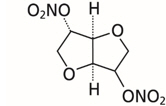
Isosorbide dinitrate is described chemically as 1,4:3,6-dianhydro-D-glucitol dinitrate and its structural formula is:
structure1
Isosorbide dinitrate is a white to off-white, crystalline powder with the empirical formula C
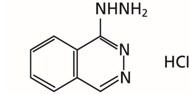
Hydralazine hydrochloride is described chemically as 1-hydrazinophthalazine monohydrochloride, and its structural formula is:
structure2
Hydralazine hydrochloride is a white to off-white, crystalline powder with the empirical formula C
Each BiDil Tablet for oral administration contains 20 mg of isosorbide dinitrate and 37.5 mg of hydralazine hydrochloride.
The inactive ingredients in BiDil tablets include: anhydrous lactose, microcrystalline cellulose, sodium starch glycolate, colloidal silicon dioxide, magnesium stearate, hypromellose, FD&C Yellow No. 6 aluminum lake, polyethylene glycol, titanium dioxide, polysorbate 80.
6CLINICAL STUDIES
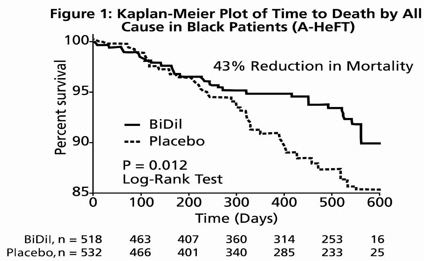
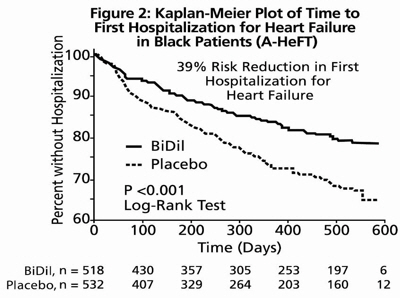
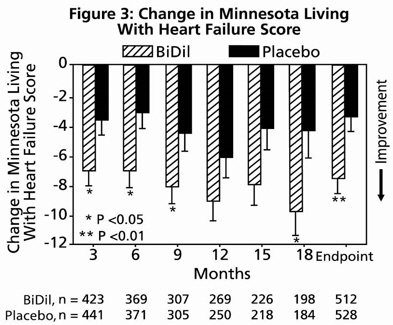
BiDil or a combination of isosorbide dinitrate and hydralazine hydrochloride was studied in two placebo-controlled clinical trials in 1,692 patients with mild to severe heart failure (mostly NYHA class II and III) and one active control trial (vs. enalapril) in 804 patients. The results of the trials follow: 
figure-1
figure-2
figure-3
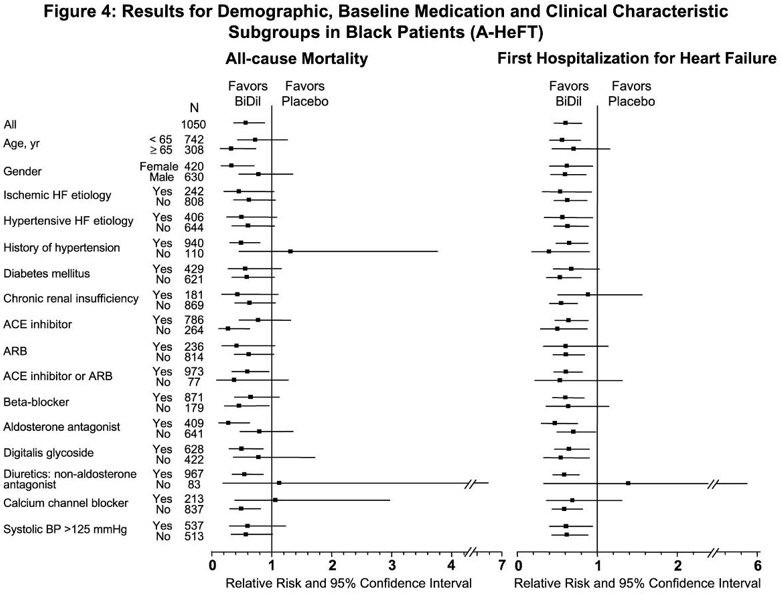
Effects on survival and hospitalization for heart failure were similar in subgroups by age, gender, baseline disease, and use of concomitant medications, as shown in Figure 4.
figure-4
Patients treated with BiDil in the A-HeFT study had randomly measured blood pressures on average 3/3 mmHg lower than did patients on placebo. The contribution of the difference in blood pressure to the overall outcome difference is unknown. Whether both hydralazine and isosorbide dinitrate contribute to the overall outcome difference has not been studied in outcome trials. Isosorbide dinitrate and hydralazine have not been systematically studied for the treatment of heart failure as separate agents, and neither drug is indicated for heart failure.
7HOW SUPPLIED/STORAGE AND HANDLING
BiDil Tablets contain 20 mg of isosorbide dinitrate and 37.5 mg of hydralazine hydrochloride. They are biconvex, approximately 8 mm in diameter, scored, film-coated, orange tablets debossed "20" on one side over the score and "
  • NDC 24338-010-09: Bottles of 90
Store at 25°C (77°F), excursions permitted to 15-30°C (59-86°F). [See USP Controlled Room Temperature.]  Keep bottles tightly closed.  
8PATIENT COUNSELING INFORMATION
Patients should be informed of possible side effects and advised to take the medication regularly and continuously as directed. 
Azurity Pharmaceuticals, Inc.
BDL-PI-07
CIA75474J
9PRINCIPAL DISPLAY PANEL - 90 Tablet Bottle Label
NDC 24338-010-09
BiDil
20 mg/37.5 mg
Store at room temperature 15°C - 30°C (59°F - 86°F)
BDL-TL-09-01  Rev. 11/25
Rx only
bidil-20mg