Cystinuria Treatments
Find Cystinuria Treatments
Generic Name
Tiopronin
Brand Names
Thiola, Venxxiva
FDA approval date: August 11, 1988
Classification: Reducing and Complexing Thiol
Form: Tablet
What is Thiola (Tiopronin)?
THIOLA EC is indicated, in combination with high fluid intake, alkali, and diet modification, for the prevention of cystine stone formation in adults and pediatric patients 20 kg and greater with severe homozygous cystinuria, who are not responsive to these measures alone. THIOLA EC is a reducing and complexing thiol indicated, in combination with high fluid intake, alkali, and diet modification, for the prevention of cystine stone formation in adults and pediatric patients 20 kg and greater with severe homozygous cystinuria, who are not responsive to these measures alone.
Approved To Treat

Save this treatment for later
Not sure about your diagnosis?
Tired of the same old research?
Related Clinical Trials
There is no clinical trials being done for this treatment
Related Latest Advances
Brand Information
Thiola EC (tiopronin)
1INDICATIONS AND USAGE
THIOLA EC is indicated, in combination with high fluid intake, alkali, and diet modification, for the prevention of cystine stone formation in adults and pediatric patients 20 kg and greater with severe homozygous cystinuria, who are not responsive to these measures alone.
2DOSAGE FORMS AND STRENGTHS
Tablets for oral use:
3CONTRAINDICATIONS
THIOLA EC is contraindicated in patients with hypersensitivity to tiopronin or any other components of THIOLA EC
4ADVERSE REACTIONS
The following adverse reactions are discussed in greater detail in other sections of the labeling:
- Proteinuria
- Hypersensitivity
4.1Clinical Trials Experience
Because clinical trials are conducted under widely varying conditions, the adverse reaction rates observed in the clinical trials of the drug cannot be directly compared to rates in the clinical trials of another drug and may not reflect the rates observed in practice.
Adverse reactions occurring at an incidence of ≥5% in an uncontrolled trial in 66 patients with cystinuria age 9 to 68 years are shown in the table below. Patients in group 1 had previously been treated with d-penicillamine; those in group 2 had not. Of those patients who had stopped taking d-penicillamine due to toxicity (34 out of 49 patients in group 1), 22 were able to continue treatment with THIOLA. In those without prior history of d-penicillamine treatment, 6% developed reactions of sufficient severity to require THIOLA withdrawal.
Table 1presents adverse reactions ≥5% in either treatment group occurring in this trial.
Taste Disturbance
A reduction in taste perception may develop. It is believed to be the result of chelation of trace metals by tiopronin. Hypogeusia is often self-limited.
A reduction in taste perception may develop. It is believed to be the result of chelation of trace metals by tiopronin. Hypogeusia is often self-limited.
4.2Postmarketing Experience
Adverse reactions have been reported from the literature, as well as during post-approval use of THIOLA. Because the post-approval reactions are reported voluntarily from a population of uncertain size, it is not always possible to reliably estimate their frequency or establish a causal relationship to THIOLA exposure.
Adverse reactions reported during the postmarketing use of THIOLA are listed by body system in
5OVERDOSAGE
There is no information on overdosage with tiopronin.
6DESCRIPTION
THIOLA EC (tiopronin) delayed-release tablets are a reducing and cystine-binding thiol drug (CBTD) for oral use. Tiopronin is N‑(2‑Mercaptopropionyl) glycine and has the following structure:
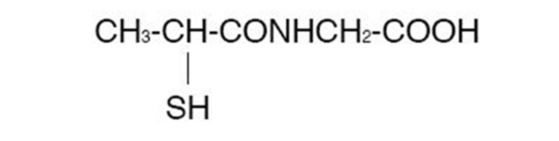
Tiopronin has the empirical formula C
Tiopronin is a white crystalline powder, which is freely soluble in water.
Each THIOLA EC tablet contains 100 or 300 mg of tiopronin. The inactive ingredients in THIOLA EC tablets include lactose monohydrate, hydroxypropyl cellulose, hydroxypropyl cellulose (low substitute), magnesium stearate, hydroxypropyl methylcellulose E5, methacrylic acid: ethyl acrylate copolymer (Eudragit L 100-55), talc, triethyl citrate.
7HOW SUPPLIED/STORAGE AND HANDLING
100 mg delayed-release, round, white to off-white tablet imprinted with “T1” on one side with red ink and blank on the other side: Bottles of 300
300 mg delayed-release, round, white to off-white tablet imprinted with “T3” on one side with red ink and blank on the other side: Bottles of 90
Store at 25°C (77°F); excursions permitted to 15-30°C (59-86°F)
8PATIENT COUNSELING INFORMATION
Administration Instructions
For patients who cannot swallow the tablet whole, the THIOLA EC tablets can be crushed and mixed with applesauce. See Dosage and Administration ( for preparation and administration instructions.
For patients who cannot swallow the tablet whole, the THIOLA EC tablets can be crushed and mixed with applesauce. See Dosage and Administration ( for preparation and administration instructions.
Lactation
Advise women that breastfeeding is not recommended during treatment with THIOLA EC [see Use in Specific Populations ( .
Advise women that breastfeeding is not recommended during treatment with THIOLA EC [see Use in Specific Populations ( .

Manufactured and packaged by Mission Pharmacal Company, San Antonio, TX 78230 1355
Copyright© 2024 Mission Pharmacal Company.
L090201R0824
THL_T13768R0924