Brand Name

Beovu

Generic Name
Brolucizumab
View Brand Information
FDA approval date: July 26, 2018
Form: Injection

What is Beovu (Brolucizumab)?

BEOVU ® is indicated for the treatment of: BEOVU is a human vascular endothelial growth factor inhibitor indicated for the treatment of: Neovascular Age-Related Macular Degeneration .
Save this treatment for later
Sign Up
Not sure about your diagnosis?
Check Your Symptoms
Tired of the same old research?
Check Latest Advances

Related Clinical Trials

Treatment of Severe Diabetic Macular Oedema With Anti-vascular Endothelial Growth Factor (Anti-VEGF) Monotherapy vs Anti-VEGF Followed by Subthreshold Micropulse Laser When the Thickness of the Central Retina Goes Below 400 Microns: Pragmatic Randomised Equivalence Trial

Summary: The macula is the centre of the retina; it gives central sight, colour and fine detail. People with diabetes may develop diabetic macular oedema (DMO). In DMO, fluid leaks from blood vessels and builds up at the macula, causing sight loss. DMO can be mild or severe; this is determined by measuring, in microns (µm), how thick the macula is. One µm is one-thousandth of a millimetre. People presentin...

Regulatory Post-Marketing Surveillance (rPMS) Study for Brolucizumab(Beovu ® Injection, Beovu ®Prefilled Syringe)

Summary: This study is an open-label, multicenter, single-arm, observational post-marketing surveillance.

Efficacy of Switching to Aflibercept 8mg in Patients with Neovascular AMD Showing Limited Response to Faricimab or Aflibercept 2mg

Summary: The treatment landscape for neovascular AMD has evolved with various anti-VEGF agents since 2006. Ranibizumab initially led the way, but its limited efficacy in reducing retinal edema paved the way for aflibercept in 2011, which became globally popular for its effectiveness and safety. Yet, aflibercept did not fully meet all patients' needs. In 2019, brolucizumab showed promising anatomical result...

Brand Information

BEOVU (brolucizumab)
1INDICATIONS AND USAGE
BEOVU
2DOSAGE FORMS AND STRENGTHS
BEOVU is a clear to slightly opalescent and colorless to slightly brownish-yellow solution available as:
  • Intravitreal injection: 6 mg/0.05 mL in a single-dose pre-filled syringe.
  • Intravitreal injection: 6 mg/0.05 mL in a single-dose vial.
3ADVERSE REACTIONS
The following potentially serious adverse reactions are described elsewhere in the labeling:
  • Hypersensitivity
  • Endophthalmitis and Retinal Detachment
  • Retinal Vasculitis and/or Retinal Vascular Occlusion
  • Increase in Intraocular Pressure
  • Thromboembolic Events
3.1Clinical Trials Experience
Because clinical trials are conducted under widely varying conditions, adverse reaction rates observed in one clinical trial of a drug cannot be directly compared with rates in the clinical trials of the same or another drug and may not reflect the rates observed in practice.
A total of 1,646 patients treated with brolucizumab constituted the safety population in four Phase 3 studies. Among these, 1,098 patients were treated with the recommended dose of 6 mg.
A total of 1,088 patients treated with brolucizumab, constituted the safety population in the two controlled neovascular AMD Phase 3 studies (HAWK and HARRIER) with a cumulative 96-week exposure to BEOVU, and 730 patients treated with the recommended dose of 6 mg
In clinical trials, scleritis and episcleritis were reported (incidence < 1%).
In a clinical study (MERLIN), patients with nAMD who received BEOVU every 4-week maintenance dosing experienced a higher incidence of intraocular inflammation (including retinal vasculitis) and retinal vascular occlusion than patients who received BEOVU every 8 or 12-week maintenance dosing in the clinical studies (HAWK and HARRIER). The interval between two BEOVU doses during maintenance treatment should not be less than 8 weeks.
3.2Immunogenicity
As with all therapeutic proteins, there is a potential for an immune response in patients treated with BEOVU. The immunogenicity of BEOVU was evaluated in serum samples. The immunogenicity data reflect the percentage of patients whose test results were considered positive for antibodies to BEOVU in immunoassays. The detection of an immune response is highly dependent on the sensitivity and specificity of the assays used, sample handling, timing of sample collection, concomitant medications, and underlying disease. For these reasons, comparison of the incidence of antibodies to BEOVU with the incidence of antibodies to other products may be misleading.
Anti-brolucizumab antibodies were detected in the pre-treatment sample of 36% to 64% of treated naive patients. After initiation of dosing, anti-brolucizumab antibodies were detected in at least one serum sample in 53% to 76% of patients treated with BEOVU. Intraocular inflammation was observed in 6% of patients with anti-brolucizumab antibodies detected during dosing with BEOVU in clinical trials. Retinal vasculitis and/or retinal vascular occlusion, typically in the presence of intraocular inflammation, are immune-mediated adverse events related to exposure to BEOVU. This treatment-emergent antibody response may develop following the first intravitreal injection. Anti-brolucizumab antibodies were not associated with an impact on clinical efficacy.
4DESCRIPTION
Brolucizumab-dbll is a recombinant human vascular endothelial growth factor inhibitor. Brolucizumab-dbll is a humanized monoclonal single-chain Fv (scFv) antibody fragment. Brolucizumab-dbll has a molecular weight of ~26 kilodaltons and is produced in
BEOVU (brolucizumab-dbll) injection is a sterile, clear to slightly opalescent, colorless to slightly brownish-yellow solution in a single-dose pre-filled syringe or a single-dose vial for intravitreal administration. Each single-dose pre-filled syringe and vial is designed to deliver 0.05 mL of solution containing 6 mg brolucizumab-dbll, polysorbate 80 (0.02%), sodium citrate (10 mM), sucrose (5.8%), and Water for Injection, USP and with a pH of approximately 7.2. This product does not contain an antimicrobial preservative.
5PATIENT COUNSELING INFORMATION
Advise patients that in the days following BEOVU administration, patients are at risk of developing endophthalmitis, retinal detachment, retinal vasculitis and/or retinal vascular occlusion. If the eye becomes red, sensitive to light, painful, or if a patient develops any change in vision, instruct the patient to seek immediate care from an ophthalmologist
Patients may experience temporary visual disturbances after an intravitreal injection with BEOVU and the associated eye examination
Manufactured by:
© Novartis
T2024-60
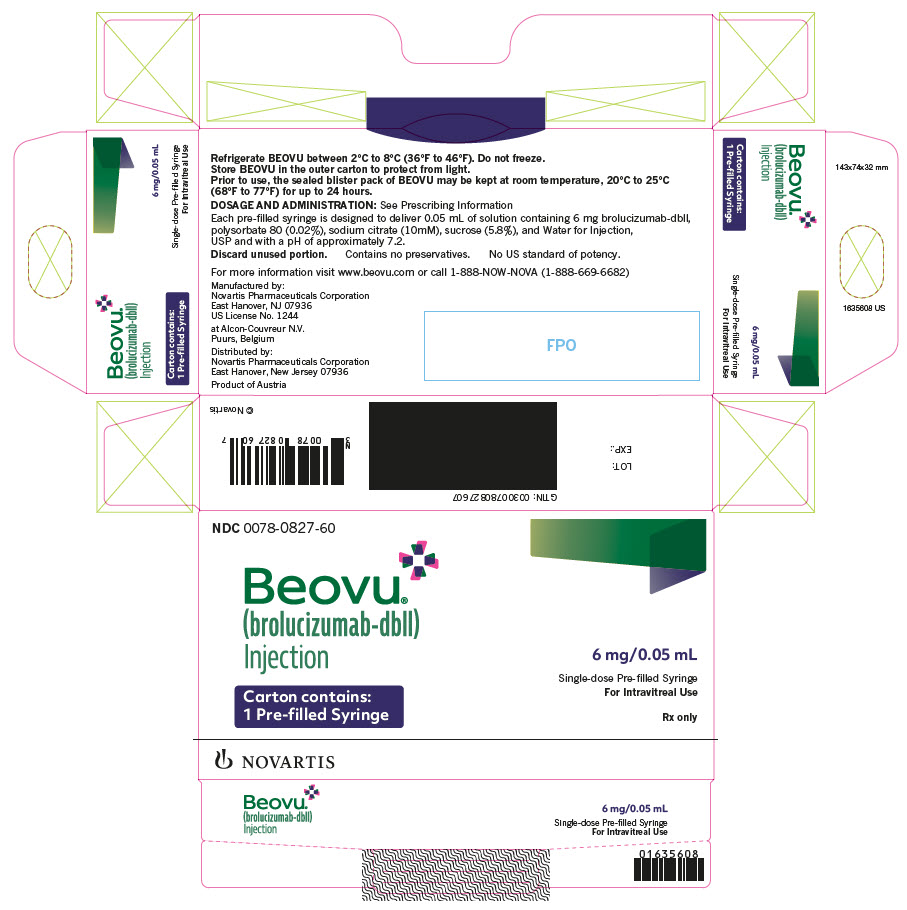
6PRINCIPAL DISPLAY PANEL
NDC 0078-0827-60
Beovu
(brolucizumab-dbll)
6 mg/0.05 mL
Single-dose Pre-filled Syringe
For Intravitreal Use
Carton contains:
1 Pre-filled Syringe
Rx only
NOVARTIS
PRINCIPAL DISPLAY PANEL
								NDC 0078 0827 60
								Beovu
								(brolucizumab-dbll) Injection
								6 mg/0.05 mL
								Single-dose Pre-filled Syringe
								For Intravitreal Use
								Carton contains:
								1 Pre-filled Syringe
								Rx only
								NOVARTIS