Diabetic Macular Edema (DME) Treatments
Find Diabetic Macular Edema (DME) Treatments
Vabysmo
What is Vabysmo (Faricimab)?
A diagnosis of a retinal condition like wet age-related macular degeneration (AMD) or diabetic macular edema (DME) can be frightening. These conditions affect the macula, the part of your eye responsible for sharp, central vision, making everyday activities like reading, driving, or recognizing faces difficult. For years, treatment has involved frequent injections into the eye to preserve sight. However, newer therapies are changing this experience. One of the latest advancements is Vabysmo (faricimab-svoa).
Vabysmo is a next-generation prescription medication for serious retinal diseases. It is a biologic, meaning it’s a complex protein derived from living cells, and it belongs to an innovative class of drugs called bispecific antibodies. It is the first and only injectable eye medication that works by targeting two distinct disease pathways. For many patients, this dual-action approach may lead to longer-lasting results, potentially reducing the frequency of eye injections needed to protect their vision.
What does Vabysmo do?
Vabysmo is approved by the U.S. Food and Drug Administration (FDA) to treat two of the leading causes of vision loss in adults:
- Wet Age-Related Macular Degeneration (nAMD): An advanced form of AMD where abnormal, leaky blood vessels grow under the retina, causing rapid and severe central vision loss.
- Diabetic Macular Edema (DME): A complication of diabetes where damaged blood vessels leak fluid into the macula, causing swelling and blurred vision.
The primary goal of treatment with Vabysmo is to stop further vision loss and, in many cases, improve vision. Patients can expect a reduction in the fluid that damages the retina. Clinical trials have shown Vabysmo to be highly effective, with many patients achieving and maintaining vision gains while on treatment intervals of up to four months apart, after an initial series of doses (Genentech, Inc., 2023).
How does Vabysmo work?
To understand how Vabysmo works, it helps to know what causes the damage in wet AMD and DME. Two key proteins play a major role in these conditions:
- Vascular Endothelial Growth Factor-A (VEGF-A): This protein signals the body to create new blood vessels. In excess, it causes abnormal, leaky vessels to grow in the eye.
- Angiopoietin-2 (Ang-2): This protein makes blood vessels unstable, further increasing leakage and inflammation.
Think of these two proteins working together to create a “perfect storm” of leakage in your retina. Older treatments, known as anti-VEGF therapies, focused only on blocking VEGF-A. Vabysmo is different because it is a bispecific antibody. This means a single molecule of Vabysmo is engineered to capture and neutralize both VEGF-A and Ang-2 at the same time.
By simultaneously blocking these two pathways, Vabysmo provides a more comprehensive approach. It not only stops the growth of leaky blood vessels but also helps to stabilize them, reducing inflammation more effectively. This dual mechanism is believed to be why the treatment effects can last longer, giving patients more time between injections.
Vabysmo side effects
The most common side effects of Vabysmo are related to the injection procedure rather than the drug. Your eye doctor takes many precautions to minimize discomfort and risk.
Common side effects may include:
- Subconjunctival hemorrhage: A harmless but visible spot of blood on the white of the eye.
- Eye pain or discomfort immediately after the injection.
- Floaters or specks in your vision.
- Feeling something is in your eye.
- Temporary blurry vision.
Serious side effects are rare but require immediate medical attention. These include complications from the injection, such as:
- Endophthalmitis: A severe infection inside the eye.
- Retinal detachment: When the retina pulls away from the back of the eye.
- A significant increase in eye pressure
Do not use Vabysmo with an active eye infection. Report increased eye pain, significant vision changes, severe redness, or light sensitivity to your retina specialist post-injection immediately (American Academy of Ophthalmology, 2023).
Vabysmo dosage
Vabysmo is administered as an intravitreal injection, which is a shot given directly into the vitreous, the jelly-like substance that fills the eye. A retina specialist in an office setting performs this procedure. Your eye will be numbed with anesthetic drops before the injection to ensure you feel minimal discomfort.
Treatment plans are customized based on your condition and eye response. You will receive four monthly injections. Your doctor will then use OCT scans to check for fluid resolution. Depending on the results, injections may be extended every 16 weeks. Regular follow-ups monitor vision, retina health, treatment effectiveness, and injection schedule.
Does Vabysmo have a generic version?
No, there is currently no generic or biosimilar version of Vabysmo (faricimab-svoa). However, international versions may exist in other markets. Vabysmo is a complex biologic medication protected by patents. The development of a biosimilar, the equivalent of a generic for a biologic drug, is a highly regulated and lengthy process. Therefore, Vabysmo is only available under its brand name.
Conclusion
Vabysmo represents a major step forward in the treatment of wet AMD and diabetic macular edema. As the first dual-action therapy, it offers a powerful way to protect and improve vision by targeting two key drivers of these diseases. For patients, its most significant benefit is the potential for a less burdensome treatment schedule, requiring fewer trips to the doctor for eye injections over the course of a year.
While any eye injection comes with risks, Vabysmo has a well-established safety profile when administered by a qualified retina specialist. If you or a loved one is living with a retinal condition, discussing Vabysmo with your eye doctor can help you understand if this innovative therapy is the right choice for your journey toward preserving sight.
References
- American Academy of Ophthalmology. (2023). What Is Vabysmo? Retrieved from https://www.aao.org/eye-health/drugs/vabysmo-faricimab-svoa-injection
- Genentech, Inc. (2023). VABYSMO® (faricimab-svoa) Prescribing Information. U.S. Food and Drug Administration. Retrieved from https://www.accessdata.fda.gov/drugsatfda_docs/label/2023/761235s005lbl.pdf
Approved To Treat
Top Global Experts


Related Clinical Trials
Summary: The purpose of this study is to evaluate the safety, tolerability, Pharmacodynamics (PD), and Pharmacokinetics (PK) of multiple doses of RO7823653 in participants with DME, administered by intravitreal (IVT) injection as monotherapy and co-administered with faricimab.
Summary: This randomized controlled trial will evaluate the effect of intravitreal faricimab or fluocinolone acetonide (FAc) intravitreal implant compared with observation on long-term visual acuity following treatment of choroidal melanoma with iodine-125 plaque brachytherapy.
Summary: This randomized trial will compare treatment strategies for proliferative diabetic retinopathy (PDR). Participants will receive either combination a of faricimab + PRP or vitrectomy + endolaser. The participants will be followed for 3 years. The study will evaluate long-term visual acuity as well as differences in number of injections, procedures, and complications during follow-up (after completi...
Related Latest Advances
Brand Information
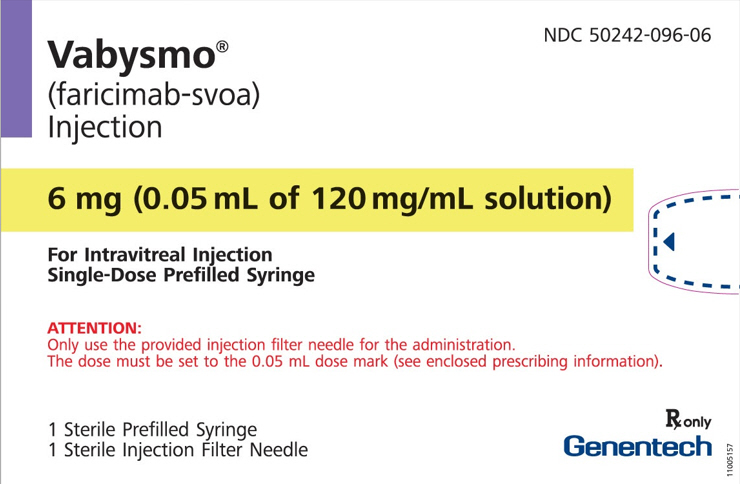
- Injection: 6 mg (0.05 mL of 120 mg/mL solution) in a single-dose prefilled glass syringe
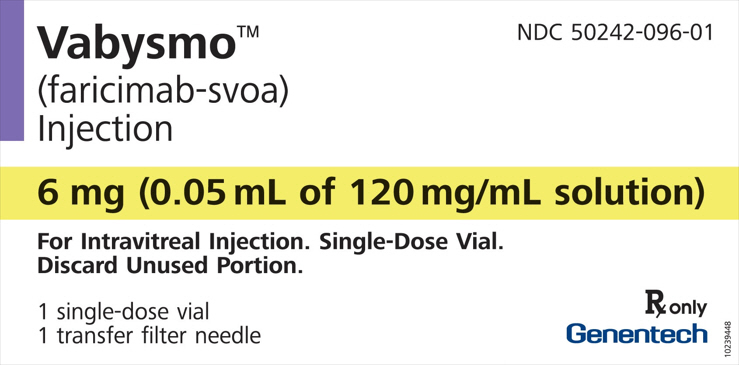
- Injection: 6 mg (0.05 mL of 120 mg/mL solution) in a single-dose glass vial
- Hypersensitivity
- Endophthalmitis and retinal detachments
- Increase in intraocular pressure
- Thromboembolic events
- Retinal Vasculitis and/or Retinal Vascular Occlusion