Embryonal Tumor with Multilayered Rosettes Treatments

Find Embryonal Tumor with Multilayered Rosettes Treatments

Brand Name

Iwilfin

Generic Name
Eflornithine
View Brand Information
FDA approval date: January 15, 2024
Classification: Antiprotozoal
Form: Tablet

What is Iwilfin (Eflornithine)?

IWILFIN is indicated to reduce the risk of relapse in adult and pediatric patients with high-risk neuroblastoma who have demonstrated at least a partial response to prior multiagent, multimodality therapy including anti-GD2 immunotherapy. IWILFIN is an ornithine decarboxylase inhibitor indicated to reduce the risk of relapse in adult and pediatric patients with high-risk neuroblastoma who have demonstrated at least a partial response to prior multiagent, multimodality therapy including anti-GD2 immunotherapy.
Save this treatment for later
Sign Up
Not sure about your diagnosis?
Check Your Symptoms
Tired of the same old research?
Check Latest Advances

Related Clinical Trials

Phase II Trial of Eflornithine/DFMO as Maintenance Therapy for Molecular High Risk/Very High Risk and Relapsed/Refractory Medulloblastoma

Summary: Difluoromethylornithine (DFMO) will be used in an open label, multicenter, study as Maintenance Therapy for Molecular High Risk/Very High Risk and Relapsed/Refractory Medulloblastoma.

Phase II Trial of Eflornithine (DFMO) and Etoposide for Relapsed/Refractory Neuroblastoma

Summary: Difluoromethylornithine (DFMO) will be used in an open label, multicenter, study in combination with etoposide for subjects with relapsed/refractory neuroblastoma.

A Dose Escalation Study Using Eflornithine (DFMO) and AMXT 1501 Followed by a Randomized Controlled Trial of DFMO With or Without AMXT 1501 for Neuroblastoma, CNS Tumors, and Sarcomas

Summary: The purpose of this study is to evaluate the investigational oral drug AMXT 1501 in combination with oral eflornithine (DFMO). An investigational drug is one that has not been approved by the U.S. Food \& Drug Administration (FDA), or any other regulatory authorities around the world for use alone or in combination with any drug, for the condition or illness it is being used to treat. The goals of...

Brand Information

iwilfin (EFLORNITHINE HYDROCHLORIDE)
1INDICATIONS AND USAGE
IWILFIN (eflornithine) is indicated to reduce the risk of relapse in adult and pediatric patients with high-risk neuroblastoma (HRNB) who have demonstrated at least a partial response to prior multiagent, multimodality therapy including anti-GD2 immunotherapy.
2DOSAGE FORMS AND STRENGTHS
Tablets: 192 mg eflornithine, white to off-white, round, imprinted with "EFL" on one side and "192" on the other side.
3CONTRAINDICATIONS
None.
4ADVERSE REACTIONS
The following clinically significant adverse reactions are described elsewhere in the labeling:
  • Myelosuppression
  • Hepatotoxicity
  • Hearing Loss
4.1Clinical Trials Experience
Because clinical trials are conducted under widely varying conditions, adverse reaction rates observed in the clinical trials of a drug cannot be directly compared to rates in the clinical trials of another drug and may not reflect rates observed in clinical practice.
The pooled safety population described in the WARNINGS AND PRECAUTIONS reflect exposure to IWILFIN as a single agent, taken orally at doses ranging from 192 - 768 mg twice daily, based on body surface area (BSA), until disease progression, unacceptable toxicity, or for a maximum of 2 years in patients who demonstrated at least a partial response to prior multiagent, multimodality therapy for newly diagnosed or relapsed/refractory high-risk neuroblastoma in Study 3b (n=101; NCT02395666) and Study 14 (n=259; NCT02679144). Among 360 patients who received IWILFIN, 84% were exposed for 6 months or longer and 73% were exposed for greater than one year. In this pooled safety population, the most common (≥5%) adverse reactions were hearing loss (11%), otitis media (10%), pyrexia (7%), pneumonia (5%), and diarrhea (5%). The most common (≥2%) Grade 3 or 4 laboratory abnormalities were increased ALT (11%), increased AST (6%), decreased neutrophils (4.2%), and decreased hemoglobin (3.3%).
5DESCRIPTION
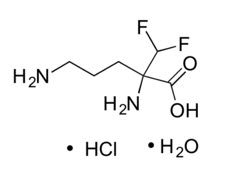
IWILFIN is an ornithine decarboxylase inhibitor. The chemical name of eflornithine hydrochloride is 2,5-diamino-2-(difluoromethyl) pentanoic acid hydrochloride hydrate with a molecular formula of C
Chemical Structure
IWILFIN is available as a round, white to off-white tablet for oral administration. Each tablet contains 192 mg eflornithine, equivalent to 250 mg of eflornithine hydrochloride, and the following inactive ingredients: 220 mg silicified microcrystalline cellulose, 25 mg partially pregelatinized maize starch, 2.5 mg colloidal silicon dioxide, and 2.5 mg vegetable source magnesium stearate.
6CLINICAL STUDIES
The efficacy of IWILFIN is based on an externally controlled trial comparison of Study 3b (investigational arm) and Study ANBL0032 (clinical trial-derived external control arm).
7HOW SUPPLIED/STORAGE AND HANDLING
IWILFIN (eflornithine) is available as 192 mg round, white to off-white tablets imprinted with EFL on one side and 192 on the other side; approximately 11 mm in diameter and supplied as follows:
  • Bottle of 100 tablets containing desiccant, NDC 78670-150-01
8PATIENT COUNSELING INFORMATION
Advise the patient to read the FDA-approved patient labeling (Patient Information).
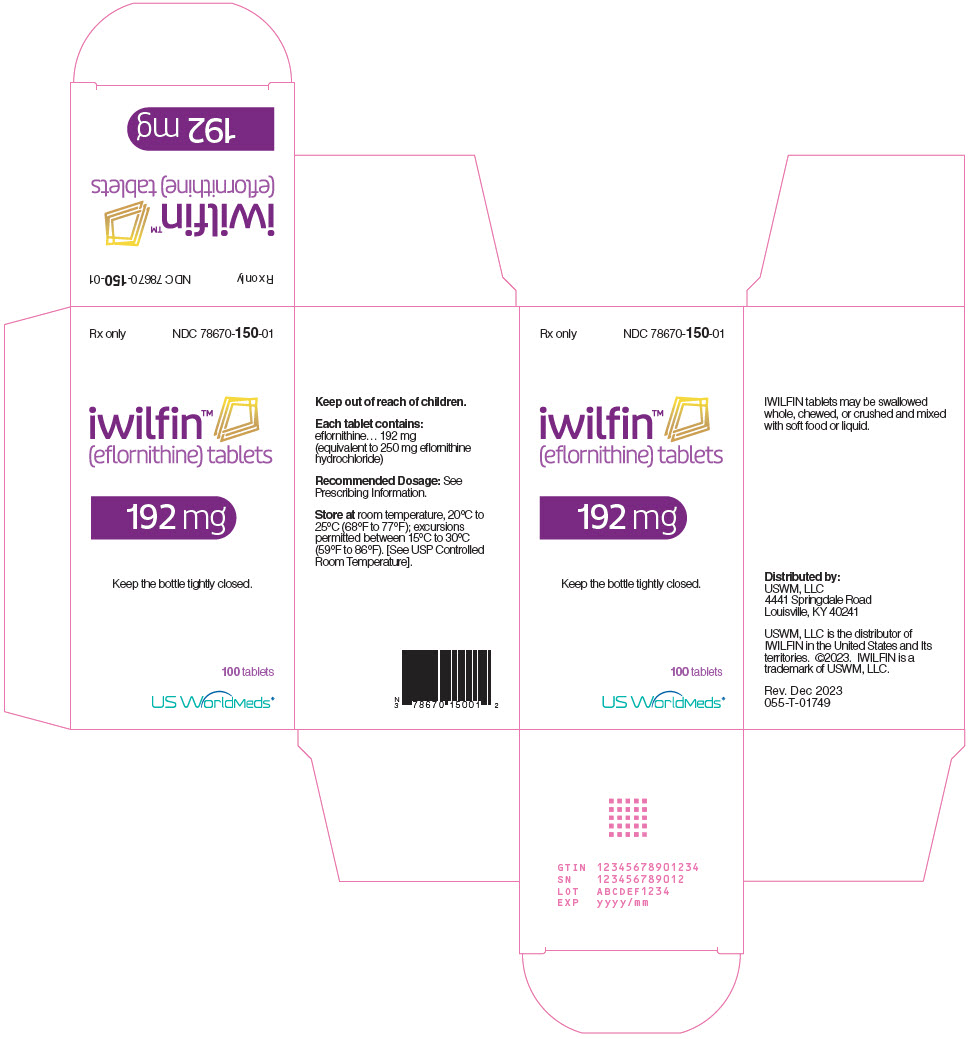
9PRINCIPAL DISPLAY PANEL - 192 mg Bottle Carton
Rx only
NDC 78670-150-01
iwilfin™
192 mg
Keep the bottle tightly closed.
100 tablets
US WorldMeds
PRINCIPAL DISPLAY PANEL - 192 mg Bottle Carton