Brand Name

Danyelza

Generic Name
Naxitamab
View Brand Information
FDA approval date: November 25, 2020
Classification: Glycolipid Disialoganglioside-directed Antibody
Form: Injection

What is Danyelza (Naxitamab)?

DANYELZA is indicated, in combination with granulocyte-macrophage colony-stimulating factor , for the treatment of pediatric patients 1 year of age and older and adult patients with relapsed or refractory high-risk neuroblastoma in the bone or bone marrow who have demonstrated a partial response, minor response, or stable disease to prior therapy. This indication is approved under accelerated approval based on overall response rate and duration of response. Continued approval for this indication may be contingent upon verification and description of clinical benefit in a confirmatory trial. DANYELZA is a GD2-binding monoclonal antibody indicated, in combination with granulocyte-macrophage colony-stimulating factor , for the treatment of pediatric patients 1 year of age and older and adult patients with relapsed or refractory high-risk neuroblastoma in the bone or bone marrow who have demonstrated a partial response, minor response, or stable disease to prior therapy. This indication is approved under accelerated approval based on overall response rate and duration of response. Continued approval for this indication may be contingent upon verification and description of clinical benefit in a confirmatory trial.
Save this treatment for later
Sign Up
Not sure about your diagnosis?
Check Your Symptoms
Tired of the same old research?
Check Latest Advances

Related Clinical Trials

Quadruple Immunotherapy for Paediatric Patients With Relapsed or Refractory Neuroblastoma

Summary: This is a single-arm clinical trial to evaluate the efficacy and safety of quadruple immunotherapy with natural killer (NK) cells, anti-GD2 antibody, cytokines (interleukin-2 (IL-2) and granulocyte-macrophage colony stimulating factor (GM-CSF)) and retinoid X receptor gamma (RXRg) agonist spironolactone for paediatric patients with relapsed or refractory neuroblastoma.

N10: Reduced Therapy for High-Risk Neuroblastoma

Summary: The purpose of this study is to find out whether N10 chemotherapy is a safe and effective treatment for children with high-risk neuroblastoma.

A Phase II Study of Naxitamab Added to Induction Therapy for Subjects With Newly Diagnosed High-Risk Neuroblastoma

Summary: This is a prospective, multicenter clinical trial in subjects with newly diagnosed high-risk neuroblastoma to evaluate the efficacy and safety of administering naxitamab with standard induction therapy. The initial chemotherapy will include 5 cycles of multi-agent chemotherapy. Naxitamab will be added to all 5 Induction cycles. We hypothesize that the addition of anti-GD2 therapy to induction chem...

Brand Information

DANYELZA (Naxitamab)
1INDICATIONS AND USAGE
DANYELZA is indicated, in combination with granulocyte-macrophage colony-stimulating factor (GM-CSF), for the treatment of pediatric patients 1 year of age and older and adult patients with relapsed or refractory high-risk neuroblastoma in the bone or bone marrow who have demonstrated a partial response, minor response, or stable disease to prior therapy.
This indication is approved under accelerated approval based on overall response rate and duration of response
2DOSAGE FORMS AND STRENGTHS
Injection: 40 mg/10 mL (4 mg/mL) clear to slightly opalescent and colorless to slightly yellow solution in a single-dose vial.
3CONTRAINDICATIONS
DANYELZA is contraindicated in patients with a history of severe hypersensitivity reaction to naxitamab-gqgk. Reactions have included anaphylaxis
4ADVERSE REACTIONS
The following clinically significant adverse reactions are also described elsewhere in the labeling:
  • Serious Infusion-Related Reactions
  • Neurotoxicity
  • Myocarditis
  • Hypertension
  • Orthostatic Hypotension
4.1Clinical Trials Experience
Because clinical trials are conducted under widely varying conditions, adverse reaction rates observed in the clinical trials of a drug cannot be directly compared to rates in the clinical trials of another drug and may not reflect the rates observed in practice.
The safety of DANYELZA in combination with GM-CSF was evaluated in patients with refractory or relapsed high-risk neuroblastoma in bone or bone marrow who had demonstrated a partial response, minor response, or stable disease following initial or subsequent therapy, and in patients who were in second complete remission, from two open-label, single arm studies, Study 201 (n=25) and Study 12-230 (n=72). Patients received DANYELZA 9 mg/kg/cycle administered as three separate intravenous infusions of 3 mg/kg (Day 1, 3 and 5) in the first week of each cycle. Patients also received GM-CSF 250 µg/m
The most common adverse reactions in Studies 201 and 12-230 (≥25% in either study) were infusion-related reaction, pain, tachycardia, vomiting, cough, nausea, diarrhea, decreased appetite, hypertension, fatigue, erythema multiforme, peripheral neuropathy, urticaria, pyrexia, headache, injection site reaction, edema, anxiety, localized edema and irritability. The most common Grade 3 or 4 laboratory abnormalities (≥5% in either study) were decreased lymphocytes, decreased neutrophils, decreased hemoglobin, decreased platelet count, decreased potassium, increased alanine aminotransferase, decreased glucose, decreased calcium, decreased albumin, decreased sodium and decreased phosphate.
4.2Immunogenicity
As with all therapeutic proteins, there is a potential for immunogenicity. The detection of anti-drug antibody formation is highly dependent on the sensitivity and specificity of the assay. Additionally, the observed incidence of anti-drug antibody (including neutralizing antibody) positivity in an assay may be influenced by several factors, including assay methodology, sample handling, timing of sample collection, concomitant medications, and underlying disease. For these reasons, comparison of the incidence of anti-drug antibodies in the studies described below with the incidence of anti-drug antibodies in other studies or to other naxitamab products may be misleading.
In Study 201, 2 of 24 (8%) patients tested positive for anti-drug antibodies (ADA) after treatment with DANYELZA.
In Study 12-230, 27 of 117 patients (23%) tested positive for ADA after treatment with DANYELZA by an assay that was not fully validated; therefore, the incidence of ADA may not be reliable.
4.3Postmarketing Experience/Spontaneous Reports
The following adverse reactions have been identified during expanded access and post-approval use of DANYELZA. Because these reactions are reported voluntarily from a population of uncertain size, it is not always possible to reliably estimate their frequency or establish a causal relationship to drug exposure.
Neurological: Orthostatic hypotension, Transverse myelitis
Cardiac disorders: Myocarditis
5DESCRIPTION
Naxitamab-gqgk is a glycolipid disialoganglioside (GD2)-binding recombinant humanized monoclonal IgG1 antibody, that contains human framework regions and murine complementarity-determining regions. Naxitamab-gqgk is produced in a Chinese hamster ovary cell line and has an approximate molecular weight of 144 kDa without glycosylation.
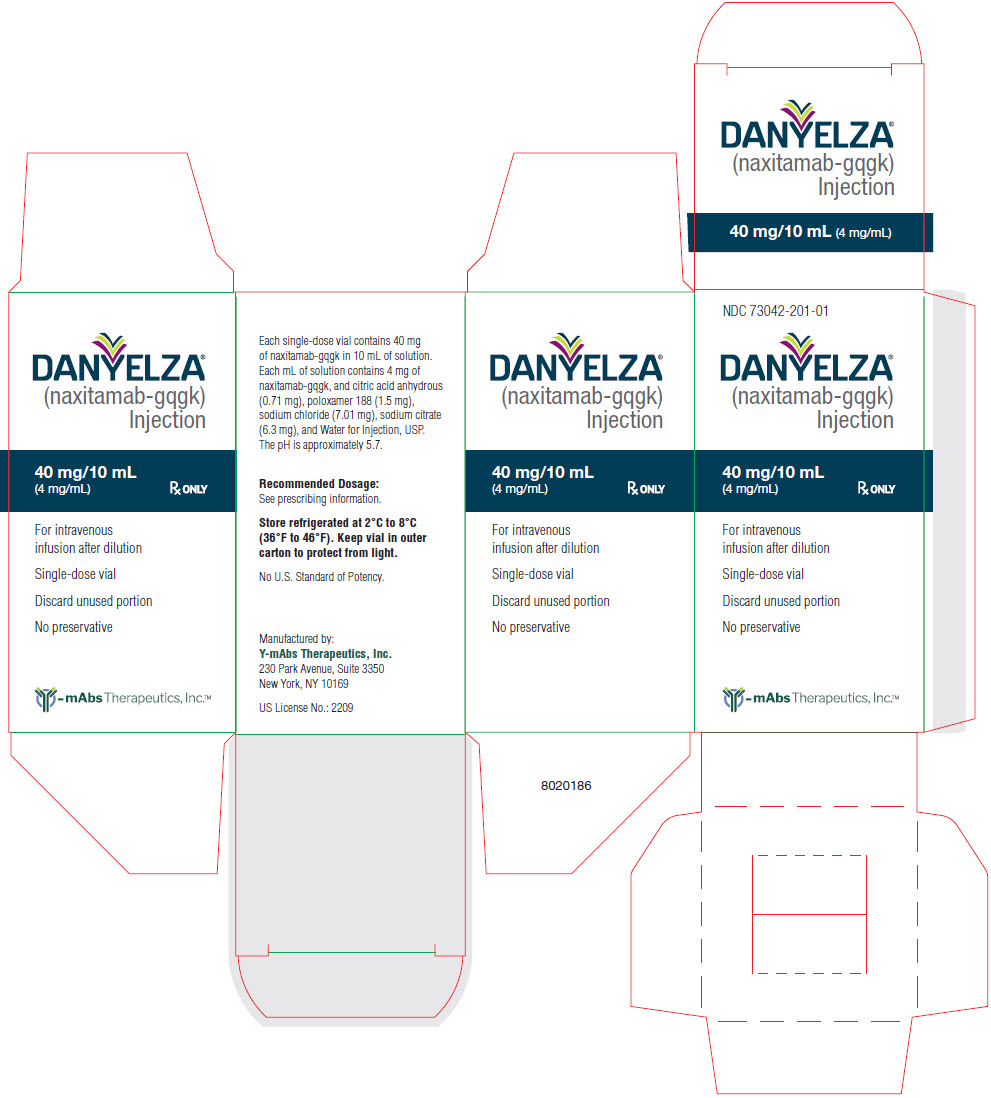
DANYELZA (naxitamab-gqgk) injection is a sterile, preservative-free, clear to slightly opalescent and colorless to slightly yellow solution for intravenous infusion. Each single-dose vial contains 40 mg of naxitamab-gqgk in 10 mL of solution. Each mL of solution contains 4 mg of naxitamab-gqgk, and citric acid anhydrous (0.71 mg), poloxamer 188 (1.5 mg), sodium chloride (7.01 mg), sodium citrate (6.3 mg), and Water for Injection, USP. The pH is approximately 5.7.
6CLINICAL STUDIES
The efficacy of DANYELZA in combination with GM-CSF was evaluated in two open-label, single arm trials in patients with high-risk neuroblastoma with refractory or relapsed disease in the bone or bone marrow, Study 201 and Study 12-230.
7HOW SUPPLIED / STORAGE AND HANDLING
DANYELZA (naxitamab-gqgk) injection is a sterile, preservative-free, clear to slightly opalescent and colorless to slightly yellow solution for intravenous infusion supplied as a carton containing one 40mg/10 mL (4 mg/mL) single-dose vial.
NDC 73042-201-01
8PATIENT COUNSELING INFORMATION
Advise the patient and caregiver to read the FDA-approved patient labeling (Patient Information).
9PRINCIPAL DISPLAY PANEL - 10 mL Vial Carton
NDC 73042-201-01
DANYELZA
40 mg/10 mL
Rx ONLY
For intravenous
Single-dose vial
Discard unused portion
No preservative
Y-mAbs Therapeutics, Inc.™
PRINCIPAL DISPLAY PANEL - 10 mL Vial Carton