Generic Name

Hydrchloride

Brand Names
Qlosi, Salagen, VUITY
FDA approval date: October 14, 2005
Classification: Cholinergic Receptor Agonist
Form: Tablet, Solution

What is Qlosi (Hydrchloride)?

QLOSI is indicated for the treatment of presbyopia in adults. QLOSI is a cholinergic agonist indicated for the treatment of presbyopia in adults.
Save this treatment for later
Sign Up
Not sure about your diagnosis?
Check Your Symptoms
Tired of the same old research?
Check Latest Advances

Related Clinical Trials

Skin-interfaced Colorimetric Bifluidic Sweat Sensor Device for the Diagnosis of Cystic Fibrosis (CF)

Summary: Cystic fibrosis (CF) is a multisystem autosomal recessive inherited disease affecting approximately 75,000 individuals in USA. The sweat chloride (Cl) test remains the gold standard for diagnosis of CF but still has a number of limitations. The objectives of this study are: 1)To evaluate a skin-interfaced colorimetric bifluidic sweat device with two synchronous channels as a potential low-cost but...

A Prospective Randomized Control Trial of Pilocarpine Use After Combined Cataract/Kahook Dual Blade Surgery

Summary: The goal of this study is to determine whether using pilocarpine provides added benefit to the success of combined cataract + Kahook Dual Blade (KDB) surgery.

Understanding Quality of Life in Presbyopic Patients Who Are Treated With Qlosi

Summary: The goal of this clinical trial is to determine how Qlosi™ (pilocarpine HCL ophthalmic solution) 0.4%impacts the quality of life of participants with presbyopia by using a battery of validated and investigator-developed instruments * Improvement in presbyopic symptoms as measured with the Near Activity Visual Questionnaire-Presbyopia (NAVQ-P) when using Qlosi™ at week 4 compared to baseline (conti...

Brand Information

    Qlosi (Pilocarpine Hydrochloride)
    1INDICATIONS AND USAGE
    QLOSI is indicated for the treatment of presbyopia in adults.
    2DOSAGE AND ADMINISTRATION
    Instill one drop of QLOSI in each eye. This can be repeated a second time after 2 to 3 hours for an effect up to 8 hours. QLOSI can be administered on a daily basis, or as needed, up to twice each day.
    If more than one topical ophthalmic medication is being used, the medicines must be administered at least 5 minutes apart.
    Discard single-patient-use vial after use.
    3DOSAGE FORMS AND STRENGTHS
    QLOSI is a clear, colorless to slightly yellowish ophthalmic solution containing pilocarpine hydrochloride 0.4% (4 mg /mL) in a single-patient-use vial.
    4CONTRAINDICATIONS
    QLOSI is contraindicated in patients with known hypersensitivity to the active ingredient or to any of the excipients.
    5OVERDOSAGE
    Systemic toxicity following topical ocular administration of pilocarpine is rare, but occasionally patients who are sensitive may develop sweating and gastrointestinal overactivity.
    Accidental ingestion can produce sweating, salivation, nausea, tremors and slowing of the pulse and a decrease in blood pressure.
    In moderate overdosage, spontaneous recovery is to be expected and is aided by intravenous fluids to compensate for dehydration. For patients demonstrating severe poisoning, atropine, the pharmacologic antagonist to pilocarpine, should be used.
    6DESCRIPTION
    QLOSI (pilocarpine hydrochloride ophthalmic solution) 0.4% is a sterile, clear, colorless to slightly yellowish and slightly viscous ophthalmic solution for topical ophthalmic use which has a pH between 5.1-6.1.
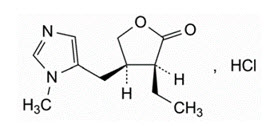
    The structural formula of pilocarpine hydrochloride is:
    Chemical Structure
    The chemical name for pilocarpine hydrochloride is: 2(3
    Each mL contains 0.4% (4 mg) of pilocarpine hydrochloride as the active ingredient, equivalent to 0.3% (3.4 mg) of pilocarpine free-base. The inactive ingredients in QLOSI are: hypromellose, sodium chloride, sodium hyaluronate, edetate disodium dihydrate, water for injection, and may also include sodium hydroxide and/or hydrochloric acid for pH adjustment. QLOSI does not contain an anti-microbial preservative.
    7CLINICAL STUDIES
    The efficacy of QLOSI for the treatment of presbyopia was demonstrated in two Phase 3, randomized, double-masked, vehicle-controlled studies, namely NEAR-1 (NCT04599933) and NEAR-2 (NCT04599972). A total of 613 participants aged 45 to 64 years old with presbyopia were randomized (309 to QLOSI group) in these two studies. Participants were instructed to instill one drop of QLOSI or vehicle, in each eye, once in the morning and to repeat the instillation 2 to 3 hours later. Participants were treated for two weeks. Ophthalmic assessments were conducted on Day 1, 8 and 15 of the study at various timepoints.
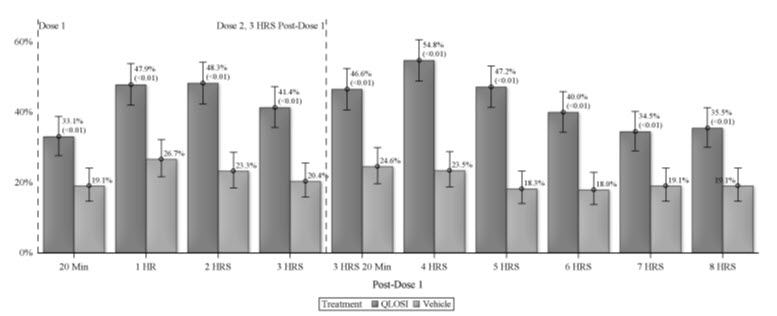
    Responders demonstrated improvement by achieving a gain from baseline of 3 lines or more in near BDCVA at 40 centimeters without a loss of 1 line or more (≥ 5 letters) in BDCVA at 4 meters. Overall, the percentages of responders were consistently higher in the QLOSI group than in the Vehicle group at each assessment day.
    Figure 1 presents the percentage of responders for each time point at Day 15. (Standard analysis of pooled data NEAR-1 and NEAR-2)
    Figure 1
    Abbreviations: HRS: hours; min: minutes
    This figure demonstrates the onset of the QLOSI effect on presbyopia, from 20 minutes post dose 1, and lasting up to 8 hours (i.e., 5 hours from the second dose).