Heart Attack Treatments

Find Heart Attack Treatments

Generic Name

Metoprolol

Brand Names
Kapspargo, Lopressor, Toprol
FDA approval date: December 23, 1993
Classification: beta-Adrenergic Blocker
Form: Injection, Tablet, Capsule, Solution

What is Kapspargo (Metoprolol)?

KAPSPARGO Sprinkle is a beta 1 -adrenergic blocker indicated for the treatment of: Hypertension, to lower blood pressure. Lowering blood pressure reduces the risk of fatal and non-fatal cardiovascular events, primarily strokes and myocardial infarctions.
Save this treatment for later
Sign Up
Not sure about your diagnosis?
Check Your Symptoms
Tired of the same old research?
Check Latest Advances

Related Clinical Trials

Artificial Intelligence-assisted CT for Risk Stratification in COronary Artery Disease to PreveNt Future Coronary Events and Improve Outcomes

Summary: The goal of this observational study is to learn if AI-assisted cardiac CT imaging can improve cardiovascular risk stratification and prediction of future coronary events in an adult population undergoing clinically indicated cardiac CT. The main questions it aims to answer are: * Can AI-enhanced cardiac CT accurately assess cardiovascular risk in a real-world adult population? * How do CT-derived...

Phase II Trial of Cardioprotective Prophylaxis With Combination of Beta Blocker and Angiotensin-Converting Enzyme Inhibitors During Intensive Chemotherapy for Patients With Newly Diagnosed Acute Myeloid Leukemia

Summary: Patients with acute myeloid leukemia (AML) often receive a drug called daunorubicin. Daunorubicin is a type of drug called an anthracycline, which increases the risk of some damage to the heart. Beta blockers and angiotensin-converting enzyme inhibitors (ACEi) are two types of drugs that are often used (and are FDA approved) to treat the type of damage to the heart caused by anthracyclines. They h...

Personalizing Heart Failure Treatment With Genomics: A Clinical Trial to Understand the Mechanisms and Validate a Polygenic Risk Score for Beta-Blocker Response

Summary: The purpose of this trial is to better understand how the beta-blocker metoprolol works in people with Heart Failure with Reduced Ejection Fraction (HFrEF) according to participants genetics. Participants will have the beta-blocker (BB) polygenic score calculated from genotype data. The score will be used to stratify the patients in the low and high polygenic score groups in the study. The hypothe...

Brand Information

    KAPSPARGO (Metoprolol Succinate)
    1DOSAGE FORMS AND STRENGTHS
    25 mg capsule: Light yellow opaque cap and white opaque body both imprinted with '
    50 mg capsule: Dark yellow opaque cap and white opaque body both imprinted with '
    100 mg capsule: White opaque cap and white opaque body both imprinted with '
    200 mg capsule: Yellow opaque cap and yellow opaque body both imprinted with '
    2CONTRAINDICATIONS
    Metoprolol succinate is contraindicated in severe bradycardia, second- or third-degree heart block, cardiogenic shock, decompensated heart failure, sick sinus syndrome (unless a permanent pacemaker is in place), and in patients who are hypersensitive to any component of this product.
    3ADVERSE REACTIONS
    The following adverse reactions are described elsewhere in labeling:
    • Worsening angina or myocardial infarction
    • Worsening heart failure
    • Worsening AV block
    3.1Clinical Trials Experience
    Because clinical trials are conducted under widely varying conditions, adverse reaction rates observed in the clinical trials of a drug cannot be directly compared to rates in the clinical trials of another drug and may not reflect the rates observed in practice. The adverse reaction information from clinical trials does, however, provide a basis for identifying the adverse events that appear to be related to drug use and for approximating rates.
    Hypertension and Angina: Most adverse reactions have been mild and transient. The most common (> 2%) adverse reactions are tiredness, dizziness, depression, diarrhea, shortness of breath, bradycardia, and rash.
    Heart Failure: In the MERIT-HF study comparing metoprolol succinate in daily doses up to 200 mg (mean dose 159 mg once-daily; n = 1990) to placebo (n = 2001), 10.3% of metoprolol succinate patients discontinued for adverse events vs. 12.2% of placebo patients.
    The table below lists adverse reactions in the MERIT-HF study that occurred at an incidence of ≥ 1% in the metoprolol succinate group and greater than placebo by more than 0.5%, regardless of the assessment of causality.
    Adverse Reactions Occurring in the MERIT-HF Study at an Incidence ≥ 1% in the Metoprolol Succinate Group and Greater Than Placebo by More Than 0.5%
    Post-operative Adverse Events: In a randomized, double-blind, placebo-controlled trial of 8351 patients with or at risk for atherosclerotic disease undergoing non-vascular surgery and who were not taking beta–blocker therapy, metoprolol succinate 100 mg was started 2 to 4 hours prior to surgery then continued for 30 days at 200 mg per day. Metoprolol succinate use was associated with a higher incidence of bradycardia (6.6% vs. 2.4%; HR, 2.74; 95% CI 2.19, 3.43), hypotension (15% vs. 9.7%; HR 1.55; 95% CI 1.37, 1.74), stroke (1.0% vs. 0.5%; HR 2.17; 95% CI 1.26, 3.74) and death (3.1% vs. 2.3%; HR 1.33; 95% CI 1.03, 1.74) compared to placebo.
    3.2Post-Marketing Experience
    The following adverse reactions have been identified during post-approval use of extended-release metoprolol or immediate-release metoprolol. Because these reactions are reported voluntarily from a population of uncertain size, it is not always possible to reliably estimate their frequency or establish a causal relationship to drug exposure.
    Cardiovascular: Cold extremities, arterial insufficiency (usually of the Raynaud type), palpitations, peripheral edema, syncope, chest pain and hypotension.
    Respiratory: Wheezing (bronchospasm), dyspnea.
    Central Nervous System: Confusion, short-term memory loss, headache, somnolence, nightmares, insomnia, anxiety/nervousness, hallucinations, paresthesia.
    Gastrointestinal: Nausea, dry mouth, constipation, flatulence, heartburn, hepatitis, vomiting.
    Hypersensitive Reactions: Pruritus.
    Miscellaneous: Musculoskeletal pain, arthralgia, blurred vision, decreased libido, male impotence, tinnitus, reversible alopecia, agranulocytosis, dry eyes, worsening of psoriasis, Peyronie's disease, sweating, photosensitivity, taste disturbance.
    Potential Adverse Reactions: In addition, there are adverse reactions not listed above that have been reported with other beta-adrenergic blocking agents and should be considered potential adverse reactions to metoprolol succinate.
    Central Nervous System: Reversible mental depression progressing to catatonia; an acute reversible syndrome characterized by disorientation for time and place, short-term memory loss, emotional lability, clouded sensorium, and decreased performance on neuropsychometrics.
    Hematologic: Agranulocytosis, nonthrombocytopenic purpura, thrombocytopenic purpura.
    Hypersensitive Reactions: Laryngospasm, respiratory distress.
    4OVERDOSAGE
    Signs and Symptoms - Overdosage of metoprolol succinate may lead to severe bradycardia, hypotension, and cardiogenic shock. Clinical presentation can also include: atrioventricular block, heart failure, bronchospasm, hypoxia, impairment of consciousness/coma, nausea and vomiting.
    Treatment – Consider treating the patient with intensive care. Patients with myocardial infarction or heart failure may be prone to significant hemodynamic instability. Beta-blocker overdose may result in significant resistance to resuscitation with adrenergic agents, including beta-agonists. On the basis of the pharmacologic actions of metoprolol, employ the following measures.
    Hemodialysis is unlikely to make a useful contribution to metoprolol elimination
    Bradycardia: Evaluate the need for atropine, adrenergic-stimulating drugs, or pacemaker to treat bradycardia and conduction disorders.
    Hypotension: Treat underlying bradycardia. Consider intravenous vasopressor infusion, such as dopamine or norepinephrine.
    Heart failure and shock: May be treated when appropriate with suitable volume expansion, injection of glucagon (if necessary, followed by an intravenous infusion of glucagon), intravenous administration of adrenergic drugs such as dobutamine, with α
    Bronchospasm: Can usually be reversed by bronchodilators.
    5DESCRIPTION
    Metoprolol succinate, is a beta
    Metoprolol succinate, USP is a white to off-white powder with a molecular weight of 652.82. It is freely soluble in water, soluble in methanol, sparingly soluble in alcohol, slightly soluble in isopropyl alcohol. Inactive ingredients: ethyl cellulose, hypromellose, polyethylene glycol 400, polyethylene glycol 6000, sugar spheres (corn starch and sucrose), talc and triethyl citrate. The capsule shell and imprinting ink has the following composition: ferric oxide yellow (25 mg, 50 mg and 200 mg), ferrosoferric oxide, gelatin, potassium hydroxide, propylene glycol, shellac and titanium dioxide.
    6HOW SUPPLIED/STORAGE AND HANDLING
    Each extended-release capsule contains 10.24 mg, 20.48 mg, 40.96 mg, and 81.92 mg of metoprolol free base, present as 23.75 mg, 47.5 mg, 95 mg, and 190 mg of metoprolol succinate and equivalent to 25 mg, 50 mg, 100 mg, and 200 mg of metoprolol tartrate, USP respectively and are supplied as follows:
    7PATIENT COUNSELING INFORMATION
    Advise patients to take KAPSPARGO Sprinkle regularly and continuously, as directed, preferably with or immediately following meals. If a dose is missed, the patient should take only the next scheduled dose (without doubling it). Patients should not interrupt or discontinue KAPSPARGO Sprinkle without consulting the physician.

    KAPSPARGO Sprinkle is a trademark of Sun Pharmaceutical Industries Limited. All other trademarks are property of their respective owners.

    Manufactured by:
    Ohm Laboratories Inc.
    New Brunswick, NJ 08901

    Distributed by:
    Sun Pharmaceutical Industries, Inc.
    Cranbury, NJ 08512
    FDA-09
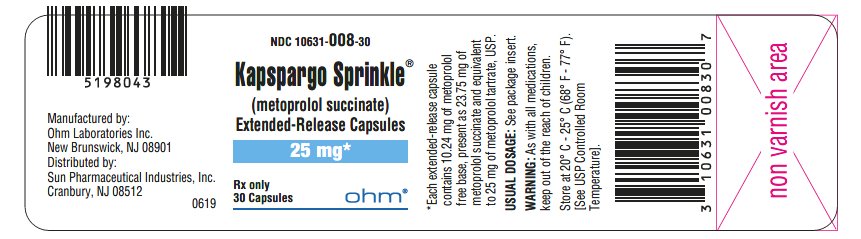
    8PACKAGE/LABEL PRINCIPAL DISPLAY PANEL - 25 mg
    NDC 10631-008-30
    Kapspargo Sprinkle
    (metoprolol succinate)
    Extended-Release Capsules
    25 mg*
    Rx only
    30 Capsules
    ohm
    spl-kapspargo-label1
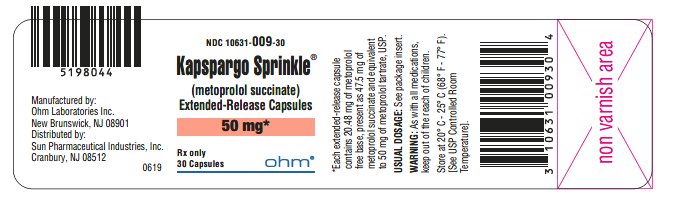
    9PACKAGE/LABEL PRINCIPAL DISPLAY PANEL - 50 mg
    NDC 10631-009-30
    Kapspargo Sprinkle
    (metoprolol succinate)
    Extended-Release Capsules
    50 mg*
    Rx only
    30 Capsules
    ohm
    spl-kapspargo-label2
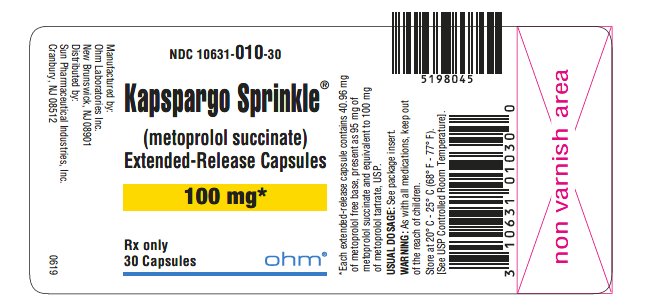
    10PACKAGE/LABEL PRINCIPAL DISPLAY PANEL - 100 mg
    NDC 10631-010-30
    Kapspargo Sprinkle
    (metoprolol succinate)
    Extended-Release Capsules
    100 mg*
    Rx only
    30 Capsules
    ohm
    spl-kapspargo-label3
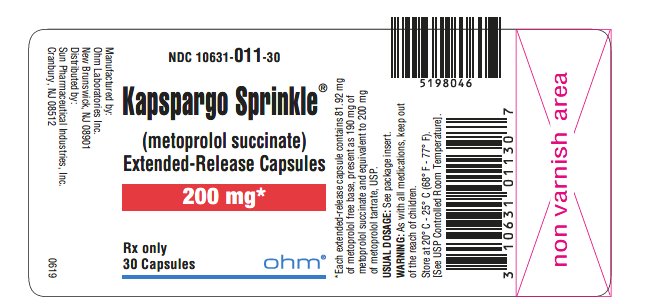
    11PACKAGE/LABEL PRINCIPAL DISPLAY PANEL - 200 mg
    NDC 10631-011-30
    Kapspargo Sprinkle
    (metoprolol succinate)
    Extended-Release Capsules
    200 mg*
    Rx only
    30 Capsules
    ohm
    spl-kapspargo-label4
    Kapspargo has been selected.