High Potassium Level Treatments
Find High Potassium Level Treatments
Brand Name
Guna-Diur
Generic Name
Amiloride
View Brand Information FDA approval date: January 22, 1986
Classification: Thiazide Diuretic
Form: Tablet, Solution
Approved To Treat
Save this treatment for later
Not sure about your diagnosis?
Tired of the same old research?
Related Clinical Trials
Phase II Open-label Study of ARX788 (Anti-HER2 Antibody Drug Conjugate (ADC)) for Patients With HER2-low Locally Advanced Unresectable or Metastatic Breast Cancer
Summary: This phase II trial tests how well ARX788 works in treating patients diagnosed with HER2-low, locally advanced unresectable or metastatic breast cancer. ARX788 is an antibody-drug conjugate (ADC) that is given by infusion (diluted and injected slowly into veins). Antibodies are proteins which are naturally produced by the body's immune system to help fight infections. ARX788 consists of antibodies...
Mechanisms of Diuretic Resistance in Heart Failure, Aim 2
Summary: Randomized placebo-controlled, double-blind, double-dummy, crossover design testing combinations placebo/placebo, bendroflumethiazide/placebo, amiloride/placebo, and bendroflumethiazide/amiloride added to bumetanide.
Mechanisms of Diuretic Resistance in Heart Failure, Aim 3
Summary: Randomized double-blind placebo-controlled crossover study design
Related Latest Advances
Brand Information
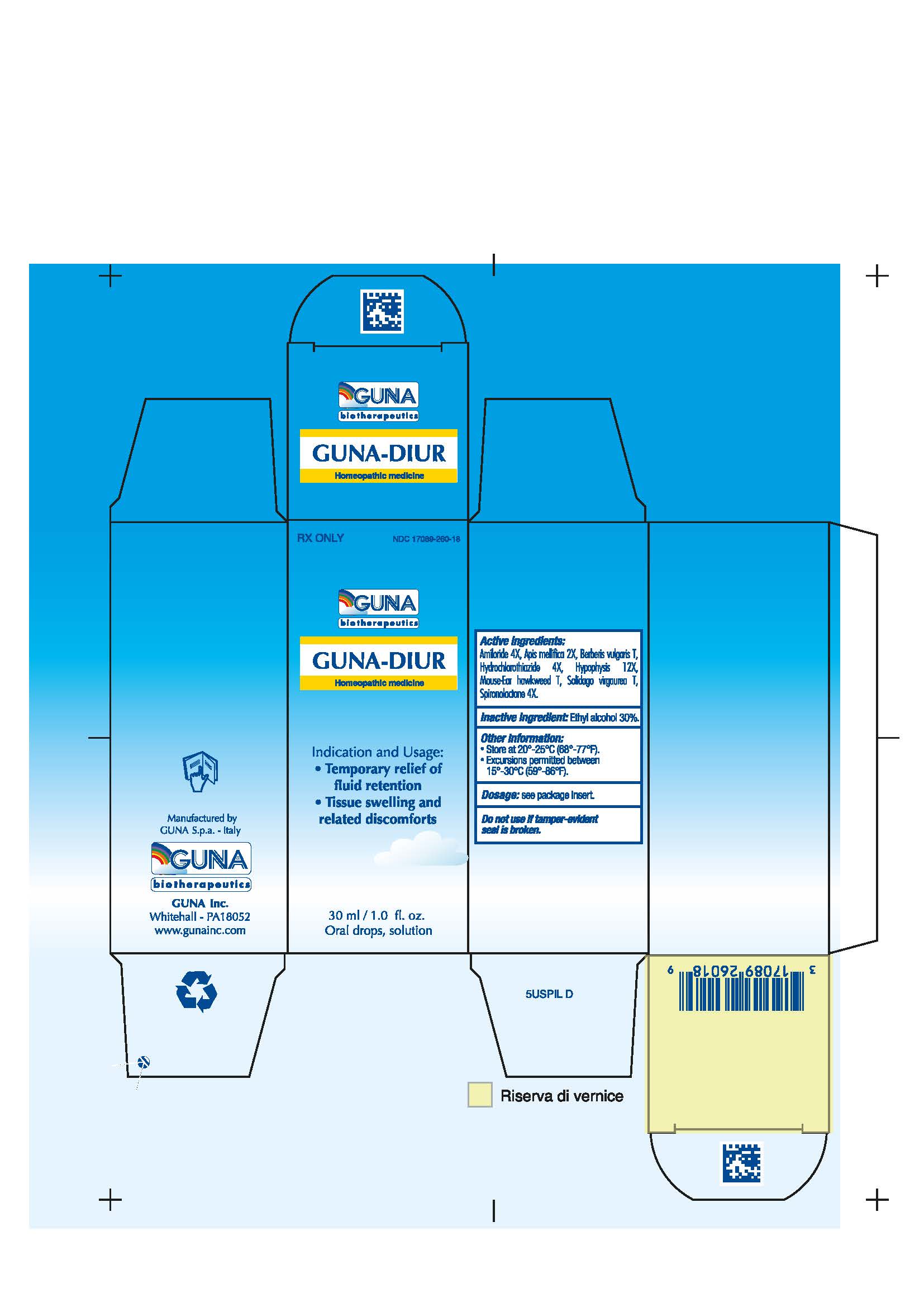
GUNA-DIUR (amiloride - apis mellifera - berberis vulgaris fruit - hieracium pilosella flowering top - hydrochlorothiazide - solidago virgaurea flowering top - spironolactone - sus scrofa pituitary gland -)
1INDICATIONS AND USAGE
1.1 Temporary relief of fluid retention
1.2 Tissue swelling and related disconforts
2DOSAGE AND ADMINISTRATION
Adults: 20 drops in a little water, 2 times per day for an avarage of two months.
Stop use and ask a doctor if symptoms persist more than 5 days.
Administration may very according to individual needs.
GUNA-DIUR may be used together with other homeopthic medicines.
3DOSAGE FORMS AND STRENGTHS
3.1. 30 ml Bottle dropper container contains:
4CONTRAINDICATIONS
4.1. There is no history of hypersensitivity to GUNA-DIUR. However, do not use if you are hypersensitive to any of the active ingredients of Guna-Diur.
5WARNINGS AND PRECAUTIONS
5.1. GUNA-DIUR is contraindicated in patients with anuria and in patients with a history of hypersensitivity to Spironolactone, Amiloride, or Hydrocholorthiazide.
5.3 Keep out of reach of children.
6ADVERSE REACTIONS
6.1. None known (see CONTRAINDICATIONS for hypersensitivity information).
7DRUG INTERACTIONS
7.1. None Known
8USE IN SPECIFIC POPULATIONS
8.1.
8.4. Geriatric use: No restrictions.
9DRUG ABUSE AND DEPENDENCE
9.1. No Known.
10OVERDOSAGE
10.1. No Known.
11DESCRIPTION
11. 1 GUNA-DIUR is a homeopathic medicine indicated for the temporary relief of fluid retention, tissue swelling and related disconforts.
12CLINICAL PHARMACOLOGY
12.1. GUNA-DIUR exerts a diuretic effect. This is based on homeopthica Materia Medica and homeopathic principles.
12.3. Pharmacokinetics
Not applicable to homeopthic medicinal products.
13NONCLINICAL TOXICOLOGY
13.1. Not available.
14CLINICAL STUDIES
14.1. GUNA-DIUR efficacy is not supported by clinical studies. It is based on homeopathic Materia Medica and scientific literature.
15REFERENCES
15.1. H.H. Reckeweg. Homeopathic Materia Medica. Aurelia Verlag.
16HOW SUPPLIED/STORAGE AND HANDLING
16.1. NDC 17089-260-18 Oral Solution/Drops 30 mL
17PATIENT COUNSELING INFORMATION
17.1. Patients should be informed about Homeopathy and the main differences with conventional clinical approaches.
18PACKAGE LABEL