Brand Name

Rayaldee

Generic Name
Calcifediol
View Brand Information
FDA approval date: October 25, 2016
Classification: Vitamin D3 Analog
Form: Capsule

What is Rayaldee (Calcifediol)?

RAYALDEE is a vitamin D 3 analog indicated for the treatment of secondary hyperparathyroidism in adult patients with stage 3 or 4 chronic kidney disease and serum total 25-hydroxyvitamin D levels less than 30 ng/mL. Limitations of Use RAYALDEE is not indicated for the treatment of secondary hyperparathyroidism in patients with stage 5 chronic kidney disease or in patients with end-stage renal disease on dialysis. RAYALDEE is a vitamin D 3 analog indicated for the treatment of secondary hyperparathyroidism in adults with stage 3 or 4 chronic kidney disease and serum total 25-hydroxyvitamin D levels less than 30 ng/mL. Limitations of Use: RAYALDEE is not indicated in patients with stage 5 chronic kidney disease or end-stage renal disease on dialysis.
Save this treatment for later
Sign Up
Not sure about your diagnosis?
Check Your Symptoms
Tired of the same old research?
Check Latest Advances

Related Clinical Trials

Effects of High Doses of Liquid Vitamin D Supplementation on Clinical Outcomes in Critically Traumatic Patients.

Summary: Trauma has been an important global public health issue. Yet it is the sixth cause of death in Taiwan, trauma brings great negative impact to national productivity since it presents specifically as the leading cause of death for the population aged below 40 years. According to the national databank from Formosa Association for the Surgery of Trauma, mortality rate in critically traumatic patients ...

Effects of Early Vitamin D3 Supplementation on Clinical Outcomes for Critically Ill Patients

Summary: There are no clear international guidelines for dosing vitamin D based on deficiency severity. Therefore, a new clinical trial is needed to evaluate the benefits of early vitamin D supplementation in maintaining sufficient levels for critically ill patients. The investigators conducted a multicenter clinical trial in Taiwan focusing on vitamin D and critically ill patients. 240 patients with low c...

Vitamin D and Its Metabolites Quantification in Adipose Tissues of Obese and Non-obese

Summary: Vitamin D (VD) is a pleiotropic hormone, involved in many physiological processes including calcium and phosphorus absorption. The VD metabolism begin to be well-known and involves a hepatic hydroxylation (mediated by enzymes, which belong to the cytochrome P450 family) leading to the production of the 25(OH)D, which corresponds to the circulating form of the VD. After circulation in blood, the 25...

Brand Information

Rayaldee (calcifediol)
1INDICATIONS AND USAGE
RAYALDEE is a vitamin D
Limitations of Use
RAYALDEE is not indicated for the treatment of secondary hyperparathyroidism in patients with stage 5 chronic kidney disease or in patients with end-stage renal disease on dialysis.
2DOSAGE FORMS AND STRENGTHS
Extended-release capsules, 30 mcg available as:
  • blue oval soft capsules imprinted with “O” in white ink
  • White two-piece banded hard capsules imprinted with ”O” and “30” in blue ink
3CONTRAINDICATIONS
None.
4ADVERSE REACTIONS
The following important adverse reactions are discussed in greater detail in other sections of the label:
  • Hypercalcemia [
  • Adynamic Bone Disease [
4.1Clinical Trial Experience
Because clinical trials are conducted under widely varying conditions, adverse reaction rates observed cannot be directly compared to rates in other trials and may not reflect the rates observed in clinical practice.
The data in
Table 1 shows common adverse reactions associated with the use of RAYALDEE in the pooled placebo-controlled trials. These adverse reactions were not present at baseline, occurred more commonly on RAYALDEE than on placebo, and occurred in at least 1.4% of patients treated with RAYALDEE.
Increase in Serum Calcium
Patients randomized to RAYALDEE experienced a greater mean (SE) increase in serum calcium (P<0.001) than patients randomized to placebo [i.e., 0.2 (0.02) mg/dL on RAYALDEE versus 0.1 (0.03) mg/dL on placebo from baseline to trial end]. Six subjects (2%) in the RAYALDEE treatment group and no subjects (0%) in the placebo group required dose reductions for protocol-defined hypercalcemia (two consecutive serum calcium values greater than 10.3 mg/dL). A total of 4.2% of RAYALDEE treated subjects and 2.1% of placebo treated subjects experienced at least one elevation in serum calcium above the upper limit of normal (10.5 mg/dL).
Increase in Serum Phosphorus
Patients randomized to RAYALDEE experienced a greater mean (SE) increase in serum phosphorus than patients randomized to placebo [i.e., 0.2 (0.03) mg/dL on RAYALDEE versus 0.1 (0.04) mg/dL on placebo from baseline to trial end]. One subject (0.4%) in the RAYALDEE treatment group met protocol-defined hyperphosphatemia (two consecutive serum phosphorus values greater than 5.5 mg/dL deemed to be study drug related) compared to no subjects in the placebo group. A total of 45% of RAYALDEE treated subjects and 44% of placebo treated subjects experienced at least one elevation in serum phosphorus above the upper limit of normal (4.5 mg/dL).
5OVERDOSAGE
Excessive administration of RAYALDEE can cause hypercalciuria, hypercalcemia, hyperphosphatemia, or oversuppression of intact PTH. Common symptoms of vitamin D overdosage may include constipation, decreased appetite, dehydration, fatigue, irritability, muscle weakness, or vomiting.
Treatment of acute accidental overdosage with RAYALDEE should consist of general supportive measures. If the overdosage is discovered within a short time, induce emesis or perform gastric lavage to prevent further absorption. Obtain serial serum and urine calcium measurements, and assess any electrocardiographic abnormalities due to hypercalcemia. Discontinue supplemental calcium. Treat with standard medical care if persistent and markedly elevated serum calcium levels occur.
Calcifediol is not significantly removed by dialysis.
6DESCRIPTION
Calcifediol, USP, the active ingredient in RAYALDEE, is synthetically manufactured as calcifediol monohydrate. Calcifediol is also known as calcidiol, 25-hydroxycholecalciferol or 25-hydroxyvitamin D
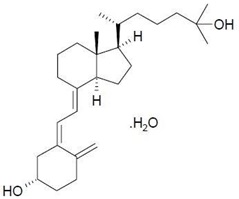
Calcifediol monohydrate is a white crystalline powder, has a calculated molecular weight of 418.65 and is soluble in alcohol and fatty oils but practically insoluble in water. Chemically, calcifediol monohydrate is (3β,5Z,7E)-9,10-secocholesta-5,7,10(19)-triene-3,25-diol monohydrate and its structural formula is:
calcifediol Chemical Structure
RAYALDEE is formulated as extended-release capsules containing 30 mcg of calcifediol.
RAYALDEE is available as soft capsules or two-piece banded hard capsules containing 30 mcg of calcifediol for oral administration. Each capsule contains the following excipients: butylated hydroxytoluene, dehydrated alcohol, hypromellose, lauroyl polyoxylglycerides, mineral oil, monoglycerides and diglycerides, and paraffin. The soft capsule shells contain carrageenan, FD&C Blue #1, modified starch, purified water, sodium phosphate dibasic, sorbitol sorbitan solution, and titanium dioxide. Medium chain triglyceride (fractionated coconut) oil is used as a lubricant during manufacture, and trace amounts may be present in the final formulation. The hard capsule shells contain gellan gum, hypromellose, and titanium dioxide.
7CLINICAL STUDIES
The efficacy and safety of RAYALDEE were evaluated in two identical multicenter, randomized, placebo-controlled, double-blind trials in patients with secondary hyperparathyroidism, stage 3 or 4 chronic kidney disease and serum total 25-hydroxyvitamin D levels between 10 and 30 ng/mL. Subjects were stratified by chronic kidney disease stage and randomized in a 2:1 ratio to receive RAYALDEE or a matching placebo at bedtime over 26 weeks. The dose of RAYALDEE was 30 mcg once daily for the first 12 weeks and either 30 or 60 mcg once daily for the last 14 weeks. The dose was increased to 60 mcg at the start of week 13 if the plasma intact PTH level was greater than 70 pg/mL, the serum 25-hydroxyvitamin D level was less than 65 ng/mL and the serum calcium level was less than 9.8 mg/dL.
A total of 213 subjects were randomized in one trial (72 received placebo and 141 received RAYALDEE), and 216 subjects were randomized in the second trial (72 received placebo and 144 received RAYALDEE). The subjects’ mean age was 66 years (range 25-85), 50% were male, 65% White, 32% African-American or Black and 3% Other. At baseline, subjects had secondary hyperparathyroidism, and stage 3 (52%) or stage 4 (48%) chronic kidney disease without macroalbuminuria. The most common causes of chronic kidney disease were diabetes and hypertension and the mean estimated GFR was 31 mL/min/1.73m
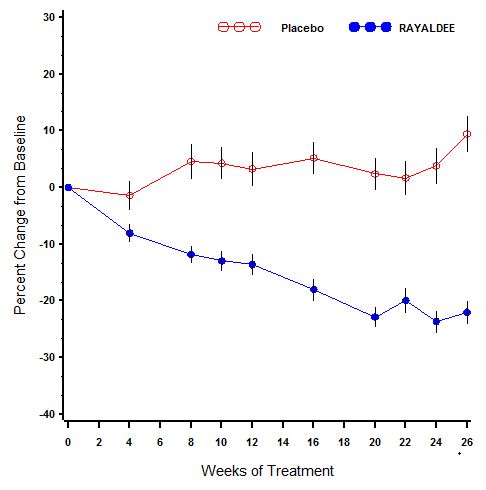
The primary analysis compared the proportion of individuals who experienced an at least 30% reduction in plasma intact PTH from baseline to end of trial (average of weeks 20, 22, 24 and 26). A larger proportion of patients randomized to RAYALDEE experienced an at least 30% reduction in plasma intact PTH from baseline compared to placebo in both trials [33% versus 8% in the first trial (P<0.001) and 34% versus 7% in the second trial (P<0.001)].
A description of mean (SE) percent change in plasma intact PTH from baseline across study visits in the two trials combined is shown in
Figure 1
The Per Protocol (PP) population consisted of all subjects with at least 2 intact PTH values in the calculated baseline and efficacy assessment period (EAP) values and who did not have a major protocol deviation during the treatment period of the study. The PP population comprised 83% of randomized subjects.
8HOW SUPPLIED/STORAGE AND HANDLING
RAYALDEE is supplied as 30 mcg calcifediol in blue, oval extended-release soft capsules, imprinted O:
Bottles of 30 [
Bottles of 60 [
RAYALDEE is also supplied as 30 mcg calcifediol in white extended-release two-piece banded hard capsules, imprinted O on the cap and 30 on the body:
Bottles of 30 [
Bottles of 60 [
Store at 20 to 25°C (68 to 77°F); excursions permitted to 15 to 30°C (59 to 86°F) [
9PATIENT COUNSELING INFORMATION
  • Inform patients to take RAYALDEE at bedtime and to swallow the capsules whole.
  • Inform patients if they miss a dose, to take RAYALDEE at the next scheduled time. Do not take an extra dose to make up for the missed dose.
  • Inform patients that they will need routine monitoring of laboratory parameters such as calcium, iPTH and total 25-hydroxyvitamin D while taking RAYALDEE.
  • Advise patients to contact a health care provider if they develop symptoms of elevated calcium (e.g., feeling tired, having difficulty thinking clearly, loss of appetite, nausea, vomiting, constipation, increased thirst, increased urination or weight loss).
  • Advise patients to inform their physician of all use of medications, including prescription and nonprescription drugs, supplements and herbal preparations, and of any changes in medical condition. Patients should also be advised to inform their physicians, when receiving a newly prescribed medication, that they are taking RAYALDEE.
  • Inform lactating women about the need to monitor infants exposed to RAYALDEE through breast milk for signs of hypercalcemia to include seizures, vomiting, constipation and weight loss [
RAYALDEE
Patent: https://www.opko.com/what-we-do/our-research/patents
Manufactured for:
© 2024 OPKO Pharmaceuticals, LLC. All rights reserved.
10PRINCIPAL DISPLAY PANEL NDC: 70301-1001-1 - 30-count Bottle Label
Principal Display Panel NDC: 70301-1001-1: 30-count Soft Capsule Bottle Label
NDC 70301-1001-1                    
Rayaldee
30 mcg
Rx only
Each capsule contains:
Manufactured for:
Rev. 03/21
PC2192
Store between 20 - 25°C
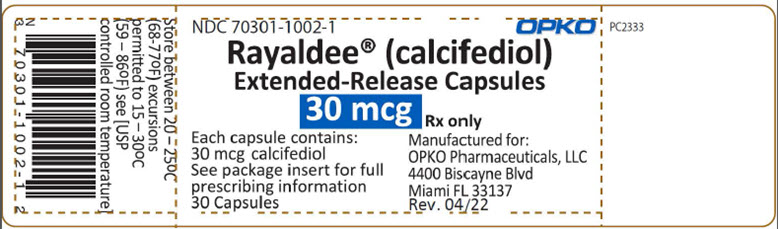
11PRINCIPAL DISPLAY PANEL NDC: 70301-1002-1 - 30-count Bottle Label
Principal Display Panel NDC: 70301-1002-1: 30-count Hard Capsule Bottle Label
NDC 70301-1002-1                    
Rayaldeecalcifediol ER capsules
30 mcg
Each capsule contains:
Manufactured for:
Rev. 06/24
PC2569
Store between 20 - 25°C