Hypertension Treatments

Find Hypertension Treatments

Generic Name

Lisinopril

Brand Names
Qbrelis, Zestoretic, Zestril
FDA approval date: July 01, 2002
Classification: Angiotensin Converting Enzyme Inhibitor
Form: Tablet, Solution

What is Qbrelis (Lisinopril)?

QBRELIS is an angiotensin converting enzyme inhibitor indicated for: Treatment of hypertension in adults and pediatric patients 6 years of age and older.
Save this treatment for later
Sign Up
Not sure about your diagnosis?
Check Your Symptoms
Tired of the same old research?
Check Latest Advances

Related Clinical Trials

Randomized, Double-blind, Crossover Trial Assessing the Efficacy of Indapamide and Chlorthalidone Compared to Hydrochlorothiazide for the Reduction of Urine Supersaturation for Kidney Stone Prevention

Summary: The aim of this study is to test the efficacy of the two long-acting thiazide-like diuretics indapamide and chlorthalidone in reducing urine supersaturation for calcium oxalate and calcium phosphate compared to the short-acting thiazide diuretic hydrochlorothiazide for the prevention of calcium-containing kidney stones.

Phase II Trial of Cardioprotective Prophylaxis With Combination of Beta Blocker and Angiotensin-Converting Enzyme Inhibitors During Intensive Chemotherapy for Patients With Newly Diagnosed Acute Myeloid Leukemia

Summary: Patients with acute myeloid leukemia (AML) often receive a drug called daunorubicin. Daunorubicin is a type of drug called an anthracycline, which increases the risk of some damage to the heart. Beta blockers and angiotensin-converting enzyme inhibitors (ACEi) are two types of drugs that are often used (and are FDA approved) to treat the type of damage to the heart caused by anthracyclines. They h...

Pharmacokinetics and Safety of Commonly Used Drugs in Lactating Women and Breastfed Infants

Summary: Over half of women in the US who are breastfeeding their infants take prescription drugs. You are being asked to participate in this study because you are breastfeeding your infant and are currently taking, as part of your medical care, at least one of the drugs we are studying. We are interested in studying drugs commonly prescribed to women who are breastfeeding so we can learn more about the am...

Brand Information

    Qbrelis (lisinopril)
    WARNING: FETAL TOXICITY
    • When pregnancy is detected, discontinue QBRELIS as soon as possible
    • Drugs that act directly on the renin-angiotensin system can cause injury and death to the developing fetus
    1DOSAGE FORMS AND STRENGTHS
    QBRELIS oral solution is available in a 150 mL bottle containing 1 mg/mL of lisinopril solution. QBRELIS oral solution is a clear to slightly opalescent liquid.
    2CONTRAINDICATIONS
    QBRELIS is contraindicated in patients with:
    • a history of angioedema or hypersensitivity related to previous treatment with an angiotensin converting enzyme inhibitor
    • hereditary or idiopathic angioedema
    Do not co-administer aliskiren with QBRELIS in patients with diabetes
    QBRELIS is contraindicated in combination with a neprilysin inhibitor (e.g., sacubitril). Do not administer QBRELIS within 36 hours of switching to or from sacubitril/valsartan, a neprilysin inhibitor
    3OVERDOSAGE
    Following a single oral dose of 20 g/kg no lethality occurred in rats, and death occurred in one of 20 mice receiving the same dose. The most likely manifestation of overdosage would be hypotension, for which the usual treatment would be intravenous infusion of normal saline solution.
    Lisinopril can be removed by hemodialysis
    4DESCRIPTION
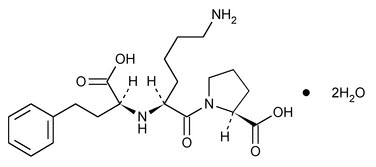
    Lisinopril is an oral long-acting angiotensin converting enzyme (ACE) inhibitor. Lisinopril is a synthetic peptide derivative that is manufactured as a dihydrate and is chemically described as 1-[
    Structural Formula
    Lisinopril is a white to off-white, crystalline powder, with a molecular weight of 441.52 (for dihydrate). It is soluble in water, sparingly soluble in methanol, and practically insoluble in ethanol.
    QBRELIS (lisinopril), 1 mg/mL, is a ready-to-use aqueous formulation. Each 1 mL of the oral solution contains 1.09 mg of lisinopril dihydrate, which is equivalent to 1 mg of lisinopril as the active ingredient and the following inactive ingredients: purified water, xylitol, sodium citrate, citric acid, sodium benzoate, and either hydrochloric acid or sodium hydroxide which may be added for pH adjustment. The solution is clear to slightly opalescent. The pH of the solution ranges from 4.3 to 5.1. QBRELIS is supplied as 150 mL of the solution packaged in a 150-mL round, white, opaque, high-density polyethylene (HDPE) bottle with a white, polypropylene, child-resistant closure with a heat induction layered inner seal.
    5HOW SUPPLIED/STORAGE AND HANDLING
    QBRELIS (lisinopril), 1 mg/mL, is supplied as 150 mL of a clear to slightly opalescent, colorless aqueous oral solution with a sweet taste in a 150-mL high-density polyethylene (HDPE) bottle with a child-resistant cap (NDC 52652-3001-1).
    Store at controlled room temperature 20°C-25°C (68°F-77°F) [see USP] in a tightly closed container. Protect from freezing and excessive heat.
    6PATIENT COUNSELING INFORMATION
    Pregnancy: Tell female patients of childbearing age about the consequences of exposure to QBRELIS during pregnancy. Discuss treatment options with women planning to become pregnant. Tell patients to report pregnancies to their physicians as soon as possible.
    Angioedema: Angioedema, including laryngeal edema may occur at any time during treatment with angiotensin converting enzyme inhibitors, including QBRELIS. Tell patients to report immediately any signs or symptoms suggesting angioedema (swelling of face, extremities, eyes, lips, tongue, difficulty swallowing or breathing) and to take no more drug until they have consulted with the prescribing physician.
    Symptomatic Hypotension: Tell patients to report light-headedness especially during the first few days of therapy. If actual syncope occurs, tell the patient to discontinue the drug until they have consulted with the prescribing physician.
    Tell patients that excessive perspiration and dehydration may lead to an excessive fall in blood pressure because of reduction in fluid volume. Other causes of volume depletion such as vomiting or diarrhea may also lead to a fall in blood pressure; advise patients accordingly.
    Hyperkalemia: Tell patients to consult their physician prior to using salt substitutes containing potassium.
    Hypoglycemia: Tell diabetic patients treated with oral antidiabetic agents or insulin starting an ACE inhibitor to monitor for hypoglycemia closely, especially during the first month of combined use
    Leukopenia/Neutropenia: Tell patients to report promptly any indication of infection (e.g., sore throat, fever), which may be a sign of leukopenia/neutropenia.
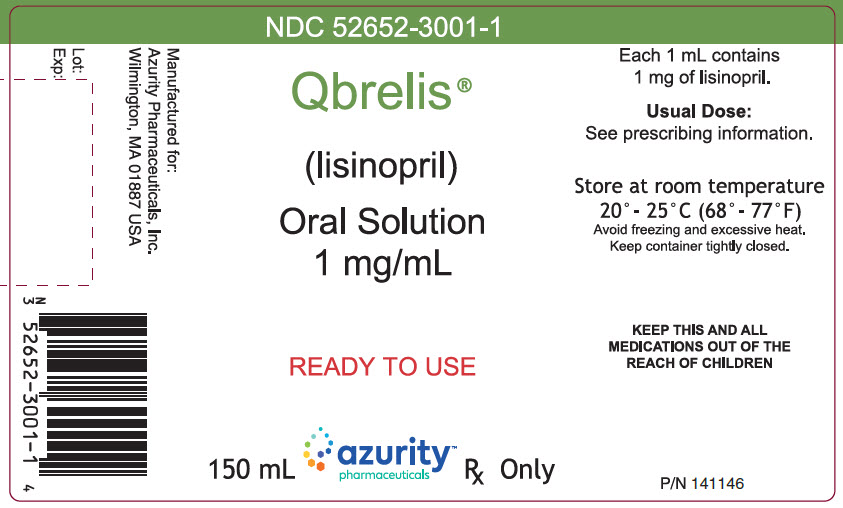
    7PRINCIPAL DISPLAY PANEL - Bottle Label
    Principal Display Panel - Bottle Label
    NDC 52652-3001-1
    Qbrelis
    Oral Solution
    READY TO USE
    150 mL
    Each 1 mL contains
    Usual Dose: See prescribing information.
    Store at room temperature
    KEEP THIS AND ALL
    P/N 141146
    Manufactured for:
    Lot: