Hypertrichosis-Acromegaloid Facial Appearance Syndrome Treatments
Find Hypertrichosis-Acromegaloid Facial Appearance Syndrome Treatments
Octreotide Acetate
What is Bynfezia (Octreotide Acetate)?
Approved To Treat
Related Clinical Trials
Summary: Between 10% and 15% of patients with endogenous hypercortisolism (Cushing syndrome) have ectopic (non-pituitary) production of adrenocorticotropin hormone (ACTH) that causes cortisol excess. In approximately 50% of these patients, the tumoral source of ACTH cannot be found initially despite very detailed and extensive imaging, including studies such as computed tomography, magnetic resonance imagi...
Summary: The purpose of this study is to collect long-term (up to two years) safety and effectiveness of octreotide subcutaneous depot in patients with acromegaly in the real-world setting.
Summary: The primary purpose of this study is to assess the effect of Debio 4126 in the maintenance of the levels of insulin-like growth factor 1 (IGF-1) ≤1x upper limit of normal (ULN) in the double-blind period (Period 1) in comparison to placebo at week 36.
Related Latest Advances
Brand Information
- Injection: 7,000 mcg/2.8 mL (2,500 mcg/mL) octreotide (as acetate) as a clear, colorless solution in a single-patient-use prefilled pen.
- Cardiac Conduction Abnormalities
- Cholelithiasis and Complications of Cholelithiasis
- Hyperglycemia and Hypoglycemia
- Thyroid Function Abnormalities
- Steatorrhea and Malabsorption of Dietary Fats
- Changes in Vitamin B
Gallbladder abnormalities, especially stones and/or biliary sludge, frequently develop in patients on chronic octreotide therapy [see Warnings and Precautions (5.1)]. In clinical trials (primarily patients with acromegaly or psoriasis) (BYNFEZIA PEN is not indicated for the treatment of psoriasis)], the incidence of biliary tract abnormalities was 63% (27% gallstones, 24% sludge without stones, 12% biliary duct dilatation). The incidence of stones or sludge in patients who received octreotide for 12 months or longer was 52%. Less than 2% of patients treated with octreotide for 1 month or less developed gallstones.
Cardiac
In acromegalics, sinus bradycardia (<50 bpm) developed in 25%; conduction abnormalities occurred in 10% and arrhythmias developed in 9% of patients during octreotide therapy [see Warnings and Precautions (5.1)].
Diarrhea, loose stools, nausea, and abdominal discomfort were each seen in 34% to 61% of acromegalic patients in U.S. studies. 2.6% of the patients discontinued therapy due to these symptoms. These symptoms were seen in 5% to 10% of patients with carcinoid tumors and VIPomas.
Hypoglycemia and hyperglycemia occurred in 3% and 16% of acromegalic patients, respectively, but only in about 1.5% of other patients. Symptoms of hypoglycemia were noted in approximately 2% of patients.
In acromegalics, biochemical hypothyroidism alone occurred in 12% while goiter occurred in 8% and 4% required initiation of thyroid replacement therapy during octreotide therapy [see Warnings and Precautions (5.4)]. In patients without acromegaly, hypothyroidism has only been reported in several isolated patients and goiter has not been reported.
Pain on injection was reported in 7.7%, headache in 6%, and dizziness in 5%. Pancreatitis was also observed [see Warnings and Precautions (5.2)].
Other events, each observed in 1% to 4% of patients, included fatigue, weakness, pruritus, joint pain, backache, urinary tract infection, cold symptoms, flu symptoms, injection site hematoma, bruise, edema, flushing, blurred vision, pollakiuria, fat malabsorption, hair loss, visual disturbance, and depression.
Gastrointestinal: intestinal obstruction, pancreatic exocrine insufficiency
Hematologic: thrombocytopenia
Dispense in the original sealed carton with the enclosed Instructions for Use.
Storage and Handling
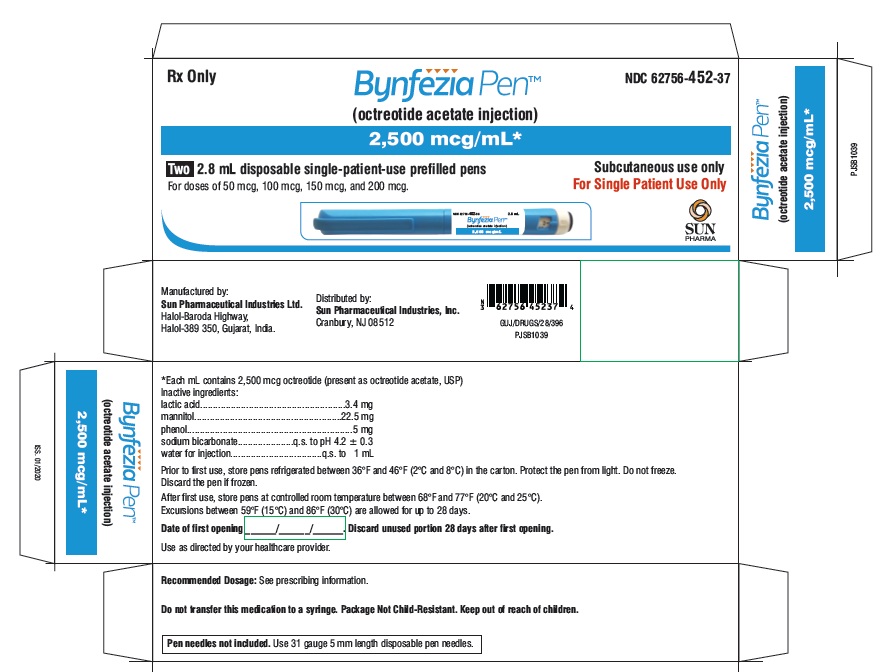
NDC 62756-452-37
Bynfezia Pen
7,000 mcg/2.8mL (2,500 mcg/mL)
Two 2.8 mL disposable single-patient-use prefilled pens
For doses of 50 mcg, 100 mcg, 150 mcg, and 200 mcg of octreotide per injection.
For Single Patient Use Only
SUN PHARMA