Hypoparathyroidism Treatments

Find Hypoparathyroidism Treatments

Brand Name

Vectical

Generic Name
Calcitriol
View Brand Information
FDA approval date: July 18, 2003
Classification: Vitamin D3 Analog
Form: Injection, Ointment, Capsule, Solution

What is Vectical (Calcitriol)?

Predialysis Patients Calcitriol capsules re indicated in the management of secondary hyperparathyroidism and resultant metabolic bone disease in patients with moderate to severe chronic renal failure not yet on dialysis. In children, the creatinine clearance value must be corrected for a surface area of.
Save this treatment for later
Sign Up
Not sure about your diagnosis?
Check Your Symptoms
Tired of the same old research?
Check Latest Advances

Related Clinical Trials

Effect Of Local Use Of 1,25 Dihydroxycholecalciferol on Rate of Canine Distillization: A Split Mouth Randomized Control Trial

Summary: Orthodontic treatment (OT) is characterized as a lengthy procedure and enormous effort has been harnessed to shorten the OT duration using either surgical or non-surgical approaches. With the emerging concept of accelerated orthodontics, scientific interest has been focused on chemical and electrical stimuli in combination with mechanical forces for rapid bone turnover and more stable results. Giv...

Comparative Study of Combined Microneedling With Either 1% Lactic Acid Solution or Vitamin D3 or Triamcinolone Acetonide in The Treatment of Alopecia Areata

Summary: Alopecia areata (AA) is an immunologically mediated disease characterized by non-scarring hair loss (Madni and Shapiro, 2000). AA is presented by rapid and complete hair loss in one or more round or oval patches, usually on the scalp, beard area, eyebrows, eyelashes, and less commonly, on other hairy areas of the body (Berker et al., 2010 and James et al., 2011) Alopecia areata is a T-cell-mediate...

Comparing the Quality of Life Associated With Empiric Calcium Repletion and Parathormone (PTH) Based Calcium Repletion for Post Thyroidectomy Hypoparathyroidism

Summary: This study aims to compare two different protocols commonly used in the management of post thyroidectomy hypoparathyroidism : PTH based calcium repletion and empiric repletion. The investigators aim to compare the quality of life associated with these two protocols in a randomized trial.

Brand Information

Vectical (calcitriol)
4OVERDOSAGE
Topically applied calcitriol can be absorbed in sufficient amounts to produce systemic effects [
5DESCRIPTION
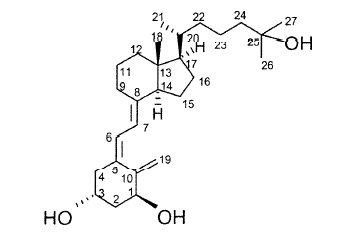
VECTICAL (calcitriol) Ointment 3 mcg/g is a vitamin D analog intended for topical application to the skin. The chemical name of the active ingredient is (5Z,7E)-9,10-secocholesta-5,7,10(19)-triene-1α,3β,25-triol. The structural formula is:
chemical-structure
Calcitriol is a white or almost white crystalline solid. It is practically insoluble in water, soluble in alcohol and in fatty oils. The molecular formula is C
VECTICAL Ointment is a translucent ointment containing 3 mcg/g (0.0003% w/w) of calcitriol, packaged in aluminum tubes with screw caps. Other components of the ointment are mineral oil, dl-α-tocopherol, and white petrolatum.
6CLINICAL PHARMACOLOGY
The contribution to efficacy of individual components of the vehicle has not been established.
6.1Mechanism of Action
The mechanism of action of calcitriol in the treatment of psoriasis has not been established.
6.2Pharmacokinetics
The systemic exposure of calcitriol was assessed in subjects with chronic, plaque psoriasis. In the pivotal pharmacokinetic/pharmacodynamic study, calcitriol ointment 3 mcg/g, was applied twice daily for 21 days (for a total dose of 30 g/day) to 35% of the body surface area (psoriatic + surrounding healthy skin) of subjects with at least 25% of body surface area involvement. At Day 21, the geometric mean plasma concentration values of C
Specific Populations
Pediatric Patients
The systemic exposure of calcitriol was assessed in pediatric subjects ages 2 to 17 years with plaque psoriasis in two trials. In one trial, 25 subjects ages 12 to 17 applied calcitriol ointment 3 mcg/g twice a day for 8 weeks to a body surface area of 10% to 35%. The mean daily dose was 10.43 g/day. In the second trial, 17 subjects ages 2 to 12 applied calcitriol ointment 3 mcg/g twice a day for 14 days to a body surface area of 3% to 18%. The mean daily dose was 17.09 g/day. In both trials, the systemic concentrations of calcitriol post treatment were relatively flat and were generally comparable to the endogenous levels observed at baseline. The PK parameters could not be reliably estimated.

There was no correlation between the elevated calcitriol levels and the pharmacodynamic parameters of serum albumin adjusted calcium, serum phosphorus, urinary calcium and urinary phosphorus.
7NONCLINICAL TOXICOLOGY

7.1Carcinogenesis, Mutagenesis, Impairment of Fertility
When calcitriol was applied topically to mice for up to 24 months, no significant changes in tumor incidence were observed. Concentrations of calcitriol in ointment base of 0 (vehicle control), 0.3, 0.6 and 1.0 ppm were evaluated.
A two-year carcinogenicity study was conducted in which calcitriol was orally administered to rats at dosages of approximately 0.005, 0.03, and 0.1 mcg/kg/day (0.03, 0.18, and 0.6 mcg/m
Calcitriol did not elicit genotoxic effects in the mouse lymphoma TK locus assay. Studies in which male and female rats received oral doses of calcitriol of up to 0.6 mcg/kg/day (3.6 mcg/m
8CLINICAL STUDIES
In two, multicenter, double-blind, vehicle-controlled studies, a total of 839 subjects with psoriasis rated "mild" or "moderate" using an investigator global assessment scale were treated twice daily for 8 weeks. Subjects were randomized in a 1:1 ratio to receive either VECTICAL Ointment or vehicle ointment. The mean age of the subjects was 48 years and 66% were male; most subjects were rated "moderate" at baseline.
Success was defined as "Clear or Minimal" (up to light red or pink in coloration, surface dryness with some white coloration, and slight elevation above normal skin) with at least a 2-grade change from baseline. The success rates are displayed in the Table 2.
9PATIENT COUNSELING INFORMATION
Advise the patient to read the FDA-approved patient labeling (Patient Information).
Patients using VECTICAL Ointment should receive the following information:
  • This medication is to be used as directed by the physician. It is for external use only. This medication is to be applied only to areas of the skin affected by psoriasis, as directed. It should be gently rubbed into the skin so that no medication remains visible.
  • This medication may affect calcium metabolism. Hypercalcemia has been observed in subjects exposed to this medicine. Increased absorption may occur with use of occlusive dressings.
  • Avoid use of more than 100 grams per week in patients ages 2-6 years and use of more than 200 grams per week in patients ages 7 years and older. 
  • Instruct patients to report any signs of adverse reactions to their physician.
  • Avoid contact with eyes, lips, and facial skin.
  • Advise breastfeeding women not to apply VECTICAL Ointment directly to the nipple and areola to avoid direct infant exposure
To report SUSPECTED ADVERSE REACTIONS, contact Galderma Laboratories, L.P. at 866-735-4137 or FDA at 1-800-FDA-1088 or
US Patent No. 7,749,986
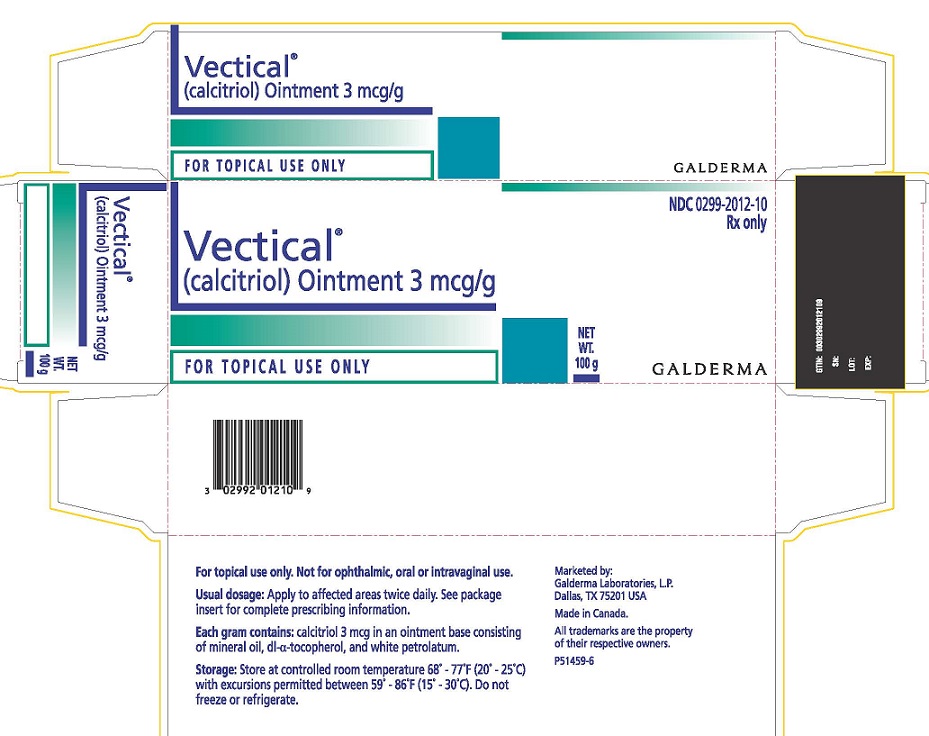
10PACKAGE LABEL - 100 g CARTON
carton-image
Vectical® NET WT. 100 g

GALDERMA
For topical use only. Not for ophthalmic, oral or intravaginal use. Apply to affected areas twice daily. See package insert for complete prescribing information.
Each gram contains:calcitriol 3mcg in an ointment base consisting of mineral oil, dl-α-tocopherol, and white petrolatum,
Storage:Store at controlled room temperature 68° - 77° (20° -25°C) with excursions permitted between 59° - 86°F (15° - 30°C).
Do not freeze or refrigerate.

Marketed by: GALDERMA LABORATORIES, L.P.
Dallas, Texas 75201 USA

Made in Canada.

All trademarks are the property of their respective owners.
P51459-6