Brand Name

Doptelet

Generic Name
Avatrombopag
View Brand Information
FDA approval date: May 23, 2018
Form: Tablet, Granule

What is Doptelet (Avatrombopag)?

Living with a condition that causes a low platelet count can bring a significant amount of worry and uncertainty into your life. Platelets are the tiny, essential blood cells responsible for forming clots to stop bleeding. When their numbers are too low, a condition called thrombocytopenia, even a minor injury can become a serious concern, and necessary medical procedures can seem dauntingly risky. For years, the primary solution was often a platelet transfusion. Today, however, targeted oral medications can help your body produce its own platelets. One of these modern treatments is Doptelet (avatrombopag).

Doptelet is a prescription medication designed to increase the number of platelets in the blood. It is not a blood product or a transfusion. Instead, it belongs to an advanced class of drugs known as thrombopoietin (TPO) receptor agonists. Whether you are preparing for a medical procedure with chronic liver disease or managing the long-term challenges of chronic immune thrombocytopenia (ITP), Doptelet offers a convenient, effective, and targeted approach to reducing your risk of bleeding.

What does Doptelet do?

Doptelet is approved by the U.S. Food and Drug Administration (FDA) for two main purposes in adults:

  • Chronic Liver Disease (CLD): For patients undergoing medical/dental procedures, Doptelet temporarily increases platelet counts to reduce bleeding risk, as CLD impairs thrombopoietin production.
  • Chronic Immune Thrombocytopenia (ITP): For patients unresponsive to other treatments, Doptelet stimulates platelet production in the bone marrow to counter immune-mediated platelet destruction.

The primary goal of treatment is to raise the platelet count to a level that minimizes the risk of dangerous bleeding. Clinical studies have shown Doptelet to be highly effective. In patients with CLD, a short course of Doptelet significantly increased platelet counts, allowing many of them to undergo their procedures without needing a platelet transfusion (Dova Pharmaceuticals, 2021).

How does Doptelet work?

To understand how Doptelet works, it’s helpful to think of your bone marrow, the spongy tissue inside your bones, as a factory that produces blood cells. This factory has a specific manager that tells it when to produce platelets. This manager is a natural hormone called thrombopoietin (TPO). TPO travels through the bloodstream, binds to special docking stations (receptors) on the surface of bone marrow cells, and gives the command: “Make more platelets!”

In conditions like chronic liver disease or ITP, this signaling system can be disrupted. Either not enough TPO is being made, or the platelets are being destroyed too quickly for the factory to keep up.

Doptelet is a TPO receptor agonist. This means it is a specially designed molecule that “mimics” the action of the TPO hormone. It acts like a master key that fits perfectly into the TPO receptors on the bone marrow cells. By binding to these receptors, Doptelet delivers the same powerful “make more platelets” signal that natural TPO would. This targeted stimulation kicks the bone marrow factory into a higher gear, increasing the production and release of new, functional platelets into the bloodstream.

Doptelet side effects

Like all medications, Doptelet has potential side effects. Most are mild to moderate, but there is one significant risk that you and your doctor must carefully consider.

Common side effects may include:

  • Fever
  • Stomach pain
  • Nausea
  • Headache
  • Fatigue
  • Swelling in the hands or feet

The most serious and important risk associated with Doptelet is the potential for thrombotic or thromboembolic events, which means blood clots. Because the medication works by increasing the number of platelets, the cells that form clots, it can increase the risk of developing unwanted clots in your veins or arteries. These clots can be very dangerous and can lead to conditions like:

  • Deep vein thrombosis (DVT): A clot in a deep vein, usually in the leg.
  • Pulmonary embolism (PE): A clot that travels to the lungs.
  • Stroke: A clot that blocks blood flow to the brain.
  • Heart attack: A clot that blocks blood flow to the heart.

Individuals with existing risk factors, such as a personal/family history or genetic conditions, face a higher risk of blood clots. Seek immediate medical attention for symptoms like leg swelling, pain, or redness; shortness of breath or chest pain; or sudden weakness, numbness, or speech difficulty.

Doptelet dosage

Doptelet is an oral tablet that is taken once daily. The exact dose you are prescribed will depend on your specific condition and your baseline platelet count. It is very important to take Doptelet with food to ensure that your body absorbs the medication properly and gets the full benefit.

Regular blood monitoring, including a complete blood count (CBC) before and throughout Doptelet treatment, is crucial. This ensures the medication effectively raises platelet levels without making them too high, which could increase clot risk. It also allows your doctor to adjust the dose to maintain a safe and effective platelet count.

Does Doptelet have a generic version?

No, there is currently no generic version of Doptelet (avatrombopag) available. However, international versions may exist in other markets. As a newer and specialized biologic medication, it is a brand-name drug that is protected by patents. These patents prevent other manufacturers from producing a generic equivalent for several years.

Conclusion

Doptelet is a modern, oral treatment that stimulates the body’s platelet production, reducing bleeding risk and potentially eliminating transfusions for patients with dangerously low platelet counts. This allows for safer procedures and better management of chronic conditions.

Doptelet’s benefits must be weighed against its serious risk of blood clots. Close collaboration with your healthcare provider, including regular platelet monitoring and open communication, is vital to ensure safe and effective use, supporting your health.

References

  1. Dova Pharmaceuticals. (2021). DOPTELET® (avatrombopag) Prescribing Information. U.S. Food and Drug Administration. Retrieved from https://www.accessdata.fda.gov/drugsatfda_docs/label/2021/210238s007lbl.pdf
  2. Mayo Clinic. (2024). Avatrombopag (Oral Route). Retrieved from https://www.mayoclinic.org/drugs-supplements/avatrombopag-oral-route/symptoms/drg-20454378
  3. National Institutes of Health. (2022). Avatrombopag. MedlinePlus. Retrieved from https://medlineplus.gov/druginfo/meds/a618023.html
Save this treatment for later
Sign Up
Not sure about your diagnosis?
Check Your Symptoms
Tired of the same old research?
Check Latest Advances

Related Clinical Trials

A Multicenter, Randomized, Double-Blind, Placebo-Controlled Phase 2 Study of Avatrombopag for Persistent Chemotherapy-Induced Thrombocytopenia in Patients With Gastrointestinal Malignancies (ACT-GI)

Summary: The purpose of this study is to compare the efficacy of two study drugs, Avatrobopag versus placebo, to treat persistent Chemotherapy-Induced Thrombocytopenia (CIT) in patients with gastrointestinal (GI) malignancies receiving cytotoxic chemotherapy. The names of the study drugs involved in this study are: * Avatrombopag (a thrombopoietin receptor agonist) * Matching placebo

Exploring the Efficacy, Safety of a Modified Starting Dosage of Avatrombopag in Immune Throbocytopenia (ITP) - a Pilot Study

Summary: This is a single-center, open label pilot trial where patients with primary ITP who require second line treatment will be offered avatrombopag at a reduced starting dose, adjusted thereafter according to the response and continued for up to 24 weeks. The study aims to acquire experience on use of avatrombopag and explore the efficacy and safety of lower starting dose of avatrombopag

Efficacy and Safety of Avatrombopag in the Treatment of Adult Immune Thrombocytopenia With Autoantibodies Fail to Eltrombopag or Herombopag Treatment: a Single-center, Prospective, One-arm Clinical Trial

Summary: This prospective, open-label, single-center, one-arm clinical trial aims at evaluating the efficacy and safety of avatrombopag in Chinese adult Immune Thrombocytopenia (ITP) patients with autoantibodies fail (due to intolerance or resistance) to eltrombopag or herombopag treatment.

Brand Information

DOPTELET (avatrombopag maleate)
1DOSAGE FORMS AND STRENGTHS
Tablets
DOPTELET Tablets: 20 mg as round, biconvex, yellow, film-coated tablets debossed with “AVA” on one side and “20” on the other side.
Oral Granules
DOPTELET SPRINKLE: 10 mg as Size 0 capsules containing white to off-white granules. The capsules have a white opaque body and light blue opaque cap with a black arrow symbol imprinted on the body and cap.
2CONTRAINDICATIONS
None.
3ADVERSE REACTIONS
The following clinically significant adverse reactions are discussed in detail in other sections of the labeling:
  • Thrombotic/Thromboembolic Complications
3.1Clinical Trial Experience 
Because clinical trials are conducted under widely varying conditions, adverse reaction rates observed in the clinical trials of a drug cannot be directly compared to rates in the clinical trials of another drug and may not reflect the rates observed in practice.
Patients with Chronic Liver Disease
The safety of DOPTELET was evaluated in two international, identically designed, randomized, double-blind, placebo-controlled trials, ADAPT-1 and ADAPT-2, in which 430 patients with chronic liver disease and thrombocytopenia received either DOPTELET (n=274) or placebo (n=156) daily for 5 days prior to a scheduled procedure, and had 1 post-dose safety assessment. Patients were divided into two groups based on their mean platelet count at baseline:
  • Low Baseline Platelet Count Cohort (less than 40×10
  • High Baseline Platelet Count Cohort (40 to less than 50×10
The majority of patients were males (65%) and median subject age was 58 years (ranging from 19-86 years of age). The racial and ethnic distribution was White (60%), Asian (33%), Black (3%) and Other (3%).
The most common adverse reactions (those occurring in ≥3% of patients) in the DOPTELET-treated groups (60 mg or 40 mg) across the pooled data from the two trials are summarized in Table 8.
Table 8Adverse Reactions with a Frequency ≥3% in Patients with Chronic Liver Disease Treated with DOPTELET – Pooled Data ADAPT-1 and ADAPT-2
For the Low Baseline Platelet Count Cohort, the incidence of serious adverse reactions was 7% (11/159) in the 60 mg DOPTELET treatment group. For the High Baseline Platelet Count Cohort, the incidence of serious adverse reactions was 8% (9/115) in the 40 mg DOPTELET treatment group. The most common serious adverse reaction reported with DOPTELET was hyponatremia. Two DOPTELET-treated patients (0.7%) developed hyponatremia.
Adverse reactions resulting in discontinuation of DOPTELET were anemia, pyrexia, and myalgia; each was reported in a single (0.4%) patient in the DOPTELET (60 mg) treatment group.
Adult Patients with Chronic Immune Thrombocytopenia
The safety of DOPTELET was evaluated in four clinical trials in adult patients with chronic immune thrombocytopenia: two Phase 3 trials (one randomized, double-blind, placebo-controlled trial, and one randomized, double-blind, active-controlled trial) and two Phase 2 trials (one randomized, double-blind, placebo-controlled, dose-ranging, trial, and one open-label extension trial) in 161 patients with chronic immune thrombocytopenia in both the double-blind and open-label extension phases.
The pooled safety data from these four clinical trials includes 128 patients who received 2.5 to 40 mg of DOPTELET once daily for a median duration of exposure of 29.1 weeks and had 1 post-dose safety assessment. The majority of patients were female (63%) and median subject age was 50.5 years (ranging from 18-88 years of age). The racial and ethnic distribution was White (84%), Black (6%), Asian (6%) and Other (6%).
The most common adverse reactions (those occurring in ≥10% of patients) in the DOPTELET-treated patients across the pooled safety data from the four trials are summarized in Table 9.
Table 9: Adverse Reactions with a Frequency ≥10% in Adult Patients with Chronic Immune Thrombocytopenia Treated with DOPTELET – Pooled Data from Clinical Trials
The incidence of serious adverse reactions was 9% (12/128) in the DOPTELET treatment group. Serious adverse reactions reported in more than 1 individual DOPTELET-treated patient included headache, occurring in 1.6% (2/128).
Adverse reactions resulting in discontinuation of DOPTELET that were reported in more than 1 patient included headache, occurring in 1.6% (2/128).
Pediatric Patients with Persistent or Chronic Immune Thrombocytopenia
The data described below reflect median exposure to DOPTELET of 12 weeks for 54 pediatric patients (≥1 to <18 years of age) with persistent or chronic immune thrombocytopenia across the core phase of one double-blind, placebo-controlled trial
Table 10 presents the most common adverse reactions (experienced by greater than or equal to 10% of pediatric patients 1 year and older receiving DOPTELET) with a higher incidence for DOPTELET versus placebo.
Table 10: Adverse Reactions in Pediatric Patients with Persistent or Chronic Immune Thrombocytopenia Treated with DOPTELET
a Adverse reactions that occurred in ≥10% of DOPTELET-treated patients and ≥2% more than placebo-treated patients.
b Viral infection includes viral upper respiratory infection, viral infection, COVID-19, parainfluenza virus infection, and rhinovirus infection.
Two patients experienced serious adverse reactions: thrombocytosis and headache. Two patients experienced adverse reactions resulting in discontinuation of DOPTELET: vomiting and headache (in one patient) and leukocytosis (in one patient).
3.2Postmarketing Experience
The following adverse reactions have been identified during post approval use of DOPTELET. Because these reactions are reported voluntarily from a population of uncertain size, it is not always possible to reliably estimate their frequency or establish a causal relationship to drug exposure.
Immune System Disorders: Hypersensitivity reactions including pruritus, rash, choking sensation, erythema, pharyngeal edema, pruritus generalized, rash macular, swelling face, and swollen tongue.
4OVERDOSAGE
In the event of overdose, platelet count may increase excessively and result in thrombotic or thromboembolic complications. Closely monitor the patient and platelet count. Treat thrombotic complications in accordance with standard of care.
No antidote for DOPTELET overdose is known.
Hemodialysis is not expected to enhance the elimination of DOPTELET because avatrombopag is only approximately 6% renally excreted and is highly bound to plasma proteins.
Consider contacting the Poison Help line (1-800-222-1222) or a medical toxicologist for additional overdose management recommendations.
5DESCRIPTION
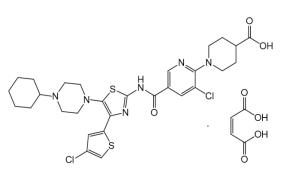
The active ingredient in DOPTELET is avatrombopag maleate, a thrombopoietin receptor agonist. The chemical name of avatrombopag maleate is 4-piperidinecarboxylic acid, 1-[3-chloro-5-[[[4-(4-chloro-2-thienyl)-5-(4-cyclohexyl-1-piperazinyl)-2-thiazolyl]amino]carbonyl]-2-pyridinyl]-, (2Z)-2-butenedioate (1:1). It has the molecular formula C
The structural formula is:
image description
The aqueous solubility of avatrombopag maleate at various pH levels indicates that the drug substance is practically insoluble at pH 1 to 11.
DOPTELET is provided as an immediate-release tablet and as a sprinkle capsule that contains oral granules.
Each DOPTELET tablet contains 20 mg avatrombopag (equivalent to 23.6 mg of avatrombopag maleate) and the following inactive ingredients: colloidal silicon dioxide, crospovidone, lactose monohydrate, magnesium stearate, and microcrystalline cellulose. Coating film: ferric oxide yellow, polyethylene glycol, polyvinyl alcohol, talc, and titanium dioxide.
Each DOPTELET SPRINKLE capsule contains 10 mg avatrombopag (equivalent to 11.8 mg of avatrombopag maleate) and the following inactive ingredients: crospovidone Type A, magnesium stearate, mannitol, microcrystalline cellulose, and sodium lauryl sulfate. Capsule shells: Hypromellose.
6PATIENT COUNSELING INFORMATION
Advise the patient or caregiver to read the FDA-approved patient labeling: Patient Information and, for DOPTELET SPRINKLE, Instructions for Use.
Prior to treatment, patients should fully understand and be informed of the following risks and considerations for DOPTELET:
Risks
Thrombotic/Thromboembolic Complications
DOPTELET is a thrombopoietin (TPO) receptor agonist and TPO receptor agonists have been associated with thrombotic and thromboembolic complications in patients with chronic liver disease or immune thrombocytopenia. Portal vein thrombosis has been reported in patients with chronic liver disease treated with TPO receptor agonists. Various thromboembolic complications (arterial and venous) have been reported in patients treated with DOPTELET
Drug Interactions
DOPTELET may be affected by other drugs and may require a dose adjustment when co-administered with other drugs; therefore, advise patients to report their use of any other prescription or nonprescription medications or dietary supplements
Pregnancy
Advise pregnant women of the potential risk to a fetus. Advise females of reproductive potential to inform their prescriber of a known or suspected pregnancy
Lactation
Advise women not to breastfeed during treatment with DOPTELET and for at least 2 weeks after the last dose
Administration Instructions for DOPTELET SPRINKLE
  • Inform patients and caregivers to open the capsules and mix the contents with the recommended soft foods or liquids. Administer immediately after mixing. Do not swallow the capsules whole. Do not chew or crush the granules.
  • Advise patients and caregivers to read and follow the Instructions for Use for DOPTELET SPRINKLE.
DOPTELET and DOPTELET SPRINKLE are not substitutable on a milligram-to-milligram basis
  • Advise patients and caregivers that DOPTELET and DOPTELET SPRINKLE are not substitutable on a milligram-to-milligram basis.
  • To avoid a dosing error from using the wrong dosage form, strongly advise patients and caregivers to visually inspect the product to verify the correct dosage form each time the prescription is filled.
DOPTELET is a registered trademark of AkaRx, Inc.
Manufactured for AkaRx, Inc., Morrisville, North Carolina 27560
©2025
For more information, go to
PI0002 R8
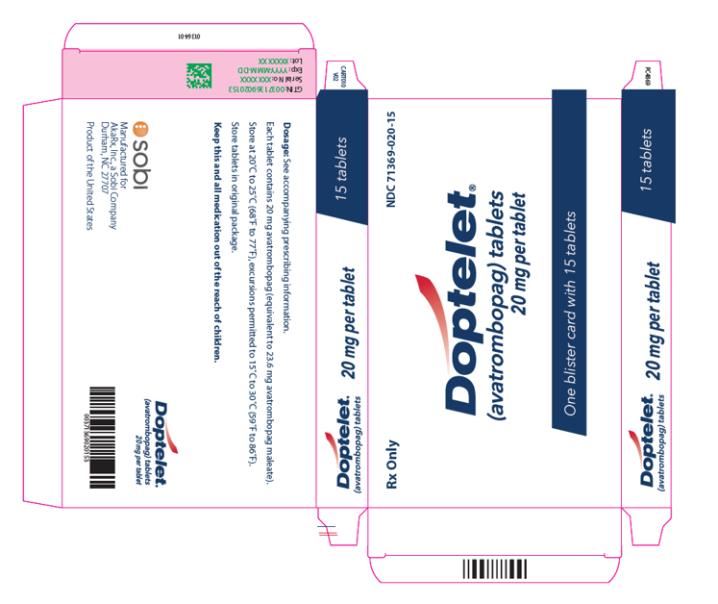
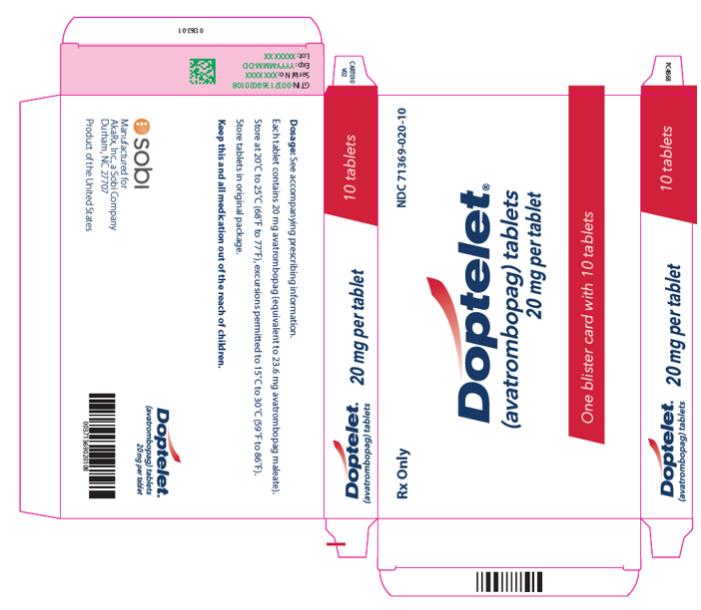
7PRINCIPAL DISPLAY PANEL
NDC 71369-020-10
image description
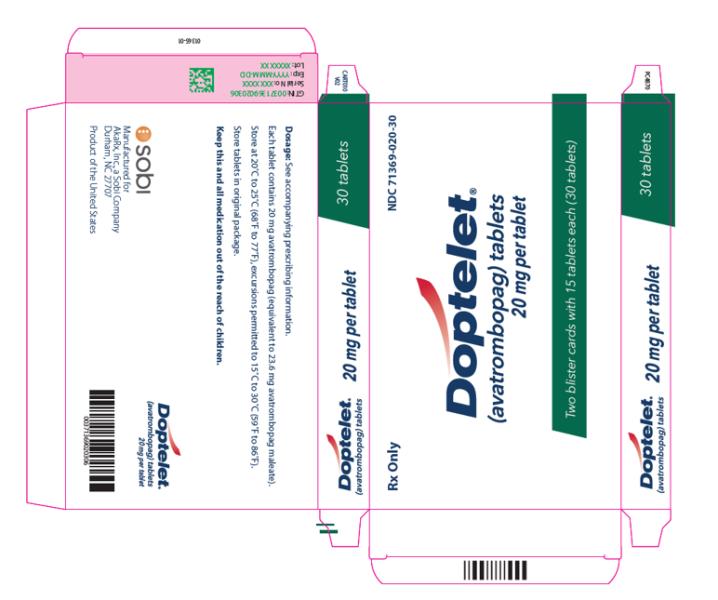
8PRINCIPAL DISPLAY PANEL
NDC 71369-020-15
image description
9PRINCIPAL DISPLAY PANEL
NDC 71369-020-30
image description
10PRINCIPAL DISPLAY PANEL
NDC 71369-010-30
one bottle with 30 capsules
image description