Lung Cancer Treatments

Find Lung Cancer Treatments

Generic Name

Pemetrexed

Brand Names
Alimta, AXTLE, Pemfexy, Pemrydi Rtu
FDA approval date: February 04, 2004
Classification: Folate Analog Metabolic Inhibitor
Form: Injection, Solution

What is Alimta (Pemetrexed)?

ALIMTA ® is a folate analog metabolic inhibitor indicated: in combination with pembrolizumab and platinum chemotherapy, for the initial treatment of patients with metastatic non-squamous NSCLC, with no EGFR or ALK genomic tumor aberrations.
Save this treatment for later
Sign Up
Not sure about your diagnosis?
Check Your Symptoms
Tired of the same old research?
Check Latest Advances

Related Clinical Trials

A Phase II Study of Aumolertinib Combined With Phased Chemotherapy for Treatment-Naïve EGFR L858R-Mutated Lung Adenocarcinoma (ACCEL Trial)

Background: While third-generation EGFR tyrosine kinase inhibitors (TKI) like aumolertinib have significantly improved outcomes for patients with advanced lung adenocarcinoma, those harboring the L858R mutation still experience inferior prognosis compared to those with exon 19 deletions. Recent evidence suggests that combining TKIs with chemotherapy improves progression-free survival (PFS), but universal appl...

Phase I/II Study of Neoadjuvant Inhaled Azacytidine With Platinum-Based Chemotherapy and Durvalumab (MEDI4736) - a Combined Epigenetic-Immunotherapy (AZA-AEGEAN) Regimen for Operable Early-Stage Non-Small Cell Lung Cancer (NSCLC)

Background: Lung cancer is the leading cause of cancer-related death worldwide. Non-small cell lung cancer (NSCLC) is the most common type of lung cancer. Surgery to remove the tumors is the standard treatment for people diagnosed with early stages of NSCLC. Despite complete removal of these tumors, many recur (happen again). An FDA-approved drug combination to treat early-stage NSCLC prior to the surgery is ...

Integration of Immunotherapy Into Adjuvant Therapy for Resected NSCLC: ALCHEMIST Chemo-IO (ACCIO)

Summary: This phase III ALCHEMIST treatment trial tests the addition of pembrolizumab to usual chemotherapy for the treatment of stage IIA, IIB, IIIA or IIIB non-small cell lung cancer that has been removed by surgery. Immunotherapy with monoclonal antibodies, such as pembrolizumab, may help the body's immune system attack the cancer, and may interfere with the ability of tumor cells to grow and spread. Ch...

Brand Information

    Alimta (Pemetrexed disodium)
    1DOSAGE FORMS AND STRENGTHS
    For injection: 100 mg or 500 mg pemetrexed as a white to light-yellow or green-yellow lyophilized powder in single-dose vials for reconstitution.
    2CONTRAINDICATIONS
    ALIMTA is contraindicated in patients with a history of severe hypersensitivity reaction to pemetrexed
    3ADVERSE REACTIONS
    The following adverse reactions are discussed in greater detail in other sections of the labeling:
    • Myelosuppression
    • Renal failure
    • Bullous and exfoliative skin toxicity
    • Interstitial pneumonitis
    • Radiation recall
    3.1Clinical Trials Experience
    Because clinical trials are conducted under widely varying conditions, adverse reactions rates cannot be directly compared to rates in other clinical trials and may not reflect the rates observed in clinical practice.
    In clinical trials, the most common adverse reactions (incidence ≥20%) of ALIMTA, when administered as a single agent, are fatigue, nausea, and anorexia. The most common adverse reactions (incidence ≥20%) of ALIMTA, when administered in combination with cisplatin are vomiting, neutropenia, anemia, stomatitis/pharyngitis, thrombocytopenia, and constipation. The most common adverse reactions (incidence ≥20%) of ALIMTA, when administered in combination with pembrolizumab and platinum chemotherapy, are fatigue/asthenia, nausea, constipation, diarrhea, decreased appetite, rash, vomiting, cough, dyspnea, and pyrexia.
    3.2Postmarketing Experience
    The following adverse reactions have been identified during post-approval use of ALIMTA. Because these reactions are reported voluntarily from a population of uncertain size, it is not always possible to reliably estimate their frequency or establish a causal relationship to drug exposure.
    • Blood and Lymphatic System — immune-mediated hemolytic anemia
    • Gastrointestinal — colitis, pancreatitis
    • General Disorders and Administration Site Conditions — edema
    • Injury, poisoning, and procedural complications — radiation recall
    • Respiratory — interstitial pneumonitis
    • Skin — Serious and fatal bullous skin conditions, Stevens-Johnson syndrome, and toxic epidermal necrolysis
    4OVERDOSAGE
    No drugs are approved for the treatment of ALIMTA overdose. Based on animal studies, administration of leucovorin may mitigate the toxicities of ALIMTA overdosage. It is not known whether pemetrexed is dialyzable.
    5DESCRIPTION
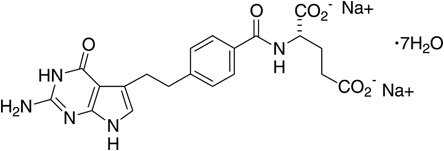
    ALIMTA (pemetrexed for injection) is a folate analog metabolic inhibitor. The drug substance, pemetrexed disodium heptahydrate, has the chemical name L-glutamic acid,
    Structural Formula
    ALIMTA is a sterile white-to-light yellow or green-yellow lyophilized powder in single-dose vials to be reconstituted for intravenous infusion. Each 100-mg vial of ALIMTA contains 100 mg pemetrexed (equivalent to 139.8 mg pemetrexed disodium heptahydrate) and 106 mg mannitol. Each 500-mg vial of ALIMTA contains 500 mg pemetrexed (equivalent to 699 mg pemetrexed disodium heptahydrate) and 500 mg mannitol. Hydrochloric acid and/or sodium hydroxide may have been added to adjust pH.
    6REFERENCES
    1. “OSHA Hazardous Drugs.”
    7PATIENT COUNSELING INFORMATION
    Advise the patient to read the FDA-approved patient labeling (
    Premedication and Concomitant Medication: Instruct patients to take folic acid as directed and to keep appointments for vitamin B12 injections to reduce the risk of treatment-related toxicity. Instruct patients of the requirement to take corticosteroids to reduce the risks of treatment-related toxicity [see Dosage and Administration () and Warnings and Precautions (].
    Myelosuppression: Inform patients of the risk of low blood cell counts and instruct them to immediately contact their physician for signs of infection, fever, bleeding, or symptoms of anemia [see Warnings and Precautions (.
    Renal Failure: Inform patients of the risks of renal failure, which may be exacerbated in patients with dehydration arising from severe vomiting or diarrhea. Instruct patients to immediately contact their healthcare provider for a decrease in urine output [see Warnings and Precautions (.
    Bullous and Exfoliative Skin Disorders: Inform patients of the risks of severe and exfoliative skin disorders. Instruct patients to immediately contact their healthcare provider for development of bullous lesions or exfoliation in the skin or mucous membranes [see Warnings and Precautions (.
    Interstitial Pneumonitis: Inform patients of the risks of pneumonitis. Instruct patients to immediately contact their healthcare provider for development of dyspnea or persistent cough [see Warnings and Precautions (.
    Radiation Recall: Inform patients who have received prior radiation of the risks of radiation recall. Instruct patients to immediately contact their healthcare provider for development of inflammation or blisters in an area that was previously irradiated [see Warnings and Precautions (.
    Increased Risk of Toxicity with Ibuprofen in Patients with Renal Impairment: Advise patients with mild to moderate renal impairment of the risks associated with concomitant ibuprofen use and instruct them to avoid use of all ibuprofen containing products for 2 days before, the day of, and 2 days following administration of ALIMTA [see Dosage and Administration (.
    Embryo-Fetal Toxicity: Advise females of reproductive potential and males with female partners of reproductive potential of the potential risk to a fetus [see Warnings and Precautions (. Advise females of reproductive potential to use effective contraception during treatment with ALIMTA and for 6 months after the last dose. Advise females to inform their prescriber of a known or suspected pregnancy. Advise males with female partners of reproductive potential to use effective contraception during treatment with ALIMTA and for 3 months after the last dose [see Warnings and Precautions (.
    Lactation: Advise women not to breastfeed during treatment with ALIMTA and for 1 week after the last dose [see Use in Specific Populations (.
    Marketed by: Lilly USA, LLCCopyright © 2004, 2022, Eli Lilly and Company. All rights reserved.
    ALM-0005-USPI-20220831
    Alimta has been selected.