Mantle Cell Lymphoma (MCL) Treatments

Find Mantle Cell Lymphoma (MCL) Treatments

Brand Name

Brukinsa

Generic Name
Zanubrutinib
View Brand Information
FDA approval date: November 14, 2019
Classification: Kinase Inhibitor
Form: Tablet, Capsule

What is Brukinsa (Zanubrutinib)?

BRUKINSA is a kinase inhibitor indicated for the treatment of adult patients with: Mantle cell lymphoma who have received at least one prior therapy.
Save this treatment for later
Sign Up
Not sure about your diagnosis?
Check Your Symptoms
Tired of the same old research?
Check Latest Advances

Related Clinical Trials

A Phase II, Multicenter, Open-label Study Evaluating Glofitamab in Combination With Venetoclax Plus Zanubrutinib or Venetoclax Alone in Subjects With Untreated or Relapsed/Refractory High-risk Mantle-cell Lymphoma

Summary: This open-label, multicenter, three cohorts, phase II study is designed to assess a combination of Zanubrutinib/Venetoclax/Glofitamab or Venetoclax/Glofitamab in high-risk subjects with either first line or R/R Mantle Cell Lymphoma (MCL). Three independent cohorts will be run: * Cohort A will include subjects with a primary refractory or progressive disease within 24 months from initiation of firs...

In Treatment-Naive Patients With Primary Central Nervous System Lymphoma (PCNSL): A Multicenter Two-Cohort Study of Methotrexate Combined With Rituximab, Sintilimab and Pirtobrutinib (Prospective Interventional Cohort) vs. Real-World Investigator-Selected Treatment (Observational Cohort)

Summary: The goal of this clinical trial is to evaluate a new combination therapy for patients with newly diagnosed Primary Central Nervous System Lymphoma (PCNSL). The main questions it aims to answer are: (1) Does the combination of Methotrexate, Rituximab, Sintilimab, and Pirtobrutinib improve the Complete Remission Rate (CRR)? (2) Is this regimen safe and tolerable for patients? Researchers will compar...

A Phase 3 Randomized Double-Blind Multicenter Study of Sonrotoclax Plus Zanubrutinib Versus Placebo Plus Zanubrutinib in Patients With Relapsed/Refractory Mantle Cell Lymphoma

Summary: The goal of this study is to compare how well sonrotoclax plus zanubrutinib works versus zanubrutinib plus placebo in treating adults with relapsed/refractory (R/R) mantle cell lymphoma (MCL). This study will also look at the safety of sonrotoclax plus zanubrutinib versus zanubrutinib plus placebo.

Related Latest Advances

There is no latest advances for this treatment

Brand Information

BRUKINSA (zanubrutinib)
1DOSAGE FORMS AND STRENGTHS
Capsules: Each 80 mg capsule is a size 0, white to off-white opaque capsule marked with "ZANU 80" in black ink.
Tablets: 160 mg, blue, oval, film-coated tablets debossed with "zanu" on one side and functional scoring on the other side.
2CONTRAINDICATIONS
None.
3ADVERSE REACTIONS
The following clinically significant adverse reactions are discussed in more detail in other sections of the labeling:
  • Hemorrhage
  • Infections
  • Cytopenias
  • Second Primary Malignancies
  • Cardiac Arrhythmias
  • Hepatotoxicity, including DILI
3.1Clinical Trials Experience
Because clinical trials are conducted under widely varying conditions, adverse reaction rates observed in the clinical trials of a drug cannot be directly compared to rates in the clinical trials of another drug and may not reflect the rates observed in practice.
The data in the WARNINGS AND PRECAUTIONS reflect exposure to BRUKINSA in nine monotherapy and 2 combination clinical trials, administered at 160 mg twice daily in 1608 patients and at 320 mg once daily in 121 patients. Among these 1729 patients, the median duration of exposure was 27.6 months, 78% of patients were exposed for at least 12 months, and 60% of patients were exposed for at least 24 months.
In this pooled safety population, the most common adverse reactions (≥30%), including laboratory abnormalities, were neutrophil count decreased (51%), platelet count decreased (41%), upper respiratory tract infection (38%), hemorrhage (32%), and musculoskeletal pain (31%).
3.2Postmarketing Experience
The following adverse reactions have been identified during postapproval use of BRUKINSA. Because these reactions are reported voluntarily from a population of uncertain size, it is not always possible to reliably estimate their frequency or establish a causal relationship to drug exposure.
  • Hepatobiliary disorder: drug-induced liver injury
4DESCRIPTION
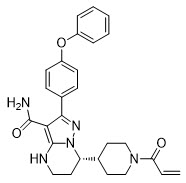
BRUKINSA (zanubrutinib) is a kinase inhibitor. The empirical formula of zanubrutinib is C
The molecular weight of zanubrutinib is 471.55 Daltons.
Zanubrutinib has the following structure:
Chemical Structure
Each BRUKINSA capsule for oral administration contains 80 mg zanubrutinib and the following inactive ingredients: colloidal silicon dioxide, croscarmellose sodium, magnesium stearate, microcrystalline cellulose, and sodium lauryl sulfate. The capsule shell contains edible black ink, gelatin, and titanium dioxide.
Each BRUKINSA tablet for oral administration contains 160 mg zanubrutinib and the following inactive ingredients: colloidal silicon dioxide, croscarmellose sodium, lactose monohydrate, magnesium stearate, microcrystalline cellulose, povidone, and sodium lauryl sulfate. The film coating contains FD&C Blue No. 1, FD&C Blue No. 2, hypromellose, titanium dioxide, and triacetin.
5PATIENT COUNSELING INFORMATION
Advise patients to read the FDA-approved patient labeling (Patient Information).
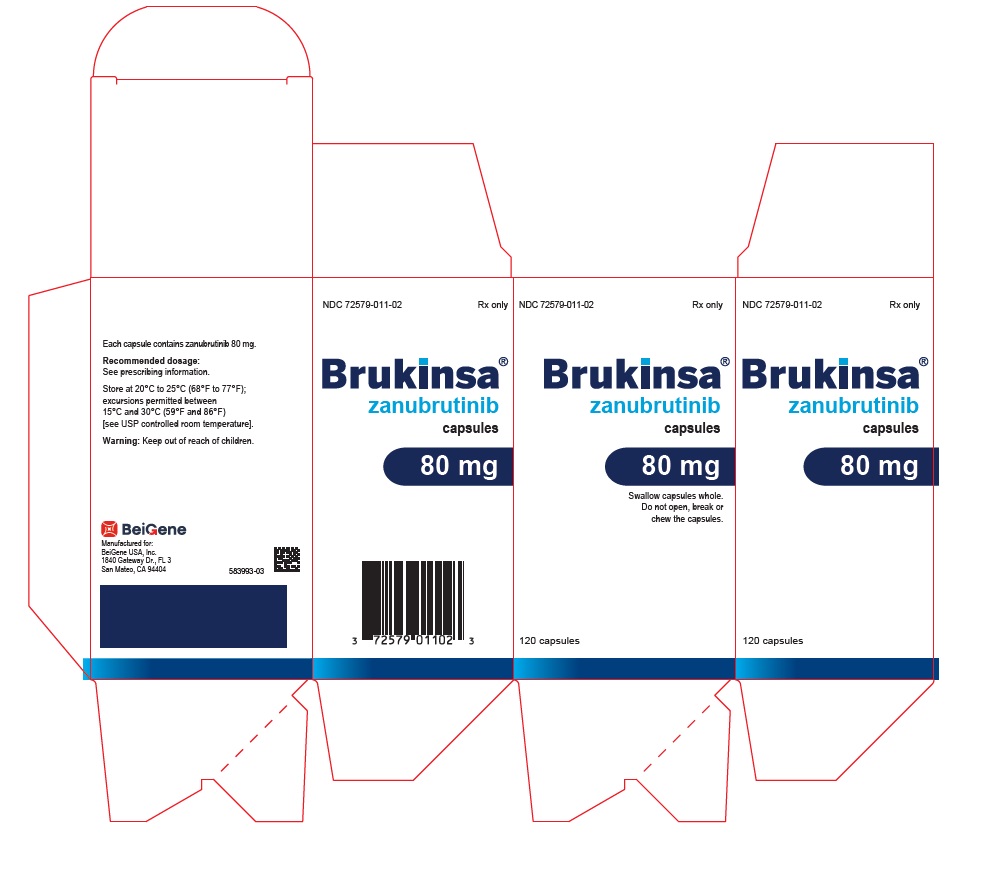
6PRINCIPAL DISPLAY PANEL - 80 mg Capsule Carton
NDC 72579-011-02
Brukinsa
80 mg
Swallow capsules whole.
120 capsules
PRINCIPAL DISPLAY PANEL - 80 mg Capsule Carton
7PRINCIPAL DISPLAY PANEL - 160 mg Tablet Carton
Rx only
Brukinsa
160 mg
Swallow tablets whole.
60 tablets
PRINCIPAL DISPLAY PANEL - 160 mg Tablet Carton