Mucopolysaccharidosis Type 2 (MPS II, Hunter Syndrome) Treatments
Find Mucopolysaccharidosis Type 2 (MPS II, Hunter Syndrome) Treatments
Brand Name
Elaprase
Generic Name
Idursulfase
View Brand Information FDA approval date: July 24, 2006
Classification: Hydrolytic Lysosomal Glycosaminoglycan-specific Enzyme
Form: Solution
What is Elaprase (Idursulfase)?
ELAPRASE is indicated for patients with Hunter syndrome . ELAPRASE has been shown to improve walking capacity in patients 5 years and older. In patients 16 months to 5 years of age, no data are available to demonstrate improvement in disease-related symptoms or long term clinical outcome; however, treatment with ELAPRASE has reduced spleen volume similarly to that of adults and children 5 years of age and older. The safety and efficacy of ELAPRASE have not been established in pediatric patients less than 16 months of age [see Use in Specific Populations.
Approved To Treat

Save this treatment for later
Not sure about your diagnosis?
Tired of the same old research?
Related Clinical Trials
A Phase 2/3, Multicenter, Double-Blind, Randomized Study to Determine the Efficacy and Safety of Tividenofusp Alfa (DNL310) vs Idursulfase in Pediatric and Young Adult Participants With Neuronopathic or Non-Neuronopathic Mucopolysaccharidosis Type II
Summary: This is a Phase 2/3, multiregional, two-arm, double-blind, randomized, active (standard-of-care)-controlled study of the efficacy and safety of tividenofusp alfa (DNL310), an investigational central nervous system (CNS)-penetrant enzyme-replacement therapy (ERT) for mucopolysaccharidosis type II (MPS II). Participants may also qualify to enter an open-label treatment phase with DNL310 or idursulfa...
Related Latest Advances
Brand Information
ELAPRASE (idursulfase)
WARNING: RISK OF ANAPHYLAXIS
Life-threatening anaphylactic reactions have occurred in some patients during and up to 24 hours after ELAPRASE infusions. Anaphylaxis, presenting as respiratory distress, hypoxia, hypotension, urticaria and/or angioedema of throat or tongue have been reported to occur during and after ELAPRASE infusions, regardless of duration of the course of treatment. Closely observe patients during and after ELAPRASE administration and be prepared to manage anaphylaxis. Inform patients of the signs and symptoms of anaphylaxis and have them seek immediate medical care should symptoms occur. Patients with compromised respiratory function or acute respiratory disease may be at risk of serious acute exacerbation of their respiratory compromise due to hypersensitivity reactions and require additional monitoring
1INDICATIONS AND USAGE
ELAPRASE is indicated for patients with Hunter syndrome (Mucopolysaccharidosis II, MPS II). ELAPRASE has been shown to improve walking capacity in patients 5 years and older.
In patients 16 months to 5 years of age, no data are available to demonstrate improvement in disease-related symptoms or long term clinical outcome; however, treatment with ELAPRASE has reduced spleen volume similarly to that of adults and children 5 years of age and older.
The safety and efficacy of ELAPRASE have not been established in pediatric patients less than 16 months of age
2DOSAGE FORMS AND STRENGTHS
Injection: 6 mg/3 mL (2 mg/mL) in single-use vials
3CONTRAINDICATIONS
None.
4OVERDOSAGE
One patient with Hunter syndrome, who received ELAPRASE at twice the recommended dosage for one and a half years, experienced two anaphylactic reactions over a 3-month period 4.5 years after initiating ELAPRASE treatment.
5DESCRIPTION
ELAPRASE is a formulation of idursulfase, a purified form of human iduronate-2-sulfatase, a lysosomal enzyme. Idursulfase is produced by recombinant DNA technology in a human cell line. Idursulfase is an enzyme that hydrolyzes the 2-sulfate esters of terminal iduronate sulfate residues from the glycosaminoglycans dermatan sulfate and heparan sulfate in the lysosomes of various cell types.
Idursulfase is a 525-amino acid glycoprotein with a molecular weight of approximately 76 kilodaltons. The enzyme contains eight asparagine-linked glycosylation sites occupied by complex oligosaccharide structures. The enzyme activity of idursulfase is dependent on the post-translational modification of a specific cysteine to formylglycine. Idursulfase has a specific activity ranging from 46 to 74 units/mg of protein (one unit is defined as the amount of enzyme required to hydrolyze 1 micromole of heparin disaccharide substrate per hour under the specified assay conditions).
ELAPRASE is administered as an intravenous infusion and supplied as a sterile, nonpyrogenic clear to slightly opalescent, colorless solution that must be diluted prior to administration in 0.9% Sodium Chloride Injection, USP. Each vial contains an extractable volume of 3 mL with an idursulfase concentration of 2 mg/mL at a pH of approximately 6. Each vial contains 6 mg idursulfase, sodium chloride (24 mg), sodium phosphate monobasic monohydrate (6.75 mg), sodium phosphate dibasic heptahydrate (2.97 mg), and polysorbate 20 (0.66 mg). ELAPRASE does not contain preservatives. Each vial is for single use only.
6HOW SUPPLIED/STORAGE AND HANDLING
ELAPRASE is supplied as a sterile injection in a 5 mL Type I glass vial. The vials are closed with a butyl rubber stopper with fluororesin coating and an aluminum overseal with a blue flip-off plastic cap.
Each carton contains a single vial NDC 54092-700-01
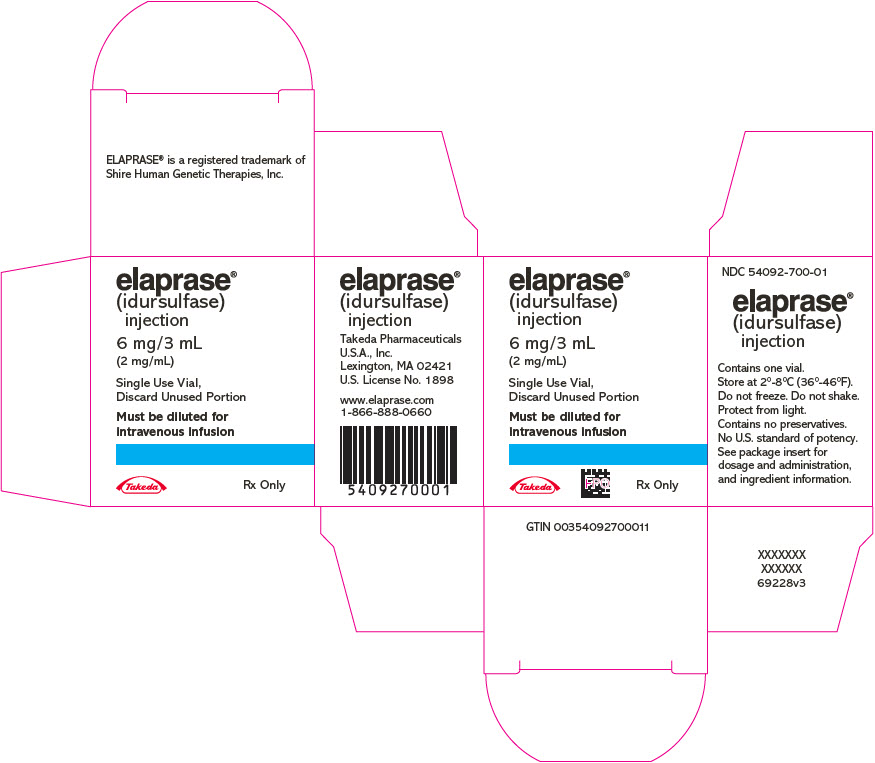
7PRINCIPAL DISPLAY PANEL - 6 mg/3 mL Vial Carton
elaprase
(idursulfase)
injection
(idursulfase)
injection
6 mg/3 mL
Single Use Vial,
Must be diluted for
Rx Only
Takeda