Multiple Myeloma Treatments

Find Multiple Myeloma Treatments

Generic Name

Daratumumab

Brand Names
Darzalex, Darzalex Faspro
FDA approval date: November 16, 2015
Classification: Endoglycosidase
Form: Injection

What is Darzalex (Daratumumab)?

DARZALEX is indicated for the treatment of adult patients with multiple myeloma: in combination with lenalidomide and dexamethasone in newly diagnosed patients who are ineligible for autologous stem cell transplant and in patients with relapsed or refractory multiple myeloma who have received at least one prior therapy. in combination with bortezomib, melphalan and prednisone in newly diagnosed patients who are ineligible for autologous stem cell transplant. in combination with bortezomib, thalidomide, and dexamethasone in newly diagnosed patients who are eligible for autologous stem cell transplant. in combination with bortezomib and dexamethasone in patients who have received at least one prior therapy. in combination with carfilzomib and dexamethasone in patients with relapsed or refractory multiple myeloma who have received one to three prior lines of therapy. in combination with pomalidomide and dexamethasone in patients who have received at least two prior therapies including lenalidomide and a proteasome inhibitor. as monotherapy, in patients who have received at least three prior lines of therapy including a proteasome inhibitor and an immunomodulatory agent or who are double-refractory to a PI and an immunomodulatory agent. DARZALEX is a CD38-directed cytolytic antibody indicated for the treatment of adult patients with multiple myeloma: in combination with lenalidomide and dexamethasone in newly diagnosed patients who are ineligible for autologous stem cell transplant and in patients with relapsed or refractory multiple myeloma who have received at least one prior therapy in combination with bortezomib, melphalan and prednisone in newly diagnosed patients who are ineligible for autologous stem cell transplant in combination with bortezomib, thalidomide, and dexamethasone in newly diagnosed patients who are eligible for autologous stem cell transplant in combination with bortezomib and dexamethasone in patients who have received at least one prior therapy in combination with carfilzomib and dexamethasone in patients with relapsed or refractory multiple myeloma who have received one to three prior lines of therapy in combination with pomalidomide and dexamethasone in patients who have received at least two prior therapies including lenalidomide and a proteasome inhibitor as monotherapy, in patients who have received at least three prior lines of therapy including a proteasome inhibitor and an immunomodulatory agent or who are double-refractory to a PI and an immunomodulatory agent.
Save this treatment for later
Sign Up
Not sure about your diagnosis?
Check Your Symptoms
Tired of the same old research?
Check Latest Advances

Related Clinical Trials

A Phase II Study of Daratumumab-Hyaluronidase for Chemotherapy-Relapsed/Refractory Minimal Residual Disease (MRD) in T Cell Acute Lymphoblastic Leukemia (T-ALL

Summary: In this study, the investigators are hypothesizing that daratumumab-hyaluronidase will effectively treat T-ALL in patients who have persistent or recurrent MRD following treatment with chemotherapy.

Daratumumab to Enhance Therapeutic Effectiveness of Revlimid in Smoldering Myeloma (DETER-SMM)

Summary: This phase III trial studies how well lenalidomide and dexamethasone works with or without daratumumab in treating patients with high-risk smoldering myeloma. Drugs used in chemotherapy, such as lenalidomide and dexamethasone, work in different ways to stop the growth of tumor cells, either by killing the cells, by stopping them from dividing, or by stopping them from spreading. Immunotherapy with...

Effective Quadruplet Utilization After Treatment Evaluation (EQUATE): A Randomized Phase 3 Trial for Newly Diagnosed Multiple Myeloma Not Intended for Early Autologous Transplantation

Summary: This phase III trial compares the combination of four drugs (daratumumab, bortezomib, lenalidomide and dexamethasone) to the use of a three drug combination (daratumumab, lenalidomide and dexamethasone). Bortezomib may stop the growth of cancer cells by blocking some of the enzymes needed for cell growth. Chemotherapy drugs, such as lenalidomide, work in different ways to stop the growth of cancer...

Brand Information

    DARZALEX (Daratumumab)
    1INDICATIONS AND USAGE
    DARZALEX is indicated for the treatment of adult patients with multiple myeloma:
    • in combination with lenalidomide and dexamethasone in newly diagnosed patients who are ineligible for autologous stem cell transplant and in patients with relapsed or refractory multiple myeloma who have received at least one prior therapy.
    • in combination with bortezomib, melphalan and prednisone in newly diagnosed patients who are ineligible for autologous stem cell transplant.
    • in combination with bortezomib, thalidomide, and dexamethasone in newly diagnosed patients who are eligible for autologous stem cell transplant.
    • in combination with bortezomib and dexamethasone in patients who have received at least one prior therapy.
    • in combination with carfilzomib and dexamethasone in patients with relapsed or refractory multiple myeloma who have received one to three prior lines of therapy.
    • in combination with pomalidomide and dexamethasone in patients who have received at least two prior therapies including lenalidomide and a proteasome inhibitor.
    • as monotherapy, in patients who have received at least three prior lines of therapy including a proteasome inhibitor (PI) and an immunomodulatory agent or who are double-refractory to a PI and an immunomodulatory agent.
    2DOSAGE FORMS AND STRENGTHS
    DARZALEX is a colorless to pale yellow, preservative-free solution available as:
    Injection:
    • 100 mg/5 mL (20 mg/mL) in a single-dose vial.
    • 400 mg/20 mL (20 mg/mL) in a single-dose vial.
    3CONTRAINDICATIONS
    DARZALEX is contraindicated in patients with a history of severe hypersensitivity (e.g. anaphylactic reactions) to daratumumab or any of the components of the formulation
    4ADVERSE REACTIONS
    The following clinically significant adverse reactions are described elsewhere in the labeling:
    • Infusion-related reactions
    • Infections
    • Neutropenia
    • Thrombocytopenia
    4.1Clinical Trials Experience
    Because clinical trials are conducted under widely varying conditions, adverse reaction rates observed in the clinical trials of a drug cannot be directly compared to rates in the clinical trials of another drug and may not reflect the rates observed in practice.
    The safety data described below reflects exposure to DARZALEX (16 mg/kg) in 2,459 patients with multiple myeloma including 2,303 patients who received DARZALEX in combination with background regimens and 156 patients who received DARZALEX as monotherapy. In this pooled safety population, the most common adverse reactions (≥20%) were upper respiratory infection, neutropenia, infusion-related reactions, thrombocytopenia, diarrhea, constipation, anemia, peripheral sensory neuropathy, fatigue, peripheral edema, nausea, cough, pyrexia, dyspnea, and asthenia.
    4.2Postmarketing Experience
    The following adverse reactions have been identified during post-approval use of daratumumab. Because these reactions are reported voluntarily from a population of uncertain size, it is not always possible to reliably estimate their frequency or establish a causal relationship to drug exposure.
    Immune System disorders: Anaphylactic reaction, IRR (including deaths)
    Gastrointestinal disorders: Pancreatitis
    Infections: Cytomegalovirus, Listeriosis
    5DESCRIPTION
    Daratumumab is an immunoglobulin G1 kappa (IgG1κ) human monoclonal antibody that binds to CD38 antigen. It is produced in Chinese Hamster Ovary (CHO) cells using recombinant DNA technology. The molecular weight of daratumumab is approximately 148 kDa.
    DARZALEX
    Each DARZALEX 20 mL single-dose vial contains (NDC 57894-502-20) 400 mg daratumumab, glacial acetic acid (3.7 mg), mannitol (510 mg), polysorbate 20 (8 mg), sodium acetate trihydrate (59.3 mg), sodium chloride (70.1 mg), and Water for Injection, USP.
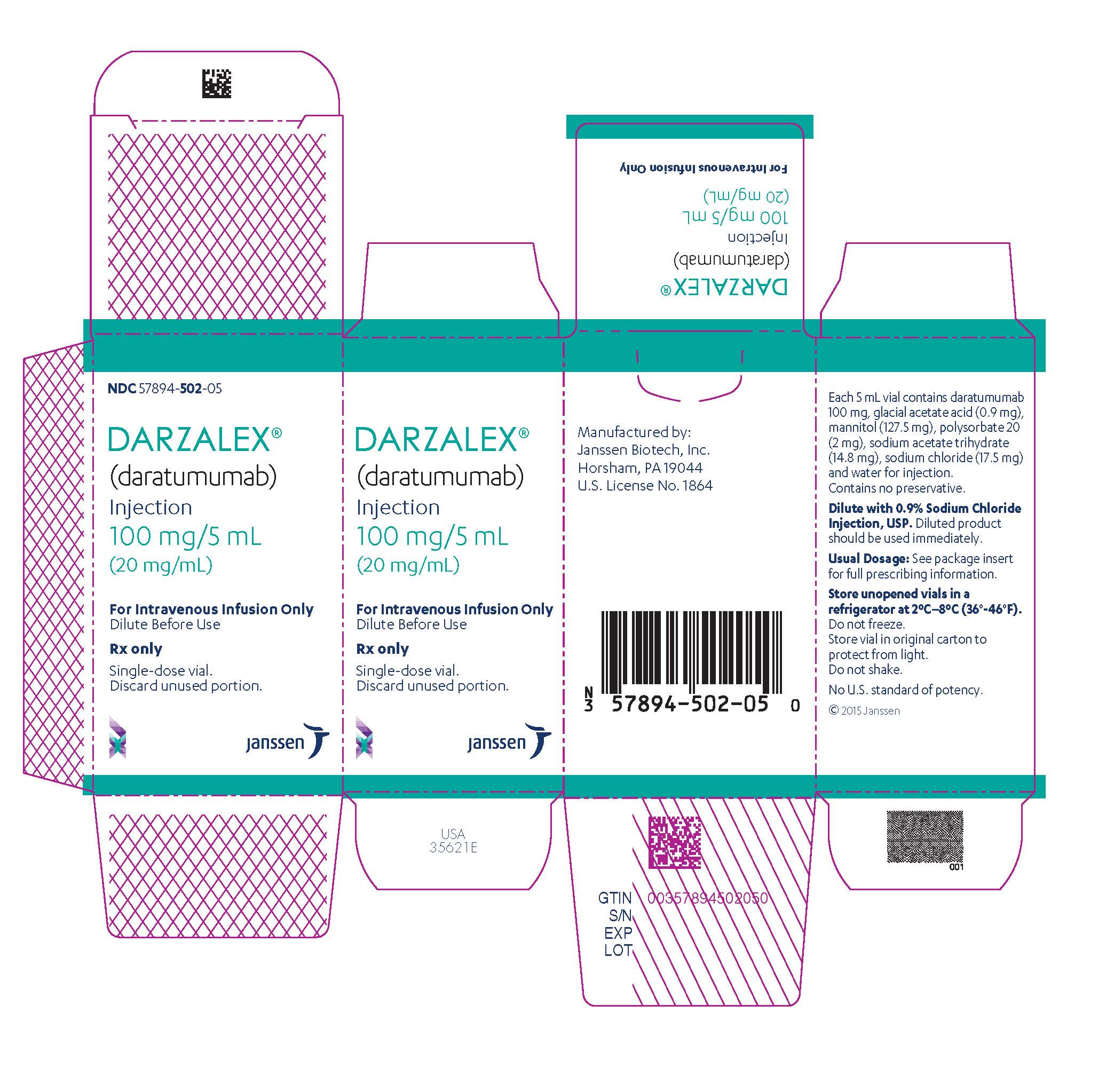
    Each DARZALEX 5 mL single-dose vial contains (NDC 57894-502-05) 100 mg daratumumab, glacial acetic acid (0.9 mg), mannitol (127.5 mg), polysorbate 20 (2 mg), sodium acetate trihydrate (14.8 mg), sodium chloride (17.5 mg), and Water for Injection, USP.
    Each DARZALEX 20 mL single-dose vial contains (NDC 57894-505-20) 400 mg daratumumab, L-histidine (7 mg), L-histidine hydrochloride monohydrate (32.6 mg), L-methionine (20 mg), polysorbate 20 (8 mg), sorbitol (1093 mg), and Water for Injection, USP.
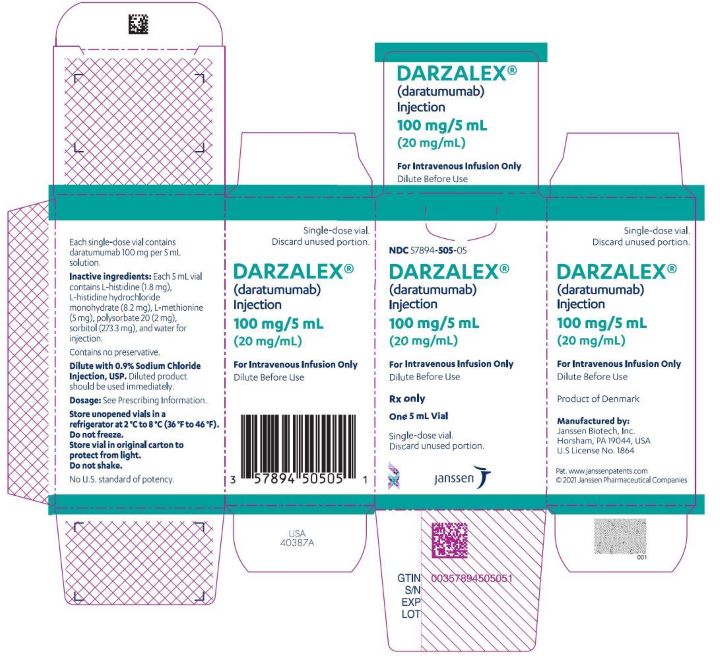
    Each DARZALEX 5 mL single-dose vial contains (NDC 57894-505-05) 100 mg daratumumab, L-histidine (1.8 mg), L-histidine hydrochloride monohydrate (8.2 mg), L-methionine (5 mg), polysorbate 20 (2 mg), sorbitol (273.3 mg), and Water for Injection, USP.
    6REFERENCES
    1. Chapuy, CI, RT Nicholson, MD Aguad, et al., 2015, Resolving the daratumumab interference with blood compatibility testing, Transfusion, 55:1545–1554 (accessible at http://onlinelibrary.wiley.com/doi/10.1111/trf.13069/epdf).
    7PATIENT COUNSELING INFORMATION
    Advise the patient to read the FDA-approved patient labeling (Patient Information).
    Darzalex has been selected.