Myelodysplastic Syndrome (MDS) Treatments

Find Myelodysplastic Syndrome (MDS) Treatments

Generic Name

AzaCITIDine

Brand Names
Onureg, Vidaza
FDA approval date: July 05, 2004
Classification: Nucleoside Metabolic Inhibitor
Form: Injection, Tablet

What is Onureg (AzaCITIDine)?

ONUREG is indicated for continued treatment of adult patients with acute myeloid leukemia who achieved first complete remission or complete remission with incomplete blood count recovery following intensive induction chemotherapy and are not able to complete intensive curative therapy. ONUREG is a nucleoside metabolic inhibitor indicated for continued treatment of adult patients with acute myeloid leukemia who achieved first complete remission or complete remission with incomplete blood count recovery following intensive induction chemotherapy and are not able to complete intensive curative therapy .
Save this treatment for later
Sign Up
Not sure about your diagnosis?
Check Your Symptoms
Tired of the same old research?
Check Latest Advances

Related Clinical Trials

Phase I/II Study of Neoadjuvant Inhaled Azacytidine With Platinum-Based Chemotherapy and Durvalumab (MEDI4736) - a Combined Epigenetic-Immunotherapy (AZA-AEGEAN) Regimen for Operable Early-Stage Non-Small Cell Lung Cancer (NSCLC)

Background: Lung cancer is the leading cause of cancer-related death worldwide. Non-small cell lung cancer (NSCLC) is the most common type of lung cancer. Surgery to remove the tumors is the standard treatment for people diagnosed with early stages of NSCLC. Despite complete removal of these tumors, many recur (happen again). An FDA-approved drug combination to treat early-stage NSCLC prior to the surgery is ...

A Randomized Phase II Study of Venetoclax and HMA-Based Therapies for the Treatment of Older and Unfit Adults With Newly Diagnosed FLT3-Mutated Acute Myeloid Leukemia (AML): A MyeloMATCH Treatment Trial

Summary: This phase II MyeloMATCH treatment trial compares the usual treatment of azacitidine and venetoclax to the combination treatment of azacitidine, venetoclax and gilteritinib in treating older and unfit patients with acute myeloid leukemia and FLT3 mutations. Azacitidine is a drug that is absorbed into DNA and leads to the activation of cancer suppressor genes, which are genes that help control cell...

A Phase 1 Study of Oral Cedazuridine and Decitabine Combination (ASTX727, NSC# 820631) and Filgrastim as Maintenance Therapy Post-Hematopoietic Stem Cell Transplant in Children With High-Risk Acute Myeloid Leukemia

Summary: This phase I trial tests the safety, side effects, and best dose of ASTX727 and filgrastim for the treatment of children with high risk acute myeloid leukemia that has come back after a period of improvement (recurrent) or that does not respond to treatment (refractory) who have undergone allogenic hematopoietic stem cell transplantation. ASTX727 is a combination of cedazuridine and decitabine. Ce...

Brand Information

    ONUREG (azacitidine)
    1INDICATIONS AND USAGE
    ONUREG is indicated for continued treatment of adult patients with acute myeloid leukemia who achieved first complete remission (CR) or complete remission with incomplete blood count recovery (CRi) following intensive induction chemotherapy and are not able to complete intensive curative therapy.
    2DOSAGE FORMS AND STRENGTHS
    Tablets:
    • 200 mg, pink, oval, film-coated tablet with debossed "200" on one side and "ONU" on the other side.
    • 300 mg, brown, oval, film-coated tablet with debossed "300" on one side and "ONU" on the other side.
    3CONTRAINDICATIONS
    ONUREG is contraindicated in patients with known severe hypersensitivity to azacitidine or its components
    4ADVERSE REACTIONS
    The following clinically significant adverse reactions are described elsewhere in the labeling:
    • Myelosuppression
    4.1Clinical Trials Experience
    Because clinical trials are conducted under widely varying conditions, adverse reaction rates observed in the clinical trials of a drug cannot be directly compared to rates in the clinical trials of another drug and may not reflect the rates observed in practice.
    4.2Postmarketing Experience
    The following adverse reactions have been identified during postapproval use of intravenous or subcutaneous azacitidine. Because these reactions are reported voluntarily from a population of uncertain size, it is not always possible to reliably estimate their frequency or establish a causal relationship to drug exposure.
    • Hypersensitivity reaction
    • Interstitial lung disease
    • Tumor lysis syndrome
    • Sweet's syndrome (acute febrile neutrophilic dermatosis)
    • Necrotizing fasciitis (including fatal cases)
    • Differentiation syndrome
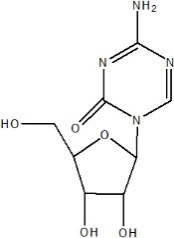
    5DESCRIPTION
    Azacitidine is a nucleoside metabolic inhibitor with a molecular formula of C
    onureg-chem-structure
    Azacitidine is a white to off-white solid. Azacitidine was found to be soluble in aqueous media across a pH range from 1.0 to 7.0.
    ONUREG (azacitidine) is supplied as film-coated tablets containing 200 mg or 300 mg of azacitidine for oral use. Each core tablet contains the following inactive ingredients: croscarmellose sodium, magnesium stearate, mannitol, and silicified microcrystalline cellulose. The 200 and 300 mg tablet coating contains hypromellose, lactose monohydrate, polyethylene glycol, titanium dioxide, and triacetin. In addition, the 200 mg tablet coating contains iron oxide red and the 300 mg tablet coating contains black iron oxide, iron oxide red, and iron oxide yellow.
    6CLINICAL STUDIES
    The efficacy of ONUREG was evaluated in QUAZAR (NCT01757535), a multicenter, randomized, double-blind, placebo-controlled study. Eligible patients were ages 55 years or older, had AML, and were within 4 months of achieving first complete remission (CR) or complete remission with incomplete blood count recovery (CRi) with intensive induction chemotherapy. Patients may have received consolidation (see
    A total of 472 patients who completed induction with or without consolidation therapy were randomized 1:1 to receive ONUREG 300 mg (n=238) or placebo (n=234) orally on Days 1 through 14 of each 28-day cycle. Randomization was stratified by age at time of induction therapy (55 to 64 vs. ≥ 65 years), cytogenetic risk category at time of induction therapy (intermediate risk vs. poor risk), prior history of MDS/CMML (yes vs. no), and received consolidation therapy following induction therapy (yes vs. no). Baseline demographic and disease characteristics are shown in Table 4.
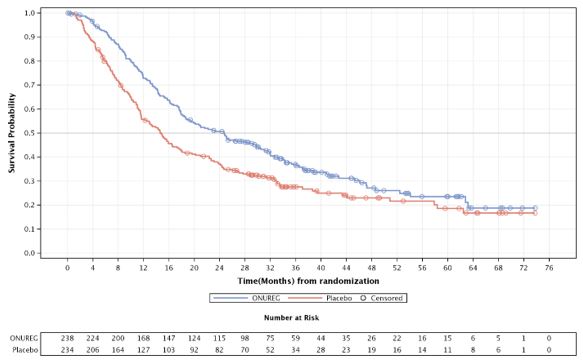
    The efficacy of ONUREG was established on the basis of overall survival (OS). The trial demonstrated a statistically significant improvement in OS for patients randomized to ONUREG compared to placebo. A subgroup analysis showed consistency in the OS benefit for patients in either CR or CRi. The efficacy results are summarized in Table 5 and Figure 1.
    Figure 1: Kaplan-Meier Curve for Overall Survival (ITT Population) in QUAZAR
    onureg-os-quazar
    7REFERENCES
    1. "OSHA Hazardous Drugs."
    8PATIENT COUNSELING INFORMATION
    Advise the patient to read the FDA-approved patient labeling (Patient Information).
    9Patient Package Insert
    This Patient Information has been approved by the U.S. Food and Drug Administration.                        Revised: June 2026
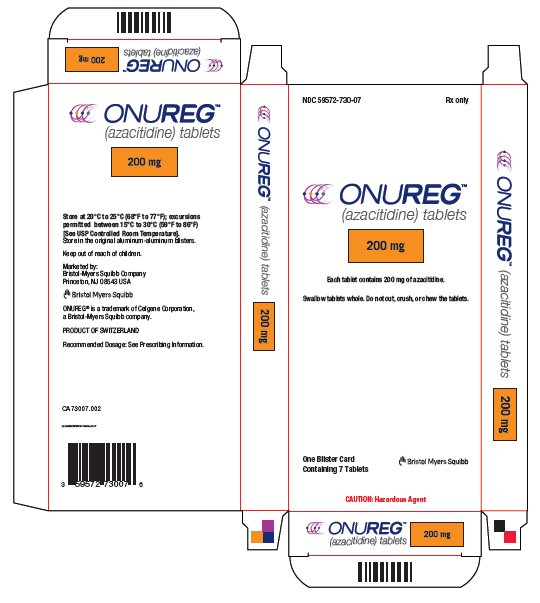
    10PRINCIPAL DISPLAY PANEL - 200 mg Blister Pack Carton
    NDC 59572-730-07
    ONUREG™
    200 mg
    Each tablet contains 200 mg of azacitidine.
    Swallow tablets whole. Do not cut, crush, or chew the tablets.
    One Blister Card
    Bristol Myers Squibb
    CAUTION: Hazardous Agent
    onureg-200-carton
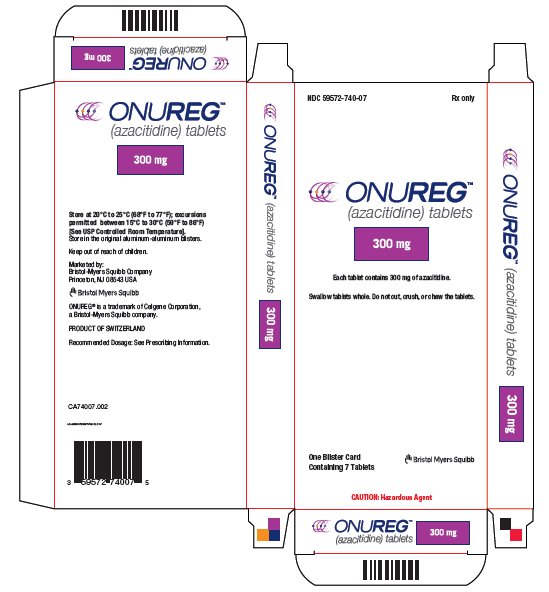
    11PRINCIPAL DISPLAY PANEL - 300 mg Blister Pack Carton
    NDC 59572-740-07
    ONUREG™
    300 mg
    Each tablet contains 200 mg of azacitidine.
    Swallow tablets whole. Do not cut, crush, or chew the tablets.
    One Blister Card
    Bristol Myers Squibb
    CAUTION: Hazardous Agent
    onureg-300-carton