Ocular Hypertension (OHT) Treatments

Find Ocular Hypertension (OHT) Treatments

Generic Name

Latanoprost

Brand Names
Iyuzeh, Xalatan, Xelpros
FDA approval date: November 15, 2010
Form: Solution

What is Iyuzeh (Latanoprost)?

IYUZEH ™
Save this treatment for later
Sign Up
Not sure about your diagnosis?
Check Your Symptoms
Tired of the same old research?
Check Latest Advances

Related Clinical Trials

Outcomes of Direct Selective Laser Trabeculoplasty With the Post-treatment Addition of Combination Netarsudil and Latanoprost vs Latanoprost Monotherapy

Summary: This is a randomized, double-masked, single-site, prospective, contralateral eye study designed to evaluate the outcomes of Direct Selective Laser Trabeculoplasty (DSLT) followed by the addition of combination netarsudil and latanoprost (Rocklatan) versus latanoprost monotherapy. The study will be conducted at one investigational site. The primary endpoint is the change in mean diurnal intraocular...

24-hour Effect Of Rocklatan Compared With Latanoprost In Open Angle Glaucoma And Ocular Hypertension Patients

Summary: The purpose of this study is to evaluate the effect on 24-hour IOP reduction of netarsudil-latanoprost fixed combination in one eye compared to latanoprost alone in the contralateral eye, dosed daily, 1 drop at night (QD, PM) in adult subjects, at least 18 years of age, with open angle glaucoma (OAG) or ocular hypertension (OHT).

A Masked, Randomized, Prospective Study of QLS-111-FDC in Subjects With Open-Angle Glaucoma or Ocular Hypertension

Summary: Firecrest study is evaluating the intraocular pressure (IOP)-lowering effect, safety, and tolerability of Qlaris' preservative free \[PF\], fixed-dose combination \[FDC\] investigational product (IP) in subjects with open-angle glaucoma (OAG) or ocular hypertension (OHT).

Brand Information

    IYUZEH (Latanoprost Ophthalmic Solution 0.005%)
    1INDICATIONS AND USAGE
    IYUZEH
    2DOSAGE AND ADMINISTRATION
    The recommended dosage is one drop in the affected eye(s) once daily in the evening. If one dose is missed, treatment should continue with the next dose as normal.
    The dosage of IYUZEH should not exceed once daily; the combined use of two or more prostaglandins, or prostaglandin analogs including IYUZEH is not recommended. It has been shown that administration of these prostaglandin drug products more than once daily may decrease the IOP lowering effect or cause paradoxical elevations in IOP.
    Reduction of the IOP starts approximately 3 to 4 hours after administration and the maximum effect is reached after 8 to 12 hours.
    IYUZEH may be used concomitantly with other topical ophthalmic drug products to lower IOP. In vitro studies have shown that precipitation occurs when eye drops containing thimerosal are mixed with the preserved 0.005% latanoprost reference product. If more than one topical ophthalmic drug is being used, the drugs should be administered at least five (5) minutes apart. Contact lenses should be removed prior to the administration of IYUZEH and may be reinserted 15 minutes after administration.
    The solution from one individual unit is to be used immediately after opening for administration to one or both eyes. Since sterility cannot be maintained after the individual unit is opened, the remaining contents should be discarded immediately after administration.
    3DOSAGE FORMS AND STRENGTHS
    Ophthalmic solution: opalescent, white to slightly yellow solution containing latanoprost 0.005% (50 mcg/mL).
    4CONTRAINDICATIONS
    Known hypersensitivity to latanoprost or any other ingredients in this product.
    5ADVERSE REACTIONS
    The following adverse reactions have been reported with the use of topical latanoprost products and are discussed in greater detail in other sections of the label:
    • Iris pigmentation changes
    • Eyelid skin darkening
    • Eyelash changes (increased length, thickness, pigmentation, and number of lashes)
    • Intraocular inflammation (iritis/uveitis)
    • Macular edema, including cystoid macular edema
    5.1Clinical Trials Experience
    Because clinical trials are conducted under widely varying conditions, adverse reaction rates observed in the clinical trials of a drug cannot be directly compared to rates in the clinical trials of another drug and may not reflect the rates observed in practice.
    In the two clinical trials conducted with IYUZEH (latanoprost ophthalmic solution) 0.005% comparing it to XALATAN the preserved 0.005% latanoprost reference product, the most frequently reported ocular adverse reactions were conjunctival hyperemia and eye irritation (
    5.2Postmarketing Experience
    The following adverse reactions have been identified during post-approval use of topical latanoprost products. Because these reactions are reported voluntarily from a population of uncertain size, it is not always possible to reliably estimate their frequency or establish a causal relationship to drug exposure. The reactions, which have been chosen for inclusion due to either their seriousness, frequency of reporting, possible causal connection to ophthalmic latanoprost products, or a combination of these factors, include:
    • Nervous System Disorders: Dizziness; headache; toxic epidermal necrolysis
    • Eye Disorders: Eyelash and vellus hair changes of the eyelid (increased length, thickness, pigmentation, and number of eyelashes); keratitis; corneal edema and erosions; intraocular inflammation (iritis/uveitis); macular edema, including cystoid macular edema; trichiasis; periorbital and lid changes resulting in deepening of the eyelid sulcus; iris cyst; eyelid skin darkening; localized skin reaction on the eyelids; conjunctivitis; pseudopemphigoid of the ocular conjunctiva.
    • Respiratory, Thoracic and Mediastinal Disorders: Asthma and exacerbation of asthma; dyspnea
    • Gastrointesting Disorders: Nausea; vomiting
    • Skin and Subcutaneous Tissue Disorders: Pruritis
    • Infections and Infestations: Herpes keratitis
    • Cardiac Disorders: Angina; palpitations; angina unstable
    • General Disorders and Administration Site Conditions: Chest pain
    6DRUG INTERACTIONS
    The combined use of two or more prostaglandins, or prostaglandin analogs including IYUZEH is not recommended. It has been shown that administration of these prostaglandin drug products more than once daily may decrease the IOP lowering effect or cause paradoxical elevations in IOP.
    7OVERDOSAGE
    Intravenous infusion of up to 3 mcg/kg of latanoprost in healthy volunteers produced mean plasma concentrations 200 times higher than during clinical treatment with latanoprost ophthalmic solution and no adverse reactions were observed. IV dosages of 5.5 to 10 mcg/kg caused abdominal pain, dizziness, fatigue, hot flushes, nausea, and sweating.
    8DESCRIPTION
    Latanoprost is a prostaglandin F
    Latanoprost is a colorless to yellow oil that is very soluble in acetonitrile and freely soluble in ethanol, ethyl acetate, and methanol. It is practically insoluble in water and hexanes.
    IYUZEH (latanoprost ophthalmic solution) 0.005% is supplied as a sterile, isotonic, aqueous solution of latanoprost with a pH of approximately 7 and an osmolality of approximately 280 mOsmol/kg. Each mL of IYUZEH contains 50 mcg of latanoprost. The inactive ingredients are: polyoxyl 40 hydrogenated castor oil, sorbitol, carbomer 974P, polyethylene glycol 4000, disodium edetate, sodium hydroxide (for pH-adjustment) and water for injections. One drop contains approximately 1.5 mcg of latanoprost.
    IYUZEH does not contain a preservative.
    9HOW SUPPLIED/STORAGE AND HANDLING
    IYUZEH (latanoprost ophthalmic solution) is an opalescent, isotonic, white to slightly yellow solution of latanoprost 50 mcg/mL (0.005%) practically free from foreign particles.
    It is supplied as a sterile solution in translucent low-density polyethylene single-dose container packaged in foil pouches (5 single-dose containers per pouch).
    NDC 82584-003-30; Unit-of-Use Carton of 30
    Storage:
    Store at 15°C to 25°C (59°F to 77°F).
    Store in the original pouch. After the pouch is opened, the single-dose containers may be stored in the opened foil pouch for up to 30 days at room temperature 15°C to 25°C (59°F to 77°F).
    Patient should be advised to write down the date the foil pouch is opened in the space provided on the pouch.
    Discard any unused containers 30 days after first opening the pouch.
    10PATIENT COUNSELING INFORMATION
    Potential for Pigmentation
    Advise patients about the potential for increased brown pigmentation of the iris, which may be permanent. Inform patients about the possibility of eyelid skin darkening, which may be reversible after discontinuation of IYUZEH.
    Potential for Eyelash Changes
    Inform patients of the possibility of eyelash and vellus hair changes in the treated eye during treatment with latanoprost ophthalmic solution. These changes may result in a disparity between eyes in length, thickness, pigmentation, number of eyelashes or vellus hairs, and/or direction of eyelash growth. Eyelash changes are usually reversible upon discontinuation of treatment.
    Handling the Container
    Advise patients that IYUZEH is a sterile solution that does not contain a preservative. The drops are supplied in single-dose container. The solution from one individual container is to be used immediately after opening for administration to one or both eyes. Since sterility cannot be maintained after the individual container is opened, the remaining contents should be discarded immediately after administration. Open a new single-dose container every time you use IYUZEH.
    When to Seek Physician Advice
    Advise patients that if they develop an intercurrent ocular condition (e.g., trauma or infection) or have ocular surgery, or develop any ocular reactions, particularly conjunctivitis and eyelid reactions, they should immediately seek their physician’s advice concerning the continued use of IYUZEH.
    Contact Lens Use
    Advise patients that contact lenses should be removed prior to administration of the solution. Lenses may be reinserted 15 minutes following administration of IYUZEH.
    Use with Other Ophthalmic Drugs
    Advise patients that if more than one topical ophthalmic drug is being used, the drugs should be administered at least five (5) minutes apart.
    If a Dose is Missed
    Advise patients that if one dose is missed, treatment should continue with the next dose as normal.
    Manufactured for:
    All rights reserved.
    U.S. Patent N°. 8,637,054. ©2021, Laboratoires Théa. All rights reserved. IYUZEH
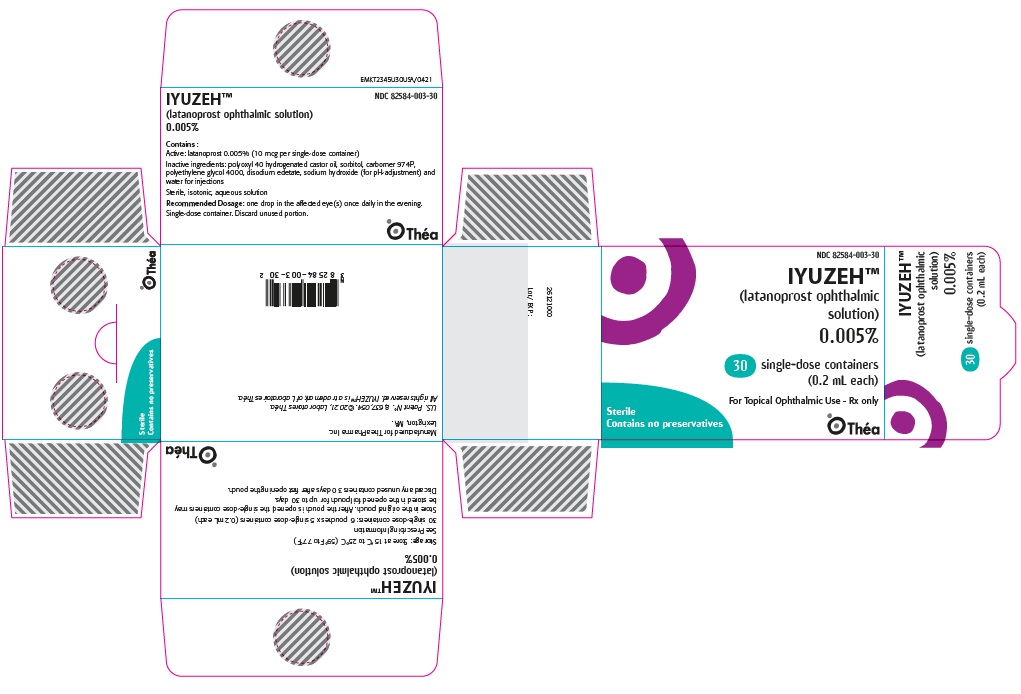
    11PACKAGE/LABEL PRINCIPAL DISPLAY PANEL
    NDC 82584-003-30
    IYUZEH™
    (latanoprost ophthalmic
    0.005%
    30 single-dose containers

    (0.2 mL each)
    For Topical Ophthalmic Use - Rx only
    Sterile
    Contains no preservatives
    Théa
    PRINCIPAL DISPLAY PANEL