Generic Name
MisoprostoL
Brand Names
Diclofenac, MisoprostoL Diclofenac-Sodium-MisoprostoL, Dicloenac, Arthrotec, Cytotec
FDA approval date: December 27, 1986
Classification: Nonsteroidal Anti-inflammatory Drug
Form: Tablet
What is Diclofenac (MisoprostoL)?
Diclofenac sodium and misoprostol delayed-release tablets are indicated for treatment of the signs and symptoms of osteoarthritis or rheumatoid arthritis in patients at high risk of developing NSAID-induced gastric and duodenal ulcers and their complications. For a list of factors that may increase the risk of NSAID-induced gastric and duodenal ulcers and their complications [see Warnings and Precautions.
Approved To Treat
Top Global Experts
There are no experts for this drug
Save this treatment for later
Not sure about your diagnosis?
Tired of the same old research?
Related Clinical Trials
There is no clinical trials being done for this treatment
Related Latest Advances
There is no latest advances for this treatment
Brand Information
Diclofenac sodium and Misoprostol (Diclofenac sodium and Misoprostol)
WARNING: RISK OF UTERINE RUPTURE, ABORTION, PREMATURE BIRTH, BIRTH DEFECTS; SERIOUS CARDIOVASCULAR EVENTS; AND SERIOUS GASTROINTESTINAL EVENTS
Uterine Rupture, Abortion, Premature Birth, and Birth Defects
- Administration of misoprostol, a component of diclofenac sodium/misoprostol, to pregnant women can cause uterine rupture, abortion, premature birth, or birth defects. Uterine rupture has occurred when misoprostol was administered in pregnant women to induce labor or an abortion
- Diclofenac sodium/misoprostol is contraindicated in pregnancy
- If diclofenac sodium/misoprostol is prescribed, verify the pregnancy status of females of reproductive potential prior to initiation of treatment and advise them to use effective contraception during treatment
Cardiovascular Thrombotic Events
- NSAIDs cause an increased risk of serious cardiovascular thrombotic events, including myocardial infarction and stroke, which can be fatal. This risk may occur early in treatment and may increase with duration of use
- Diclofenac sodium/misoprostol is contraindicated in the setting of coronary artery bypass graft (CABG) surgery
- Gastrointestinal Bleeding, Ulceration, and Perforation
- NSAIDs cause an increased risk of serious gastrointestinal (GI) adverse events including bleeding, ulceration, and perforation of the stomach or intestines, which can be fatal. These events can occur at any time during use and without warning symptoms. Elderly patients and patients with a prior history of peptic ulcer disease and/or GI bleeding are at greater risk for serious GI events
1INDICATIONS AND USAGE
Diclofenac sodium/misoprostol is indicated for treatment of the signs and symptoms of osteoarthritis or rheumatoid arthritis in adult patients at high risk of developing NSAID-induced gastric and duodenal ulcers and their complications. For a list of factors that may increase the risk of NSAID-induced gastric and duodenal ulcers and their complications
2DOSAGE FORMS AND STRENGTHS
Delayed-release tablets:
- 50 mg diclofenac sodium and 200 mcg misoprostol as round, biconvex, white to off‑white tablets imprinted with a “50” in the middle on one side and “G” and “0028” on the other.
- 75 mg diclofenac sodium and 200 mcg misoprostol as round, biconvex, white to off‑white tablets imprinted with a “75” in the middle on one side and “G” and “0029” on the other.
3CONTRAINDICATIONS
Diclofenac sodium/misoprostol is contraindicated in the following patients:
- Pregnancy. Use of misoprostol, a component of diclofenac sodium/misoprostol, during pregnancy can result in maternal and fetal harm, including uterine rupture, abortion, premature birth, or birth defects
- In the setting of coronary artery bypass graft (CABG) surgery
- Active gastrointestinal bleeding
- History of asthma, urticaria, or other allergic-type reactions after taking aspirin or other NSAIDs. Severe, sometimes fatal, anaphylactic reactions to NSAIDs have been reported in such patients
- Known hypersensitivity (e.g., anaphylactic reactions and serious skin reactions) to diclofenac sodium and misoprostol, other prostaglandins, or any components of the drug product
4ADVERSE REACTIONS
The following adverse reactions are discussed in greater detail in other sections of the labeling:
- Cardiovascular Thrombotic Events
- GI Bleeding, Ulceration and Perforation
- Hepatotoxicity
- Hypertension
- Heart Failure and Edema
- Renal Toxicity and Hyperkalemia
- Anaphylactic Reactions
- Serious Skin Reactions
- Hematologic Toxicity
4.1Clinical Trials Experience
Because clinical trials are conducted under widely varying conditions, adverse reaction rates observed in the clinical trials of a drug cannot be directly compared to rates in the clinical trials of another drug and may not reflect the rates observed in practice.
Adverse reaction information for diclofenac sodium/misoprostol is derived from multinational controlled clinical trials in over 2,000 patients receiving diclofenac sodium/misoprostol 50 or diclofenac sodium/misoprostol 75, as well as from blinded, controlled trials of diclofenac sodium delayed-release tablets and misoprostol tablets
4.2Postmarketing Experience
The following adverse reactions have been identified during post approval of diclofenac sodium/misoprostol, diclofenac or misoprostol. Because these reactions are reported voluntarily from a population of uncertain size, it is not always possible to reliable estimate their frequency or establish a causal relationship to drug exposure.
Body as a whole:death, fever, infection, sepsis, chills, edema.
Cardiovascular system:arrhythmia, atrial fibrillation, congestive heart failure, hypertension, hypotension, increased creatine phosphokinase (CPK), increased lactate dehydrogenase (LDH), myocardial infarction, palpitations, phlebitis, premature ventricular contractions, syncope, tachycardia, vasculitis.
Central and peripheral nervous system:coma, convulsions, hyperesthesia, hypertonia, hypoesthesia, meningitis, migraine, neuralgia, somnolence, stroke, tremor.
Congenital, familial and genetic disorders:birth defects.
Digestive:enteritis, GI bleeding, glossitis, heartburn, hematemesis, hemorrhoids, intestinal perforation, stomatitis and ulcerative stomatitis.
Female reproductive disorders:intermenstrual bleeding, leukorrhea, vaginitis, uterine cramping, uterine hemorrhage.
Hemic and lymphatic system:agranulocytosis, anemia, aplastic anemia, coagulation time increased, ecchymosis, eosinophilia, hemolytic anemia, leukocytosis, lymphadenopathy, pancytopenia, pulmonary embolism, rectal bleeding, thrombocythemia, thrombocytopenia.
Hypersensitivity:angioedema, laryngeal/pharyngeal edema, urticaria.
Liver and biliary system:abnormal hepatic function, bilirubinemia, liver failure, pancreatitis, hepatitis, jaundice.
Male reproductive disorders:impotence, perineal pain.
Metabolic and nutritional:blood urea nitrogen (BUN) increased, glycosuria, gout, hypercholesterolemia, hyperglycemia, hyperuricemia, hypoglycemia, periorbital edema, porphyria, weight changes, fluid retention.
Pregnancy, puerperium and perinatal conditions: abnormal uterine contractions, uterine rupture/perforation, retained placenta, amniotic fluid embolism, incomplete abortion, premature birth, fetal death.
Psychiatric:confusion, disorientation, dream abnormalities, hallucinations, nervousness, paranoia, psychotic reaction.
Reproductive system and breast disorders:female fertility decreased.
Respiratory system:dyspnea, pneumonia, respiratory depression.
Skin and appendages:acne, bruising, erythema multiforme, exfoliative dermatitis, pruritus ani, rash, skin ulceration, Stevens-Johnson syndrome, toxic epidermal necrolysis, cutaneous reactions (bullous eruption).
Special senses:hearing impairment, taste loss.
Renal and urinary disorders:cystitis, hematuria, interstitial nephritis, micturition frequency, nephrotic syndrome, oliguria, papillary necrosis, renal failure, glomerulonephritis membranous, glomerulonephritis minimal lesion, glomerulonephritis.
Vision:amblyopia, blurred vision, conjunctivitis, glaucoma, iritis, lacrimation abnormal, night blindness, vision abnormal.
5DRUG INTERACTIONS
See
6OVERDOSAGE
Manage patients with symptomatic and supportive care following an acute NSAID overdosage. There are no specific antidotes. It is advisable to contact a poison control center (1-800-222-1222) to determine the latest recommendations because strategies for the management of overdose are continually evolving.
The toxic dose of diclofenac sodium/misoprostol has not been determined. However, signs of overdosage from the components of the product have been described.
7DESCRIPTION
Diclofenac sodium/misoprostol is a combination product containing diclofenac sodium, an NSAID with analgesic properties, and misoprostol, a gastrointestinal (GI) mucosal protective prostaglandin-1 (PGE1) analog. Diclofenac sodium/misoprostol tablets are white to off-white, round, biconvex, and approximately 11 mm in diameter. Each tablet consists of an enteric-coated core containing 50 mg (diclofenac sodium/misoprostol 50) or 75 mg (diclofenac sodium/misoprostol 75) of diclofenac sodium (equivalent to 46.39 mg or 69.58 mg of diclofenac, respectively) surrounded by an outer mantle containing 200 mcg misoprostol.
Diclofenac sodium is a phenylacetic acid derivative that is a white to off-white, virtually odorless, crystalline powder. Diclofenac sodium is freely soluble in methanol, soluble in ethanol, and practically insoluble in chloroform and in dilute acid. Diclofenac sodium is sparingly soluble in water. Its chemical formula and name are:
C
Misoprostol is a water-soluble, viscous liquid that contains approximately equal amounts of two diastereomers. Its chemical formula and name are:
C
Inactive ingredients in diclofenac sodium/misoprostol include: colloidal silicon dioxide; crospovidone; hydrogenated castor oil; hypromellose; lactose; magnesium stearate; methacrylic acid copolymer; microcrystalline cellulose; povidone (polyvidone) K-30; sodium hydroxide; starch (corn); talc; triethyl citrate.
8HOW SUPPLIED/STORAGE AND HANDLING
Diclofenac sodium and misoprostol delayed-release tablets are supplied as:
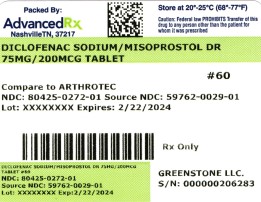
- 75 mg diclofenac sodium and 200 mcg misoprostol as round, biconvex, white to off-white tablets imprinted with a "75" in the middle on one side and "G" and "0029" on the other.
The dosage strengths are supplied in:
9PATIENT COUNSELING INFORMATION
Advise the patient to read the FDA-approved patient labeling (Medication Guide). Inform patients, families, or their caregivers of the following information before initiating therapy with diclofenac sodium/misoprostol and periodically during the course of ongoing therapy.
10PRINCIPAL DISPLAY PANEL - 75 mg/200 mcg Tablet Bottle Label