Brand Name

Beleodaq

Generic Name
Belinostat
View Brand Information
FDA approval date: July 21, 2014
Classification: Histone Deacetylase Inhibitor
Form: Injection

What is Beleodaq (Belinostat)?

Beleodaq is indicated for the treatment of adult patients with relapsed or refractory peripheral T-cell lymphoma . This indication is approved under accelerated approval based on tumor response rate and duration of response. An improvement in survival or disease-related symptoms has not been established. Continued approval for this indication may be contingent upon verification and description of clinical benefit in the confirmatory trial. Beleodaq is a histone deacetylase inhibitor indicated for the treatment of adult patients with relapsed or refractory peripheral T-cell lymphoma . This indication is approved under accelerated approval based on tumor response rate and duration of response. An improvement in survival or disease-related symptoms has not been established. Continued approval for this indication may be contingent upon verification and description of clinical benefit in the confirmatory trial.
Save this treatment for later
Sign Up
Not sure about your diagnosis?
Check Your Symptoms
Tired of the same old research?
Check Latest Advances

Related Clinical Trials

A UGT1A1 Genotype-Directed Study of Belinostat Pharmacokinetics and Toxicity

Background: High-grade neuroendocrine carcinomas (HGNEC) are cancers that develop in different parts of the body, including the digestive tract, genitals, neck, and head. One drug (belinostat), combined with 2 other drugs (etoposide and cisplatin), is approved to treat HGNEC. But some people may have a gene variant that affects how quickly their body gets rid of the drug; these people may do better with diffe...

A Phase 3, Randomized, Open-Label Study Comparing the Efficacy and Safety of the Combination of Beleodaq-CHOP or Folotyn-COP to the CHOP Regimen Alone in Newly Diagnosed Patients With Peripheral T-Cell Lymphoma

Summary: Part 1: This is a 5 Arm study primarily to determine the best dose out of the two dose levels of Belinostat and Pralatrexate combined with CHOP/COP in newly diagnosed PTCL patients based on Safety for part 2 study. Part 2 (Efficacy and Safety): This is a 3 Arm study. Patients with previously untreated PTCL will be randomized 1:1:1 into 1 of 3 treatment groups: 2 experimental treatment groups (Bel-...

Phase 1/Expansion Study of Tazemetostat Plus Belinostat for the Treatment of Relapsed or Refractory Lymphoma

Summary: This phase I trial tests the safety, side effects, and best dose of combination therapy with tazemetostat and belinostat in treating patients with lymphoma that has come back after a period of improvement (relapsed) or that does not respond to treatment (refractory). Tazemetostat is in a class of medications called EZH2 inhibitors. The EZH2 gene provides instructions for making a type of enzyme ca...

Brand Information

Beleodaq (Belinostat)
1INDICATIONS AND USAGE
Beleodaq is indicated for the treatment of adult patients with relapsed or refractory peripheral T-cell lymphoma (PTCL).
This indication is approved under accelerated approval based on tumor response rate and duration of response [
2DOSAGE FORMS AND STRENGTHS
For injection: 500 mg, lyophilized powder in single-dose vial for reconstitution
3CONTRAINDICATIONS
None
4ADVERSE REACTIONS
The following clinically significant adverse reactions are described in more detail in other sections of the prescribing information.
  • Hematologic Toxicity 
  • Infection
  • Hepatotoxicity
  • Tumor Lysis Syndrome
  • Gastrointestinal Toxicity
4.1Clinical Trials Experience
Because clinical trials are conducted under widely varying conditions, adverse reaction rates observed in the clinical trials of Beleodaq may not reflect the rates observed in practice.
Adverse Reactions in Patients with Peripheral T-Cell Lymphoma
The safety of Beleodaq was evaluated in 129 patients with relapsed or refractory PTCL in the single arm clinical trial in which patients were administered Beleodaq at a dosage of 1,000 mg/m
The most common adverse reactions observed in the trial of patients with relapsed or refractory PTCL treated with Beleodaq were nausea, fatigue, pyrexia, anemia, and vomiting
Note: Adverse reactions are listed by order of incidence in the “All Grades” category first, then by incidence in “the Grade 3 or 4” category; Measured by National Cancer Institute Common Terminology Criteria for Adverse Events (NCI-CTCAE) version 3.0
Serious Adverse Reactions
Sixty-one patients (47.3%) experienced serious adverse reactions while taking Beleodaq or within 30 days after their last dose of Beleodaq. The most common serious adverse reactions (> 2%) were pneumonia, pyrexia, infection, anemia, increased creatinine, thrombocytopenia, and multi-organ failure. One treatment-related death associated with hepatic failure was reported in the trial.
One patient with baseline hyperuricemia and bulky disease experienced Grade 4 tumor lysis syndrome during the first cycle of treatment and died due to multi-organ failure. A treatment-related death from ventricular fibrillation was reported in another monotherapy clinical trial with Beleodaq. ECG analysis did not identify QTc prolongation.
Discontinuations due to Adverse Reactions
Twenty-five patients (19.4%) discontinued treatment with Beleodaq due to adverse reactions. The adverse reactions reported most frequently as the reason for discontinuation of treatment included anemia, febrile neutropenia, fatigue, and multi-organ failure.
Dosage Modifications due to Adverse Reactions
In the trial, dosage adjustments due to adverse reactions occurred in 12% of Beleodaq-treated patients.
5OVERDOSAGE
No specific information is available on the treatment of overdosage of Beleodaq. There is no antidote for Beleodaq and it is not known if Beleodaq is dialyzable. If an overdose occurs, general supportive measures should be instituted as deemed necessary by the treating physician. The elimination half-life of belinostat is 1.1 hours 
6DESCRIPTION
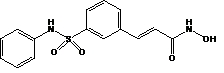
Beleodaq is a histone deacetylase inhibitor with a sulfonamide-hydroxamide structure. The chemical name of belinostat is (2E)-
Structure
The molecular formula is C
Belinostat is a white to off-white powder. It is slightly soluble in distilled water (0.14 mg/mL) and polyethylene glycol 400 (about 1.5 mg/mL), and is freely soluble in ethanol (> 200 mg/mL). The pKa values are 7.87 and 8.71 by potentiometry and 7.86 and 8.59 by UV.
Beleodaq (belinostat) for injection is supplied as a sterile lyophilized yellow powder containing 500 mg belinostat as the active ingredient. Each vial also contains 1000 mg L-Arginine, USP as an inactive ingredient. The drug product is supplied in a single-dose clear glass vial with a coated stopper and aluminum crimp seal with “flip-off” cap. Beleodaq is intended for intravenous administration after reconstitution with 9 mL Sterile Water for injection, and the reconstituted solution is further diluted with 250 mL of sterile 0.9% Sodium Chloride injection prior to infusion
7CLINICAL STUDIES
Relapsed or Refractory Peripheral T-cell Lymphoma (PTCL)
In an open-label, single-arm, non-randomized international trial conducted at 62 centers, 129 patients with relapsed or refractory PTCL were treated with Beleodaq 1,000 mg/m
Efficacy was evaluated using response rate (complete response and partial response) as assessed by an independent review committee (IRC) using the International Workshop Criteria (IWC) (Cheson 2007). Response assessments were evaluated every 6 weeks for the first 12 months and then every 12 weeks until 2 years from the start of study treatment. Duration of response was measured from the first day of documented response to disease progression or death. Response and progression of disease were evaluated by the IRC using the IWC.
Table 4 summarizes the baseline demographic and disease characteristics of the study population, who were evaluable for efficacy.
In all evaluable patients (N = 120) treated with Beleodaq, the overall response rate per central review using IWC was 25.8% (N = 31) (
CI=confidence interval, CR=complete response, PR=partial response
The median duration of response based on the first date of response to disease progression or death was 8.4 months (95% CI: 4.5 - 29.4). Of the responders, the median time to response was 5.6 weeks (range 4.3 - 50.4 weeks). Nine patients (7.5%) were able to proceed to a stem cell transplant after treatment with Beleodaq.
8REFERENCES
1 OSHA Hazardous Drugs. OSHA.  http://www.osha.gov/SLTC/hazardousdrugs/index.html
9HOW SUPPLIED/STORAGE AND HANDLING
How Supplied
Beleodaq (belinostat) for injection is supplied in single vial cartons; each clear vial contains sterile, lyophilized powder equivalent to 500 mg belinostat.

NDC 72893-002-01: Individual carton of Beleodaq single-dose vial containing 500 mg belinostat.
Storage and Handling
Store Beleodaq (belinostat) for injection at room temperature 20°C to 25°C (68°F to 77°F). Excursions are permitted between 15°C and 30°C (59°F and 86°F). Retain in original package until use. [see USP Controlled Room Temperature].
10PATIENT COUNSELING INFORMATION
Physicians should discuss the FDA approved Patient Information Leaflet with patients prior to treatment with Beleodaq. Instruct patients to read the Patient Information Leaflet carefully.
  • To report symptoms of nausea, vomiting and diarrhea so that appropriate antiemetic and antidiarrheal medications can be administered [see
  • To report any symptoms of thrombocytopenia, leukopenia (neutropenia and lymphopenia), and anemia [see
  • To immediately report symptoms of infection (e.g., pyrexia) [see
  • Of the potential risk to the fetus and for women to avoid pregnancy and use effective contraception while receiving Beleodaq and for 6 months after the last dose [
  • To avoid breastfeeding while receiving Beleodaq and for 2 weeks after the last dose [see
  • To understand the importance of monitoring liver function test abnormalities and to immediately report potential symptoms of liver injury [see
Manufactured by:
11SPL PATIENT PACKAGE INSERT SECTION
This Patient Information has been approved by the U.S. Food and Drug Administration.                                                     Revised: Apr 2025
12PACKAGE/LABEL PRINCIPAL DISPLAY PANEL
carton label
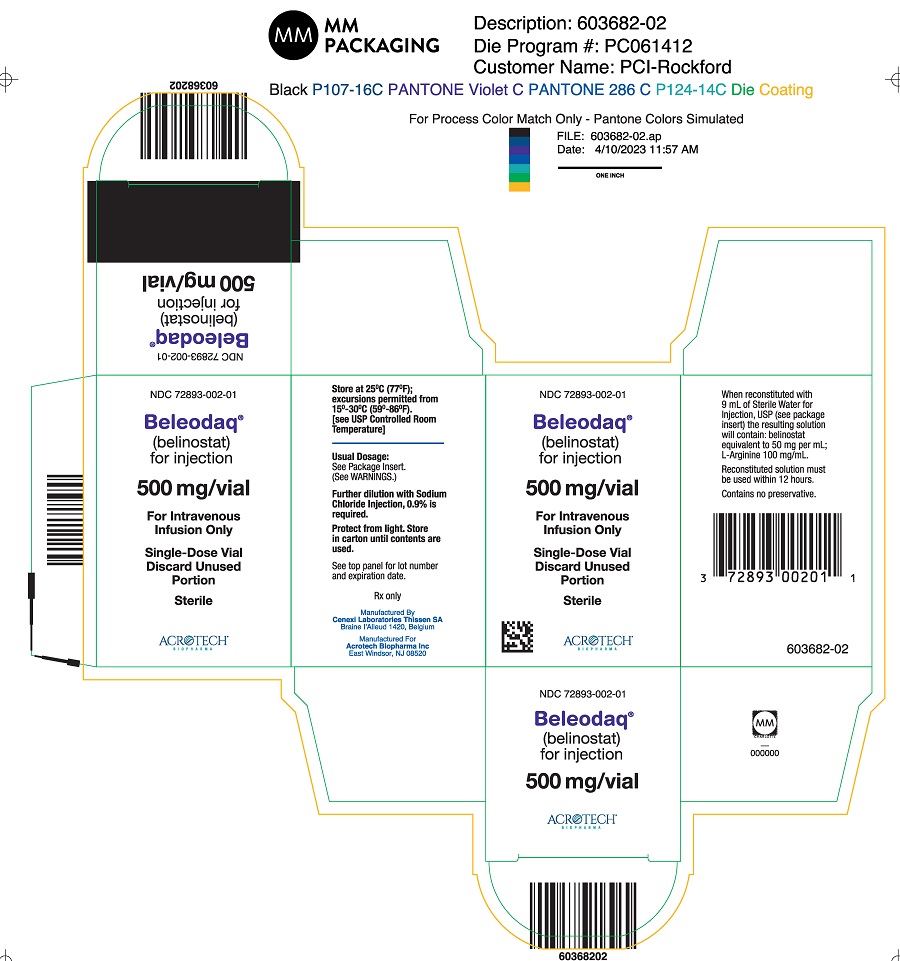
Carton Label
NDC 72893-002-01
Beleodaq® (belinostat) for injection
500 mg/vial
For Intravenous Infusion Only
Single-Dose Vial
vial label
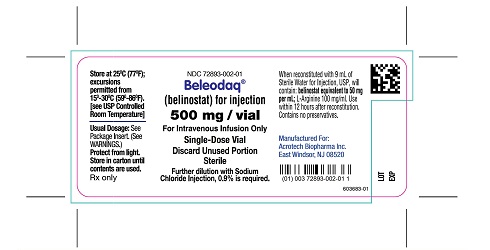
Vial Label
NDC 72893-002-01
500 mg/vial
For Intravenous Infusion Only
Single-Dose Vial