Polycythemia Vera Treatments
Find Polycythemia Vera Treatments
BESREMi
What is BESREMi (Ropeginterferon alfa-2B)?
Approved To Treat


Related Clinical Trials
Summary: This is a single-center, phase I/IB study to identify the recommended phase II dose of Ropeginterferon-alfa 2b (P1101) in patients with CTCL who have failed at least two prior lines of skin-directed therapy (Stage IA-IB) or have less than a complete response to phototherapy or extracorporeal photopheresis (ECP) or total skin electron beam therapy (TSET), or stable/progressive disease after at leas...
Summary: The primary objective of this non interventional study is to evaluate symptom burden in adult patients with PV without symptomatic splenomegaly during treatment with ropeginterferon alfa-2b in a real-world setting. Further patient-relevant endpoints include effectiveness including complete hematologic response (CHR), event-free survival (EFS), safety and tolerability, treatment reality including d...
Summary: This is a phase 3 double-blind clinical trial arm to test Ropeginterferon alfa-2b (P1101) in adult patients with Primary Myelofibrosis (PMF) at early stage or low to medium risk. Participants will receive the study drug/placebo bi-weekly and have an assessment visit every 4 weeks. The ratio of study drug to placebo group is 2:1.
Related Latest Advances
Brand Information
Obtain a pregnancy test in females of reproductive potential prior to initiating treatment with BESREMi [see Use in Specific Populations (8.3)].
Patients Not Already on Hydroxyurea:
- The recommended BESREMi starting dosage for patients not on hydroxyurea is 100 mcg by subcutaneous injection every two weeks.
- Increase the dose by 50 mcg every two weeks (up to a maximum of 500 mcg), until the hematological parameters are stabilized (hematocrit less than 45%, platelets less than 400 x 109/L, and leukocytes less than 10 x 109/L).
- When transitioning to BESREMi from hydroxyurea, start BESREMi at 50 mcg by subcutaneous injection every two weeks in combination with hydroxyurea.
- Gradually taper off the hydroxyurea by reducing the total biweekly dose by 20-40% every two weeks during Weeks 3-12.
- Increase the dose of BESREMi by 50 mcg every two weeks (up to a maximum of 500 mcg), until the hematological parameters are stabilized (hematocrit less than 45%, platelets less than 400 x 109/L, and leukocytes less than 10 x 109/L).
- Discontinue hydroxyurea by Week 13.
If dose interruption occurs, resume dosing at previously attained levels. If drug-related toxicities arise, reduce the dose to the next lower level or interrupt in accordance with the table below (Table 1). If there is insufficient efficacy at the decreased dose following dose modification, a dose increase attempt to the next higher dose level should be considered after recovery to grade 1 toxicity.
Table 1 Dose Modifications for BESREMi Adverse Reactions
Read the INSTRUCTIONS FOR USE before administering the single-dose BESREMi prefilled syringe. BESREMi is for subcutaneous injection only and may be administered by either a healthcare professional, a patient or a caregiver. Before a decision is made to allow BESREMi to be administered by a patient or caregiver, ensure that the patient is an appropriate candidate for self-administration or administration by a caregiver. Proper training on storage, preparation and administration technique should be provided. If a patient or caregiver is not an appropriate candidate for any reason, then BESREMi should be administered by a healthcare professional.
- Remove the prefilled syringe cap by unscrewing it counterclockwise.
- Attach the covered needle to the prefilled syringe by firmly pushing it onto the collar of the syringe and then screwing (turn clockwise) it on until it feels securely attached.
- Choose one of the following injection sites: Lower stomach (abdomen) area, at least 2 inches away from the belly button, or top of thighs. Rotate (change) the injection site for each injection. Do not inject into skin that is irritated, red, bruised, infected, or scarred; clean the chosen injection site with an alcohol swab and let air dry.
- Uncap needle and move air bubbles to top. Pull the pink needle shield back and hold the syringe from the syringe body. Remove the clear needle cap by pulling it straight off. Throw away the needle cap into the trash. Hold the prefilled syringe with the needle pointing up. Tap on the body of the prefilled syringe to move any air bubbles to the top.
- Depending on the prescribed dose, the amount of dose in the syringe may need to be adjusted by discarding some of the medication.
- Hold the prefilled syringe at eye level with the needle pointing straight up over a paper towel, sink, or trash can. Check that you can see the dose lines and number markings on the prefilled syringe.
- Pinch the end of the plunger and slowly push up to remove liquid medicine until the top edge of the gray stopper lines up with the marking for the prescribed dose.
Inject BESREMi
- Pinch the chosen injection site. While pinching the skin, insert needle at a 45- to 90-degree angle into the pinched skin, then release the pinched skin.
- Inject BESREMi by slowly pressing on the plunger all the way until it stops. After all the liquid medicine is injected, remove the needle from the skin.
- Carefully push the pink needle shield over the needle until it snaps into place and covers the needle. Do not recap the needle using the needle cap; only use the pink needle shield to cover the needle.
- Throw away the used prefilled syringe with the needle still attached, into an FDA-cleared sharps disposal container.
- Existence of, or history of severe psychiatric disorders, particularly severe depression, suicidal ideation, or suicide attempt
- Hypersensitivity to interferons including interferon alfa-2b or any of the inactive ingredients of BESREMi
- Moderate (Child-Pugh B) or severe (Child-Pugh C) hepatic impairment
- History or presence of active serious or untreated autoimmune disease
- History of transplantation and receiving immunosuppressant agents.
The following clinically significant adverse reactions are described elsewhere in the labeling.
- Depression and Suicide [see Warnings and Precautions (5.1)]
- Endocrine Toxicity [see Warnings and Precautions (5.2)]
- Cardiovascular Toxicity [see Warnings and Precautions (5.3)]
- Decreased Peripheral Blood Counts [see Warnings and Precautions (5.4)]
- Hypersensitivity Reactions [see Warnings and Precautions (5.5)]
- Pancreatitis [see Warnings and Precautions (5.6)]
- Colitis [see Warnings and Precautions (5.7)]
- Pulmonary Toxicity [see Warnings and Precautions (5.8)]
- Ophthalmologic Toxicity [see Warnings and Precautions (5.9)]
- Hyperlipidemia [see Warnings and Precautions (5.10)]
- Hepatotoxicity [see Warnings and Precautions (5.11)]
- Renal Toxicity [see Warnings and Precautions (5.12)]
- Dental and Periodontal Toxicity [see Warnings and Precautions (5.13)]
- Dermatologic Toxicity [see Warnings and Precautions (5.14)]
- Driving and Operating Machinery [see Warnings and Precautions (5.15)]
Because clinical trials are conducted under widely varying conditions, adverse reaction rates observed in the clinical trials of a drug cannot be directly compared to rates in the clinical trials of another drug and may not reflect the rates observed in practice.
The pooled safety population described in the Warnings and Precautions section reflects exposure to BESREMi as monotherapy for the treatment of polycythemia vera dosed every two to four weeks in 178 patients in two open-label trials [PEGINVERA, PROUD/CONTINUATION PV]. The mean age at baseline was 58.6 years (range 30-85 years), 88 (49.4%) women, 90 (50.6%) men, 177 (99%) Caucasian and 1 (1%) Asian. Among 178 patients who received BESREMi, 80% were exposed for 12 months or longer. The mean dose of BESREMi was 334 mcg SD ± 121 during the treatment period. In this pooled safety population, the most common adverse reactions greater than 10%, were liver enzyme elevations (20%), leukopenia (20%), thrombocytopenia (19%), arthralgia (13%), fatigue (12%), myalgia (11%), and influenza-like illness (11%).
The safety findings described below reflect exposure to BESREMi as monotherapy for the treatment of polycythemia vera in 51 patients in the PEGINVERA study [see Clinical Studies (14)]. Among the 51 patients receiving BESREMi, 71% were exposed for 12 months or longer, 63% were exposed for three years or longer, and 53% were exposed for greater than five years.
Serious adverse reactions were reported in 16% of patients in the PEGINVERA study. The most common serious adverse reactions observed during the study (> 4%) included urinary tract infection (8%), transient ischemic attack (6%) and depression (4%).
f Includes night sweats and hyperhidrosis.
g Includes upper respiratory tract infection, rhinitis, bronchitis, and respiratory tract infection.
h Includes abdominal pain upper, abdominal pain lower, and abdominal pain.
i Includes insomnia, sleep disorder, and abnormal dreams.
j Includes peripheral edema and generalized edema.
k Includes hypertension and hypertensive crisis.
l Includes rash, maculopapular rash, and pruritic rash.
m Includes transaminase increase, hepatic enzyme increase, GGT increase, AST increase, and ALT increase.
- Depression and Suicide
- Endocrine Toxicity
- Cardiovascular Toxicity
- Decreased Peripheral Blood Counts
- Hypersensitivity Reactions
- Pancreatitis
- Colitis
- Pulmonary Toxicity
- Ophthalmologic Toxicity
- Hyperlipidemia
- Hepatotoxicity
- Renal Toxicity
- Dental and Periodontal Toxicity
- Dermatologic Toxicity
- Driving and Operating Machinery
- Embryo-Fetal Toxicity
7.3 Narcotics, Hypnotics or Sedatives
Risk Summary
Available human data with BESREMi use in pregnant women are insufficient to identify a drug-associated risk of
major birth defects, miscarriage or adverse maternal or fetal outcomes. An abortifacient effect was reported in
cynomolgus monkeys receiving ropeginterferon alfa-2b (see Data). Based on mechanism of action and the role of
interferon alfa in pregnancy and fetal development, BESREMi may cause fetal harm and should be assumed to have
abortifacient potential when administered to a pregnant woman. There are adverse effects on maternal and fetal
outcomes associated with polycythemia vera in pregnancy (see Clinical Considerations). Advise pregnant women of
the potential risk to a fetus.
The estimated background risk of major birth defects and miscarriage for the indicated population is unknown. All
pregnancies have a background risk of birth defect, loss, or other adverse outcomes. In the U.S. general population,
the estimated background risk of major birth defects and miscarriage is 2-4% and 15-20%, respectively.
Data
Animal Data
In an embryo-fetal development study, pregnant cynomolgus monkeys received subcutaneous injection of
ropeginterferon alfa-2b twice weekly during the period of organogenesis (Gestation Days 20-48). Maternal toxicity,
characterized by a significant decline in food consumption and transient body weight loss, occurred at all dose levels
and ropeginterferon alfa-2b was abortifacient and caused embryonic death at exposures 275-times (C max) and 64-times
(AUC) the human exposure at the maximum recommended human dose of 500 μg. There were no effects on fetal
Disease-Associated Maternal and/or Embryo-Fetal Risk
Untreated polycythemia vera during pregnancy is associated with adverse maternal outcomes such as thrombosis and
hemorrhage. Adverse pregnancy outcomes associated with polycythemia vera include increased risk for miscarriage.
8.2 Lactation
There are no data on the presence of BESREMi in human or animal milk, the effects on the breastfed child, or the
effects on milk production. Because of the potential for serious adverse reactions in breastfed children from BESREMi,
advise women not to breastfeed during treatment and for 8 weeks after the final dose.
8.3 Females and Males of Reproductive Potential
BESREMi may cause embryo-fetal harm when administered to a pregnant woman [see Use in Specific Populations (8.1)].
Pregnancy Testing
Pregnancy testing prior to BESREMi treatment is recommended for females of reproductive potential.
Contraception
Females
Advise female patients of reproductive potential to use effective contraception during treatment with BESREMi and
for at least 8 weeks after the final dose.
Females
Based on its mechanism of action, BESREMi can cause disruption of the menstrual cycle [see Clinical Pharmacology (12.1)]. No animal fertility studies have been conducted with BESREMi.
8.4 Pediatric Use
Safety and effectiveness in pediatric patients have not been established.
8.5 Geriatric Use
There were 17 patients 65 years of age and older in the clinical study in polycythemia vera [see Clinical Studies (14)].
Of the total number of BESREMi-treated patients in this study, 17 (33%) were 65 years of age and older, while 5
(9.8%) were 75 years of age and older. Clinical studies of BESREMi did not include sufficient numbers of subjects
aged 65 years and over to determine whether they respond differently from younger subjects. Other reported clinical
experience has not identified differences in responses between the elderly and younger patients.
No dose adjustment is necessary in patients with estimated glomerular filtration rate (eGFR) ≥30 mL/min [see Clinical Pharmacology (12.3)]. Avoid use of BESREMi in patients with eGFR <30 mL/min [see Warnings and Precautions (5.12)].
8.7 Hepatic Impairment
BESREMi is contraindicated in patients with hepatic impairment (Child-Pugh B or C) [see Contraindications (4)].
Increased liver enzyme levels have been observed in patients treated with BESREMi. When the increase in liver
enzyme levels is progressive and persistent, reduce the dose of BESREMi. If the increase in liver enzymes is
progressive and clinically significant despite dose-reduction, or if there is evidence of hepatic impairment (Child-Pugh
B or C), discontinue BESREMi [see Dosage and Administration (2.2) and Warnings and Precautions (5.11)].
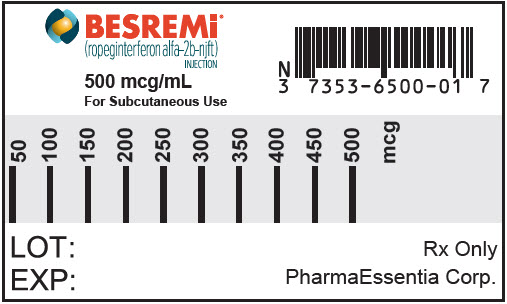
- One Single-Dose
- One Injection
- Full Prescribing
- Instructions for Use
- Medication Guide