Brand Name
Syprine
Generic Name
Trientine
View Brand Information FDA approval date: November 08, 1985
Classification: Copper Chelator
Form: Capsule
What is Syprine (Trientine)?
Trientine hydrochloride is indicated in the treatment of patients with Wilson's disease who are intolerant of penicillamine. Clinical experience with trientine hydrochloride is limited and alternate dosing regimens have not been well-characterized; all endpoints in determining an individual patient's dose have not been well defined. Trientine hydrochloride and penicillamine cannot be considered interchangeable. Trientine hydrochloride should be used when continued treatment with penicillamine is no longer possible because of intolerable or life endangering side effects. Unlike penicillamine, trientine hydrochloride is not recommended in cystinuria or rheumatoid arthritis. The absence of a sulfhydryl moiety renders it incapable of binding cystine and, therefore, it is of no use in cystinuria. In 15 patients with rheumatoid arthritis, trientine hydrochloride was reported not to be effective in improving any clinical or biochemical parameter after 12 weeks of treatment. Trientine hydrochloride is not indicated for treatment of biliary cirrhosis.
Approved To Treat
Save this treatment for later
Not sure about your diagnosis?
Tired of the same old research?
Related Clinical Trials
Decentralized Study to Assess Patient Treatment Preference Comparing Their Current Standard-of-care Wilson's Disease (WD) Treatment to a New Trientine (TETA) 4HCl Formulation.
Summary: Decentralized study to assess patient reported treatment satisfaction comparing their current standard-of-care Wilson's Disease (WD) treatment with a new once-daily Trientine (TETA) 4HCl formulation.
Description of the Copper Concentration in Breast Milk in Women Treated for Wilson's Disease
Summary: Wilson's disease is a rare genetic disease, affecting less than 1,500 people in France. The transmission is autosomal recessive linked to an anomaly of the ATP7B gene on chromosome.This gene codes for an ATPase-type transmembrane protein involved in the transport of copper through the cell plasma member.This gene codes for an ATPase-type transmembrane protein involved in the transport of copper th...
Related Latest Advances
Brand Information
Syprine (trientine hydrochloride)
1DESCRIPTION
Trientine hydrochloride is
The empirical formula is C
NH
Trientine hydrochloride is a chelating compound for removal of excess copper from the body. Syprine (trientine hydrochloride) is available as 250 mg capsules for oral administration. Syprine capsules contain gelatin, iron oxides, stearic acid, and titanium dioxide as inactive ingredients.
2INDICATIONS AND USAGE
Syprine is indicated in the treatment of patients with Wilson’s disease who are intolerant of penicillamine. Clinical experience with Syprine is limited and alternate dosing regimens have not been well-characterized; all endpoints in determining an individual patient’s dose have not been well defined. Syprine and penicillamine cannot be considered interchangeable. Syprine should be used when continued treatment with penicillamine is no longer possible because of intolerable or life endangering side effects.
Unlike penicillamine, Syprine is not recommended in cystinuria or rheumatoid arthritis. The absence of a sulfhydryl moiety renders it incapable of binding cystine and, therefore, it is of no use in cystinuria. In 15 patients with rheumatoid arthritis, Syprine was reported not to be effective in improving any clinical or biochemical parameter after 12 weeks of treatment.
Syprine is not indicated for treatment of biliary cirrhosis.
3CONTRAINDICATIONS
Hypersensitivity to this product.
4WARNINGS
Patient experience with trientine hydrochloride is limited (see
5ADVERSE REACTIONS
Clinical experience with Syprine has been limited. The following adverse reactions have been reported in a clinical study in patients with Wilson’s disease who were on therapy with trientine hydrochloride: iron deficiency, systemic lupus erythematosus (see
Syprine is not indicated for treatment of biliary cirrhosis, but in one study of 4 patients treated with trientine hydrochloride for primary biliary cirrhosis, the following adverse reactions were reported: heartburn; epigastric pain and tenderness; thickening, fissuring and flaking of the skin; hypochromic microcytic anemia; acute gastritis; aphthoid ulcers; abdominal pain; melena; anorexia; malaise; cramps; muscle pain; weakness; rhabdomyolysis. A causal relationship of these reactions to drug therapy could not be rejected or established.
To report SUSPECTED ADVERSE REACTIONS, contact Bausch Health US, LLC at 1-800-321-4576 or FDA at 1-800-FDA-1088 or www.fda.gov/medwatch.
6OVERDOSAGE
There is a report of an adult woman who ingested 30 grams of trientine hydrochloride without apparent ill effects. No other data on overdosage are available.
7DOSAGE AND ADMINISTRATION
Systemic evaluation of dose and/or interval between dose has not been done. However, on limited clinical experience, the recommended initial dose of Syprine is 500-750 mg/day for pediatric patients and 750-1250 mg/day for adults given in divided doses two, three or four times daily. This may be increased to a maximum of 2000 mg/day for adults or 1500 mg/day for pediatric patients age 12 or under.
The daily dose of Syprine should be increased only when the clinical response is not adequate or the concentration of free serum copper is persistently above 20 mcg/dL. Optimal long-term maintenance dosage should be determined at 6-to 12-month intervals (see
It is important that Syprine be given on an empty stomach, at least one hour before meals or two hours after meals and at least one hour apart from any other drug, food, or milk. The capsules should be swallowed whole with water and should not be opened or chewed.
8HOW SUPPLIED
Syprine capsules, 250 mg, are hard gelatin capsules with light brown opaque cap and body, imprinted with “SYPRINE” on cap and “ATON/710” on the body. They are supplied as follows:
NDC 0187-2120-10 in bottles of 100.
8.1STORAGE
Keep container tightly closed.
Store at 2° to 8°C (36° to 46°F).
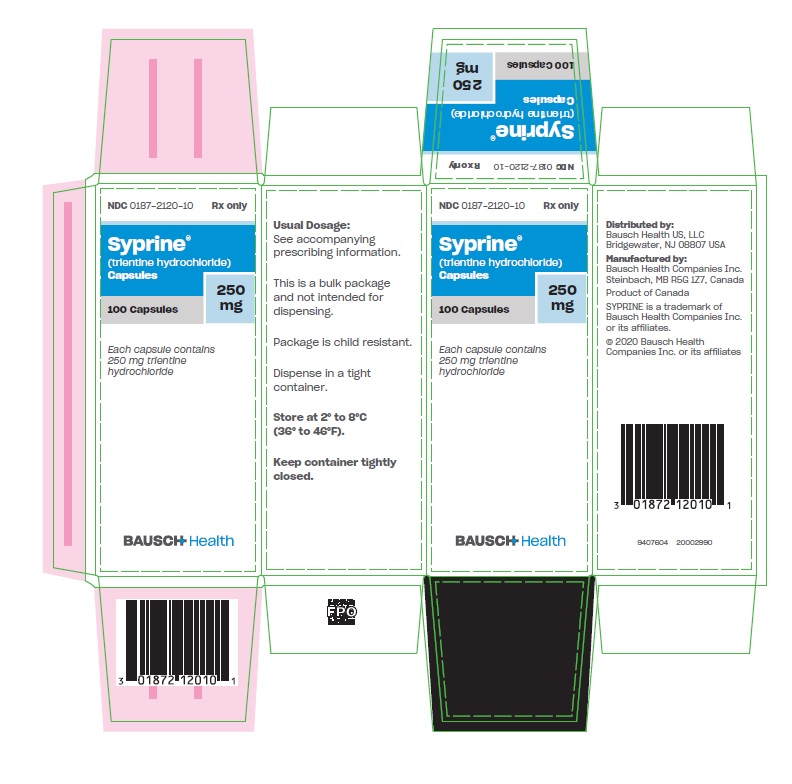
9PRINCIPAL DISPLAY PANEL - 250 mg Capsule Carton
NDC 0187-2120-10
Rx only
SYPRINE
(trientine hydrochloride)
Capsules
(trientine hydrochloride)
Capsules
100 Capsules
250 mg
BAUSCH HEALTH