Renal Cell Carcinoma (RCC) Treatments
Find Renal Cell Carcinoma (RCC) Treatments
Sorafenib
What is Nexavar (Sorafenib)?
Approved To Treat


Related Clinical Trials
Summary: The study population consisted of FLT3-ITD-mutated AML patients who were FLT3-ITD-positive before allogeneic hematopoietic stem cell transplantation. This open-label, randomized, controlled trial enrolled participants and randomly assigned them in a 1:1 ratio to either the experimental group or the control group. The experimental group received maintenance therapy with gilteritinib, while the cont...
Summary: The purpose of this study is to determine the MTD of WGI-0301 in combination with Sorafenib for advanced Hepatocellular Carcinoma (HCC) and assess its safety and efficacy in adults with advanced unresectable HCC who have previously received PD-1 / PD-L1 immune checkpoint inhibitors.
Summary: Several cancer immunotherapies that target the PD-L1/PD-1 pathway (i.e., checkpoint inhibitors) show promising clinical activity in patients with HCC. In particular, atezolizumab selectively targets PD-L1 to prevent interaction with receptors PD-1 and B7-1, thus reversing T-cell suppression. Moreover, atezolizumab in combination with bevacizumab, a monoclonal antibody that targets VEGF and inhibit...
Related Latest Advances
Brand Information
- 200 mg sorafenib, round, biconvex, red film-coated tablets, debossed with the “Bayer cross” on one side and “200” on the other side.
- 200 mg sorafenib, round, faceted biconvex, red film-coated tablets, debossed with the “Bayer cross” on one side and “200” on the other side.
- NEXAVAR is contraindicated in patients with known severe hypersensitivity to sorafenib or any other component of NEXAVAR.
- NEXAVAR in combination with carboplatin and paclitaxel is contraindicated in patients with squamous cell lung cancer
- Cardiovascular events
- Hemorrhage
- Hypertension
- Dermatologic toxicities
- Gastrointestinal perforation
- QT interval prolongation
- Drug-induced liver injury
- Impairment of TSH suppression in DTC
- Adverse reactions graded according to National Cancer Institute Common Terminology Criteria for Adverse Events version 3.0 (NCI CTCAE v3.0).
- Laboratory parameters graded according to National Cancer Institute Common Terminology Criteria for Adverse Events version 3.0 (NCI CTCAE v3.0).
- Adverse reactions graded according to National Cancer Institute Common Terminology Criteria for Adverse Events version 3.0 (NCI CTCAE v3.0).
- Laboratory parameters graded according to National Cancer Institute Common Terminology Criteria for Adverse Events version 3.0 (NCI CTCAE v3.0).
- National Cancer Institute Common Terminology Criteria for Adverse Events Version 3.0
- Includes the following terms: abdominal pain, abdominal discomfort, hepatic pain, esophageal pain, esophageal discomfort, abdominal pain lower, abdominal pain upper, abdominal tenderness, abdominal rigidity
- Includes the following terms: stomatitis, aphthous stomatitis, mouth ulceration, mucosal inflammation
- Includes the following terms: oral pain, oropharyngeal discomfort, glossitis, burning mouth syndrome, glossodynia
- Palmar-plantar erythrodysesthesia syndrome (Hand-foot skin reaction)
- Includes the following terms: hypertension, blood pressure increased, blood pressure systolic increased
- Laboratory parameters graded according to National Cancer Institute Common Terminology Criteria for Adverse Events version 3.0 (NCI CTCAE v3.0).
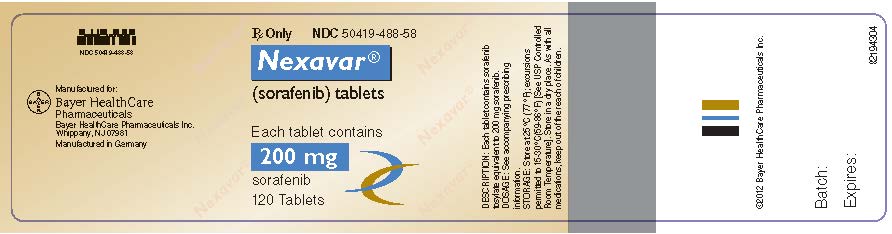
- 200 mg, round, biconvex, red film-coated tablets, debossed with the “Bayer cross” on one side and “200” on the other side. NDC 50419-488-58
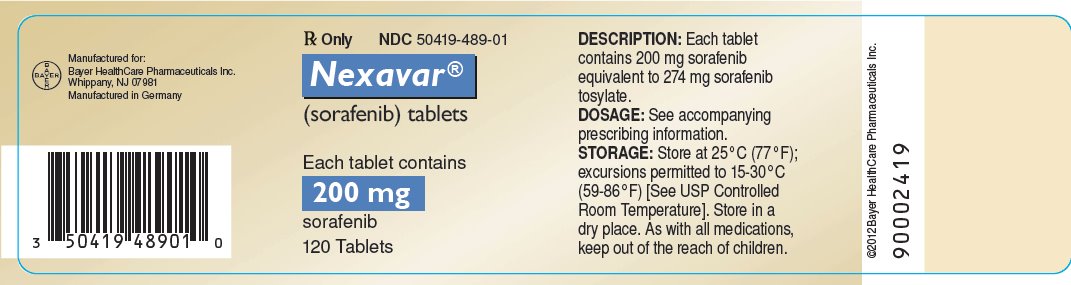
- 200 mg, round, faceted, biconvex, red film-coated tablets, debossed with the “Bayer cross” on one side and “200” on the other side. NDC 50419-489-01
(sorafenib) tablets
(sorafenib) tablets