Rheumatoid Arthritis (RA) Treatments

Find Rheumatoid Arthritis (RA) Treatments

Generic Name

Tocilizumab

Brand Names
Actemra, Actemra ACTPen, Avtozma, Tocilizumab-anoh, Tofidence, Tyenne
FDA approval date: January 08, 2010
Classification: Interleukin-6 Receptor Antagonist
Form: Injection

What is Actemra (Tocilizumab)?

ACTEMRA ® is an interleukin-6 receptor antagonist indicated for treatment of: Rheumatoid Arthritis .
Save this treatment for later
Sign Up
Not sure about your diagnosis?
Check Your Symptoms
Tired of the same old research?
Check Latest Advances

Related Clinical Trials

A Phase Ib/II, Open-label, Multicenter, Randomized Umbrella Study Evaluating the Efficacy and Safety of Multiple Treatment Combinations in Patients With Metastatic Breast Cancer (Morpheus-panBC)

Summary: This is an umbrella study evaluating the efficacy and safety of multiple treatment combinations in participants with metastatic or inoperable locally advanced breast cancer. The study will be performed in two stages. During Stage 1, seven cohorts will be enrolled in parallel in this study: Cohort 1 will consist of programmed death-ligand 1 (PD-L1)-positive participants who have received no prior s...

Targeting Inflammation and Alloimmunity in Lung Transplant Recipients With Tocilizumab (CTOT-45)

Summary: This is a trial in which 350 primary lung transplant recipients will be randomized (1:1) to receive either Tocilizumab (six doses over 20 weeks) plus standard triple maintenance immunosuppression or placebo (sterile normal saline) plus standard triple maintenance immunosuppression (Tacrolimus, Mycophenolate Mofetil, corticosteroids). The primary objective is to test the hypothesis that treatment w...

Brand Information

    ACTEMRA (tocilizumab)
    WARNING: RISK OF SERIOUS INFECTIONS
    Patients treated with ACTEMRA are at increased risk for developing serious infections that may lead to hospitalization or death
    If a serious infection develops, interrupt ACTEMRA until the infection is controlled.
    Reported infections include:
    • Active tuberculosis, which may present with pulmonary or extrapulmonary disease. Patients, except those with COVID-19, should be tested for latent tuberculosis before ACTEMRA use and during therapy. Treatment for latent infection should be initiated prior to ACTEMRA use.
    • Invasive fungal infections, including candidiasis, aspergillosis, and pneumocystis. Patients with invasive fungal infections may present with disseminated, rather than localized, disease.
    • Bacterial, viral and other infections due to opportunistic pathogens.
    The risks and benefits of treatment with ACTEMRA should be carefully considered prior to initiating therapy in patients with chronic or recurrent infection.
    Patients should be closely monitored for the development of signs and symptoms of infection during and after treatment with ACTEMRA, including the possible development of tuberculosis in patients who tested negative for latent tuberculosis infection prior to initiating therapy
    1CONTRAINDICATIONS
    ACTEMRA is contraindicated in patients with known hypersensitivity to ACTEMRA
    2ADVERSE REACTIONS
    The following serious adverse reactions are described elsewhere in labeling:
    • Serious Infections
    • Gastrointestinal Perforations
    • Laboratory Parameters
    • Immunosuppression
    • Hypersensitivity Reactions, Including Anaphylaxis
    • Demyelinating Disorders
    • Active Hepatic Disease and Hepatic Impairment
    Because clinical studies are conducted under widely varying conditions, adverse reaction rates observed in the clinical studies of a drug cannot be directly compared to rates in the clinical studies of another drug and may not predict the rates observed in a broader patient population in clinical practice.
    2.1Clinical Trials Experience in Rheumatoid Arthritis Patients Treated with Intravenous ACTEMRA (ACTEMRA-IV)
    The ACTEMRA-IV data in rheumatoid arthritis (RA) includes 5 double-blind, controlled, multicenter studies. In these studies, patients received doses of ACTEMRA-IV 8 mg per kg monotherapy (288 patients), ACTEMRA-IV 8 mg per kg in combination with DMARDs (including methotrexate) (1582 patients), or ACTEMRA-IV 4 mg per kg in combination with methotrexate (774 patients).
    The all exposure population includes all patients in registration studies who received at least one dose of ACTEMRA-IV. Of the 4009 patients in this population, 3577 received treatment for at least 6 months, 3309 for at least one year; 2954 received treatment for at least 2 years and 2189 for 3 years.
    All patients in these studies had moderately to severely active rheumatoid arthritis. The study population had a mean age of 52 years, 82% were female and 74% were Caucasian.
    The most common serious adverse reactions were serious infections
    The proportion of patients who discontinued treatment due to any adverse reactions during the double-blind, placebo-controlled studies was 5% for patients taking ACTEMRA-IV and 3% for placebo-treated patients. The most common adverse reactions that required discontinuation of ACTEMRA-IV were increased hepatic transaminase values (per protocol requirement) and serious infections.
    2.2Clinical Trials Experience in Rheumatoid Arthritis Patients Treated with Subcutaneous ACTEMRA (ACTEMRA-SC)
    The ACTEMRA-SC data in rheumatoid arthritis (RA) includes 2 double-blind, controlled, multicenter studies. Study SC-I was a non-inferiority study that compared the efficacy and safety of tocilizumab 162 mg administered every week subcutaneously and 8 mg/kg intravenously every four weeks in 1262 adult subjects with rheumatoid arthritis. Study SC-II was a placebo controlled superiority study that evaluated the safety and efficacy of tocilizumab 162 mg administered every other week subcutaneously or placebo in 656 patients. All patients in both studies received background non-biologic DMARDs.
    The safety observed for ACTEMRA-SC administered subcutaneously was consistent with the known safety profile of intravenous ACTEMRA, with the exception of injection site reactions (ISRs), which were more common with ACTEMRA-SC compared with placebo SC injections (IV arm).
    2.3Clinical Trials Experience in Giant Cell Arteritis Patients Treated with Subcutaneous ACTEMRA (ACTEMRA-SC)
    The safety of subcutaneous ACTEMRA (tocilizumab) has been studied in one Phase III study (WA28119) with 251 GCA patients. The total patient years duration in the ACTEMRA-SC GCA all exposure population was 138.5 patient years during the 12-month double blind, placebo-controlled phase of the study. The overall safety profile observed in the ACTEMRA-SC treatment groups was generally consistent with the known safety profile of ACTEMRA. There was an overall higher incidence of infections in GCA patients relative to RA patients. The rate of infection/serious infection events was 200.2/9.7 events per 100 patient years in the ACTEMRA-SC weekly group and 160.2/4.4 events per 100 patient years in the ACTEMRA-SC every other week group as compared to 156.0/4.2 events per 100 patient years in the placebo + 26 week prednisone taper and 210.2/12.5 events per 100 patient years in the placebo + 52 week taper groups.
    2.4Clinical Trials Experience in Giant Cell Arteritis Patients Treated With Intravenous ACTEMRA (ACTEMRA-IV)
    The safety of ACTEMRA-IV was studied in an open label PK-PD and safety study in 24 patients with GCA who were in remission on ACTEMRA-IV at time of enrollment. Patients received ACTEMRA 7 mg/kg every 4 weeks for 20 weeks, followed by 6 mg/kg every 4 weeks for 20 weeks. The total patient years exposure to treatment was 17.5 years. The overall safety profile observed for ACTEMRA administered intravenously in GCA patients was consistent with the known safety profile of ACTEMRA.
    2.5Clinical Trials Experience in Systemic Sclerosis-Associated Interstitial Lung Disease Patients Treated with Subcutaneous ACTEMRA (ACTEMRA-SC)
    The safety of subcutaneous ACTEMRA was evaluated in two double-blind, placebo-controlled, multicenter studies (WA29767 and WA27788). In the Phase 3 Study WA29767, 212 patients with SSc were randomized to tocilizumab 162 mg administered every week subcutaneously or placebo for 48 weeks, followed by open-label tocilizumab 162 mg administered subcutaneously every week for another 48 weeks. In the Phase 2/3 Study WA27788, 87 patients were randomized to tocilizumab 162 mg administered every week subcutaneously or placebo for 48 weeks, followed by open-label tocilizumab 162 mg administered subcutaneously every week for another 48 weeks.
    The safety profile for ACTEMRA through week 48 in WA29767 was comparable for SSc-ILD and SSc patients overall, and in both studies was consistent with the known safety profile of ACTEMRA.
    2.6Clinical Trials Experience in Polyarticular Juvenile Idiopathic Arthritis Patients Treated With Intravenous ACTEMRA (ACTEMRA-IV)
    The safety of ACTEMRA-IV was studied in 188 pediatric patients 2 to 17 years of age with PJIA who had an inadequate clinical response or were intolerant to methotrexate. The total patient exposure in the ACTEMRA-IV all exposure population (defined as patients who received at least one dose of ACTEMRA-IV) was 184.4 patient years. At baseline, approximately half of the patients were taking oral corticosteroids and almost 80% were taking methotrexate. In general, the types of adverse drug reactions in patients with PJIA were consistent with those seen in RA and SJIA patients
    2.7Clinical Trials Experience in Polyarticular Juvenile Idiopathic Arthritis Patients Treated With Subcutaneous ACTEMRA (ACTEMRA-SC)
    The safety of ACTEMRA-SC was studied in 52 pediatric patients 1 to 17 years of age with PJIA who had an inadequate clinical response or were intolerant to methotrexate. The total patient exposure in the PJIA ACTEMRA-SC population (defined as patients who received at least one dose of ACTEMRA-SC and accounting for treatment discontinuation) was 49.5 patient years. In general, the safety observed for ACTEMRA administered subcutaneously was consistent with the known safety profile of intravenous ACTEMRA, with the exception of injection site reactions (ISRs), and neutropenia.
    2.8Clinical Trials Experience in Systemic Juvenile Idiopathic Arthritis Patients Treated with Intravenous ACTEMRA (ACTEMRA-IV)
    The data described below reflect exposure to ACTEMRA-IV in one randomized, double-blind, placebo-controlled trial of 112 pediatric patients with SJIA 2 to 17 years of age who had an inadequate clinical response to nonsteroidal anti-inflammatory drugs (NSAIDs) or corticosteroids due to toxicity or lack of efficacy. At baseline, approximately half of the patients were taking 0.3 mg/kg/day corticosteroids or more, and almost 70% were taking methotrexate. The trial included a 12 week controlled phase followed by an open-label extension. In the 12 week double-blind, controlled portion of the clinical study 75 patients received treatment with ACTEMRA-IV (8 or 12 mg per kg based upon body weight). After 12 weeks or at the time of escape, due to disease worsening, patients were treated with ACTEMRA-IV in the open-label extension phase.
    The most common adverse events (at least 5%) seen in ACTEMRA-IV treated patients in the 12 week controlled portion of the study were: upper respiratory tract infection, headache, nasopharyngitis and diarrhea.
    2.9Clinical Trials Experience in Systemic Juvenile Idiopathic Arthritis Patients Treated with Subcutaneous ACTEMRA (ACTEMRA-SC)
    The safety profile of ACTEMRA-SC was studied in 51 pediatric patients 1 to 17 years of age with SJIA who had an inadequate clinical response to NSAIDs and corticosteroids. In general, the safety observed for ACTEMRA administered subcutaneously was consistent with the known safety profile of intravenous ACTEMRA, with the exception of ISRs where a higher frequency was observed in ACTEMRA-SC treated SJIA patients compared to PJIA patients and adult RA or GCA patients
    2.10Clinical Trials Experience in Patients with Cytokine Release Syndrome Treated with Intravenous ACTEMRA (ACTEMRA-IV)
    In a retrospective analysis of pooled outcome data from multiple clinical trials 45 patients were treated with tocilizumab 8 mg/kg (12 mg/kg for patients less than 30 kg) with or without additional high-dose corticosteroids for severe or life-threatening CAR T-cell-induced CRS. A median of 1 dose of tocilizumab (range, 1-4 doses) was administered. No adverse reactions related to tocilizumab were reported
    2.11Clinical Trials Experience in COVID-19 Patients Treated with Intravenous ACTEMRA (ACTEMRA-IV)
    The safety of ACTEMRA in hospitalized adult COVID-19 patients was evaluated in a pooled safety population that includes patients enrolled in EMPACTA, COVACTA, AND REMDACTA. The analysis of adverse reactions included a total of 974 patients exposed to ACTEMRA. Patients received a single, 60-minute infusion of intravenous ACTEMRA 8 mg/kg (maximum dose of 800 mg). If clinical signs or symptoms worsened or did not improve, one additional dose of ACTEMRA 8 mg/kg could be administered between 8- 24 hours after the initial dose.
    Adverse reactions summarized in
    In the pooled safety population, the rates of infection/serious infection events were 30%/19% in patients receiving ACTEMRA versus 32%/23% receiving placebo.
    2.12Postmarketing Experience
    The following adverse reactions have been identified during post-approval use of ACTEMRA. Because these reactions are reported voluntarily from a population of uncertain size, it is not always possible to reliably estimate their frequency or establish a causal relationship to drug exposure.
    • Hypersensitivity Reactions: Fatal anaphylaxis, Stevens-Johnson Syndrome, Drug Reaction with Eosinophilia and Systemic Symptoms (DRESS)
    • Pancreatitis
    • Drug-induced liver injury, Hepatitis, Hepatic failure, Jaundice
    • Hypofibrinogenemia
    3DRUG ABUSE AND DEPENDENCE
    No studies on the potential for ACTEMRA to cause dependence have been performed. However, there is no evidence from the available data that ACTEMRA treatment results in dependence.
    4OVERDOSAGE
    There are limited data available on overdoses with ACTEMRA. One case of accidental overdose was reported with intravenous ACTEMRA in which a patient with multiple myeloma received a dose of 40 mg per kg. No adverse drug reactions were observed. No serious adverse drug reactions were observed in healthy volunteers who received single doses of up to 28 mg per kg, although all 5 patients at the highest dose of 28 mg per kg developed dose-limiting neutropenia.
    In case of an overdose, it is recommended that the patient be monitored for signs and symptoms of adverse reactions. Patients who develop adverse reactions should receive appropriate symptomatic treatment.
    5DESCRIPTION
    Tocilizumab is a recombinant humanized anti-human interleukin 6 (IL-6) receptor monoclonal antibody of the immunoglobulin IgG1κ (gamma 1, kappa) subclass with a typical H
    6PATIENT COUNSELING INFORMATION
    Advise the patient to read the FDA-approved patient labeling (
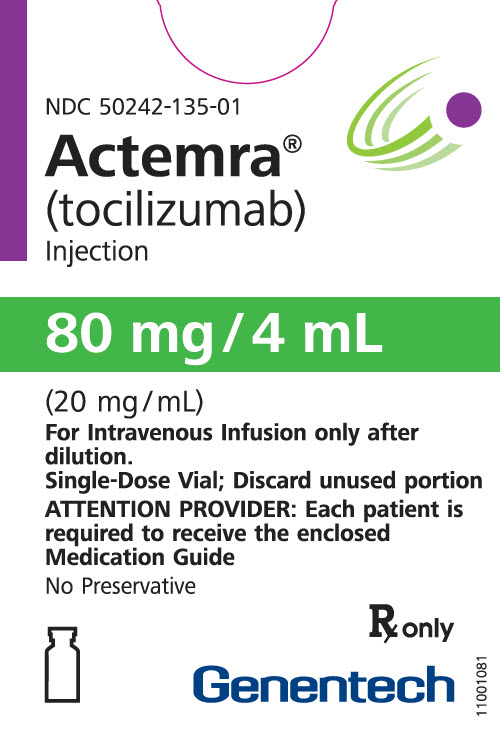
    7PRINCIPAL DISPLAY PANEL - 80 mg/4 mL Vial Carton
    NDC 50242-135-01
    Actemra
    80 mg/4 mL
    (20 mg/mL)
    Rx only
    Genentech
    11037819
    PRINCIPAL DISPLAY PANEL - 80 mg/4 mL Vial Carton
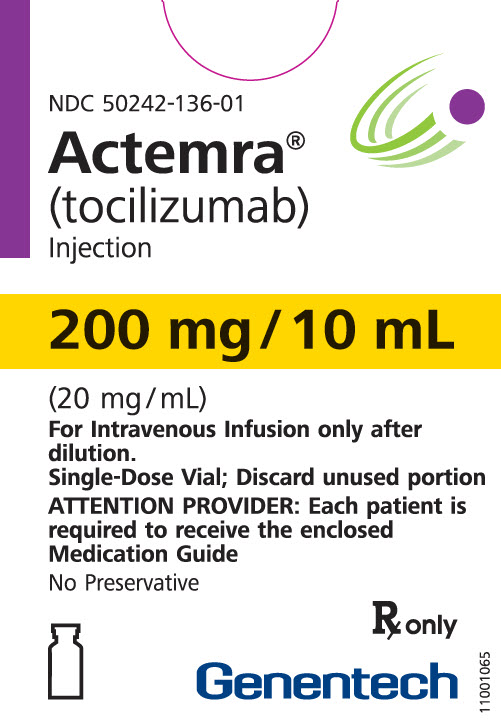
    8PRINCIPAL DISPLAY PANEL - 200 mg/10 mL Vial Carton
    NDC 50242-136-01
    Actemra
    200 mg/10 mL
    (20 mg/mL)
    Rx only
    Genentech
    11037833
    PRINCIPAL DISPLAY PANEL - 200 mg/10 mL Vial Carton
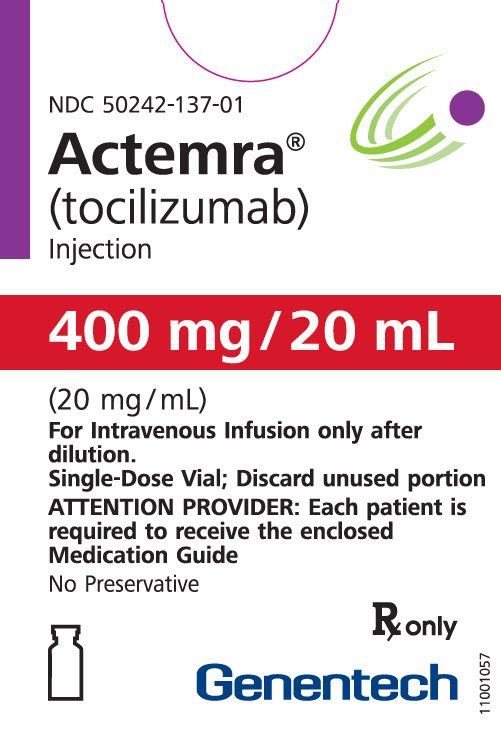
    9PRINCIPAL DISPLAY PANEL - 400 mg/20 mL Vial Carton
    NDC 50242-137-01
    Actemra
    400 mg/20 mL
    (20 mg/mL)
    Rx only
    Genentech
    11037818
    PRINCIPAL DISPLAY PANEL - 400 mg/20 mL Vial Carton
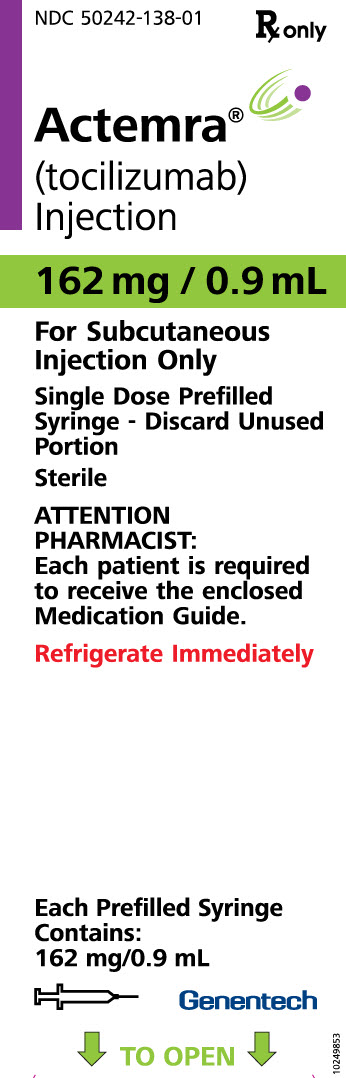
    10PRINCIPAL DISPLAY PANEL - 162 mg/0.9 mL Prefilled Syringe Carton
    NDC 50242-138-01
    Rx only
    Actemra
    162 mg/0.9 mL
    For Subcutaneous
    Single Dose Prefilled
    Sterile
    ATTENTION
    Refrigerate Immediately
    Each Prefilled Syringe
    Genentech
    ↓ TO OPEN ↓
    10249853
    PRINCIPAL DISPLAY PANEL - 162 mg/0.9 mL Prefilled Syringe Carton
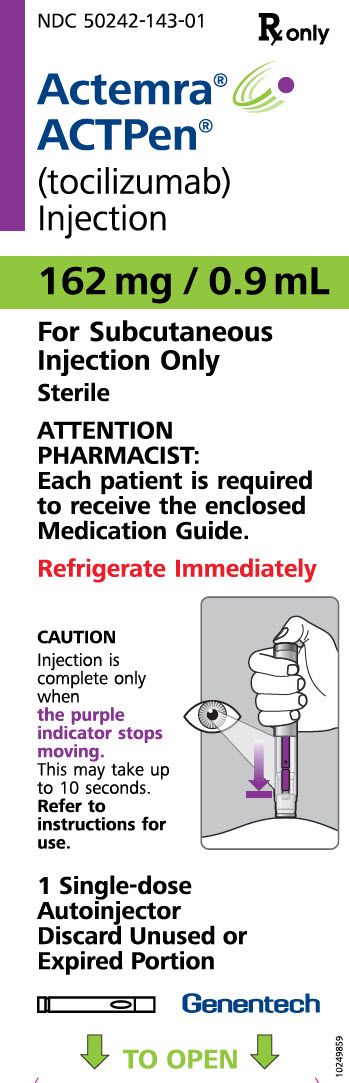
    11PRINCIPAL DISPLAY PANEL - 162 mg/0.9 mL Autoinjector Carton
    NDC 50242-143-01
    Rx only
    Actemra
    162 mg/0.9 mL
    For Subcutaneous
    ATTENTION
    Refrigerate Immediately
    CAUTION
    Injection is
    1 Single-dose
    Genentech
    ↓ TO OPEN ↓
    10249859
    PRINCIPAL DISPLAY PANEL - 162 mg/0.9 mL Autoinjector Carton
    Actemra has been selected.