Generic Name

Azithromycin

Brand Names
Zithromax, Azasite
FDA approval date: October 19, 1995
Classification: Macrolide Antimicrobial
Form: Injection, Tablet, Powder, Suspension, Solution

What is Zithromax (Azithromycin)?

Azithromycin for oral suspension USP is a macrolide antibacterial drug indicated for the treatment of patients with mild to moderate infections caused by susceptible strains of the designated microorganisms in the specific conditions listed below. Recommended dosages and durations of therapy in adult and pediatric patient populations vary in these indications.
Save this treatment for later
Sign Up
Not sure about your diagnosis?
Check Your Symptoms
Tired of the same old research?
Check Latest Advances

Related Clinical Trials

Pharmacokinetics and Safety of Commonly Used Drugs in Lactating Women and Breastfed Infants

Summary: Over half of women in the US who are breastfeeding their infants take prescription drugs. You are being asked to participate in this study because you are breastfeeding your infant and are currently taking, as part of your medical care, at least one of the drugs we are studying. We are interested in studying drugs commonly prescribed to women who are breastfeeding so we can learn more about the am...

An Open-Label, Phase 2 Study to Evaluate the Activity of Belumosudil in Subjects With New Onset and Incipient Bronchiolitis Obliterans Syndrome Following Allogeneic Hematopoietic Cell Transplantation

Summary: The goal of this research study is to test the efficacy of a novel immunosuppressive agent, belumosudil, in allogeneic hematopoietic stem cell transplant (HSCT) recipients who have been newly diagnosed or have developing (early stage) bronchiolitis obliterans syndrome (BOS). The name of the study drugs involved in this study are: * Belumosudil (an immunotherapy) * Fluticasone (an intranasal cortic...

Azithromycin Treatment for Respiratory Syncytial Virus-induced Respiratory Failure in Children

Summary: The overarching hypothesis of the ARRC trial is that administration of Azithromycin (AZM) during acute, Respiratory Syncytial Virus (RSV)-induced respiratory failure will be beneficial, mediated through the matrix metalloproteinase (MMP)-9 pathway.

Brand Information

    Zithromax (azithromycin dihydrate)
    1INDICATIONS AND USAGE
    ZITHROMAX (azithromycin) for injection is a macrolide antibacterial drug indicated for the treatment of patients with infections caused by susceptible strains of the designated microorganisms in the conditions listed below.
    1.1Community-Acquired Pneumonia
    due to
    1.2Pelvic Inflammatory Disease
    due to
    ZITHROMAX for injection should be followed by ZITHROMAX by the oral route as required.
    1.3Usage
    To reduce the development of drug-resistant bacteria and maintain the effectiveness of ZITHROMAX (azithromycin) and other antibacterial drugs, ZITHROMAX (azithromycin) should be used only to treat infections that are proven or strongly suspected to be caused by susceptible bacteria. When culture and susceptibility information are available, they should be considered in selecting or modifying antibacterial therapy. In the absence of such data, local epidemiology and susceptibility patterns may contribute to the empiric selection of therapy.
    2DOSAGE AND ADMINISTRATION
    [see
    2.1Community-Acquired Pneumonia
    The recommended dose of ZITHROMAX for injection for the treatment of adult patients with community-acquired pneumonia due to the indicated organisms is 500 mg as a single daily dose by the intravenous route for at least two days. Intravenous therapy should be followed by azithromycin by the oral route at a single, daily dose of 500 mg, administered as two 250 mg tablets to complete a 7- to 10-day course of therapy. The timing of the switch to oral therapy should be done at the discretion of the physician and in accordance with clinical response.
    2.2Pelvic Inflammatory Disease
    The recommended dose of ZITHROMAX for injection for the treatment of adult patients with pelvic inflammatory disease due to the indicated organisms is 500 mg as a single daily dose by the intravenous route for one or two days. Intravenous therapy should be followed by azithromycin by the oral route at a single, daily dose of 250 mg to complete a 7-day course of therapy. The timing of the switch to oral therapy should be done at the discretion of the physician and in accordance with clinical response.
    2.3Preparation of the Solution for Intravenous Administration
    The infusate concentration and rate of infusion for ZITHROMAX for injection should be either 1 mg/mL over 3 hr or 2 mg/mL over 1 hr. ZITHROMAX for injection should not be given as a bolus or as an intramuscular injection.
    3DOSAGE FORMS AND STRENGTHS
    ZITHROMAX for injection is supplied as white to off-white lyophilized powder in a single-dose vial equivalent to 500 mg of azithromycin for intravenous administration.
    4ADVERSE REACTIONS
    The following clinically significant adverse reactions are described elsewhere in labeling:
    • Hypersensitivity
    • Hepatotoxicity
    • Infantile Hypertrophic Pyloric Stenosis (IHPS)
    • QT Prolongation
    • Cardiovascular Death
    • Clostridioides difficile-Associated Diarrhea (CDAD) [see
    • Exacerbation of Myasthenia Gravis
    4.1Clinical Trials Experience
    Because clinical trials are conducted under widely varying conditions, adverse reaction rates observed in the clinical trials of a drug cannot be directly compared to rates in the clinical trials of another drug and may not reflect the rates observed in practice.
    In clinical trials of intravenous azithromycin for community-acquired pneumonia, in which 2 to 5 IV doses were given, the reported adverse reactions were mild to moderate in severity and were reversible upon discontinuation of the drug. The majority of patients in these trials had one or more co-morbid diseases and were receiving concomitant medications. Approximately 1.2% of the patients discontinued intravenous ZITHROMAX therapy, and a total of 2.4% discontinued azithromycin therapy by either the intravenous or oral route because of clinical or laboratory side effects.
    In clinical trials conducted in patients with pelvic inflammatory disease, in which 1 to 2 IV doses were given, 2% of women who received monotherapy with azithromycin and 4% who received azithromycin plus metronidazole discontinued therapy due to clinical side effects.
    Clinical adverse reactions leading to discontinuations from these studies were gastrointestinal (abdominal pain, nausea, vomiting, diarrhea), and rashes; laboratory side effects leading to discontinuation were increases in transaminase levels and/or alkaline phosphatase levels.
    Overall, the most common adverse reactions associated with treatment in adult patients who received IV/Oral ZITHROMAX in studies of community-acquired pneumonia were related to the gastrointestinal system with diarrhea/loose stools (4.3%), nausea (3.9%), abdominal pain (2.7%), and vomiting (1.4%) being the most frequently reported.
    Approximately 12% of patients experienced a side effect related to the intravenous infusion; most common were pain at the injection site (6.5%) and local inflammation (3.1%).
    The most common adverse reactions associated with treatment in adult women who received IV/Oral ZITHROMAX in trials of pelvic inflammatory disease were related to the gastrointestinal system. Diarrhea (8.5%) and nausea (6.6%) were most commonly reported, followed by vaginitis (2.8%), abdominal pain (1.9%), anorexia (1.9%), rash and pruritus (1.9%). When azithromycin was co-administered with metronidazole in these trials, a higher proportion of women experienced adverse reactions of nausea (10.3%), abdominal pain (3.7%), vomiting (2.8%), infusion site reaction, stomatitis, dizziness, or dyspnea (all at 1.9%).
    Adverse reactions that occurred with a frequency of 1% or less included the following:
    Gastrointestinal: Dyspepsia, flatulence, mucositis, oral moniliasis, and gastritis.
    Nervous system: Headache, somnolence.
    Allergic: Bronchospasm.
    Special senses: Taste perversion.
    4.2Postmarketing Experience
    The following adverse reactions have been identified during post-approval use of azithromycin. Because these reactions are reported voluntarily from a population of uncertain size, it is not always possible to reliably estimate their frequency or establish a causal relationship to drug exposure.
    Adverse reactions reported with azithromycin during the postmarketing period in adult and/or pediatric patients for which a causal relationship may not be established include:
    Allergic: Arthralgia, edema, urticaria and angioedema.
    Cardiovascular: Arrhythmias including ventricular tachycardia and hypotension. There have been reports of QT prolongation, torsades de pointes, and cardiovascular death.
    Gastrointestinal: Anorexia, constipation, dyspepsia, flatulence, vomiting/diarrhea, pseudomembranous colitis, pancreatitis, oral candidiasis, pyloric stenosis, and reports of tongue discoloration.
    General: Asthenia, paresthesia, fatigue, malaise and anaphylaxis (including fatalities).
    Genitourinary: Interstitial nephritis and acute renal failure and vaginitis.
    Hematopoietic: Thrombocytopenia.
    Liver/biliary: Abnormal liver function, hepatitis, cholestatic jaundice, hepatic necrosis, and hepatic failure. [see
    Nervous system: Convulsions, dizziness/vertigo, headache, somnolence, hyperactivity, nervousness, agitation and syncope.
    Psychiatric: Aggressive reaction and anxiety.
    Skin/appendages: Pruritus, serious skin reactions including, erythema multiforme, AGEP, Stevens-Johnson syndrome, toxic epidermal necrolysis, and DRESS.
    Special senses: Hearing disturbances including hearing loss, deafness and/or tinnitus and reports of taste/smell perversion and/or loss.
    4.3Laboratory Abnormalities
    Significant abnormalities (irrespective of drug relationship) occurring during the clinical trials were reported as follows:
    • elevated ALT (SGPT), AST (SGOT), creatinine (4 to 6%)
    • elevated LDH, bilirubin (1 to 3%)
    • leukopenia, neutropenia, decreased platelet count, and elevated serum alkaline phosphatase (less than 1%)

    When follow-up was provided, changes in laboratory tests appeared to be reversible.
    In multiple-dose clinical trials involving more than 750 patients treated with ZITHROMAX (IV/Oral), less than 2% of patients discontinued azithromycin therapy because of treatment-related liver enzyme abnormalities.
    5OVERDOSAGE
    Adverse reactions experienced in higher than recommended doses were similar to those seen at normal doses particularly nausea, diarrhea, and vomiting. In the event of overdosage, general symptomatic and supportive measures are indicated as required.
    6DESCRIPTION
    ZITHROMAX for injection contains the active ingredient azithromycin, an azalide, a subclass of macrolide antibacterial drug, for intravenous injection. Azithromycin has the chemical name
    Chemical Structure
    Azithromycin, as the dihydrate, is a white crystalline powder with a molecular formula of C
    ZITHROMAX for injection consists of azithromycin dihydrate and the following inactive ingredients: anhydrous citric acid and sodium hydroxide. Sodium hydroxide is added to adjust the pH. ZITHROMAX for injection is supplied as white to off-white lyophilized powder in a single-dose vial for intravenous administration. Each vial contains azithromycin dihydrate equivalent to 500 mg of azithromycin, 384.6 mg anhydrous citric acid, and sodium hydroxide. Reconstitution, according to label directions, results in approximately 5 mL of ZITHROMAX for intravenous injection with each mL containing azithromycin dihydrate equivalent to 100 mg of azithromycin, 76.9 mg anhydrous citric acid, and sodium hydroxide.
    7HOW SUPPLIED/STORAGE AND HANDLING
    ZITHROMAX for injection is supplied as white to off-white lyophilized powder under a vacuum in a single-dose vial equivalent to 500 mg of azithromycin for intravenous administration.
    These are packaged as follows:
    Before reconstitution, store vials at or below 30°C (86°F)
    8PATIENT COUNSELING INFORMATION
    Patients should be informed of the following serious and potentially serious adverse reactions that have been associated with ZITHROMAX
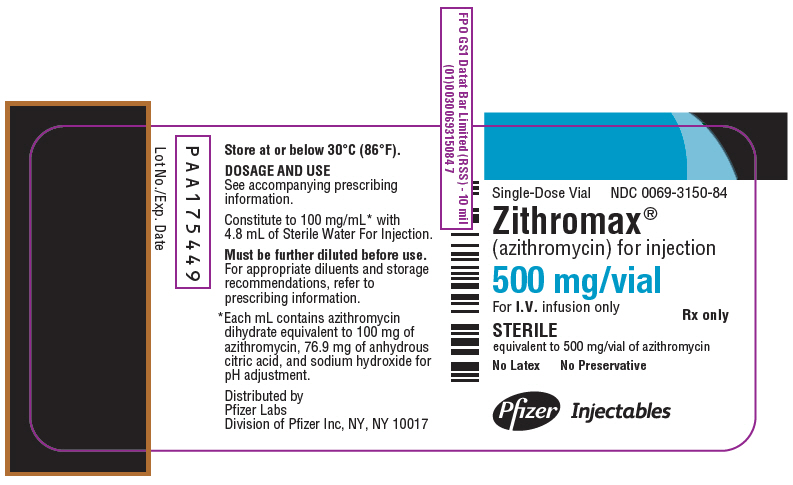
    9PRINCIPAL DISPLAY PANEL - 500 mg Vial Label
    Single-Dose Vial
    Zithromax
    500 mg/vial
    For I.V. infusion only
    Rx only
    STERILE
    No Latex
    Pfizer Injectables
    PRINCIPAL DISPLAY PANEL - 500 mg Vial Label
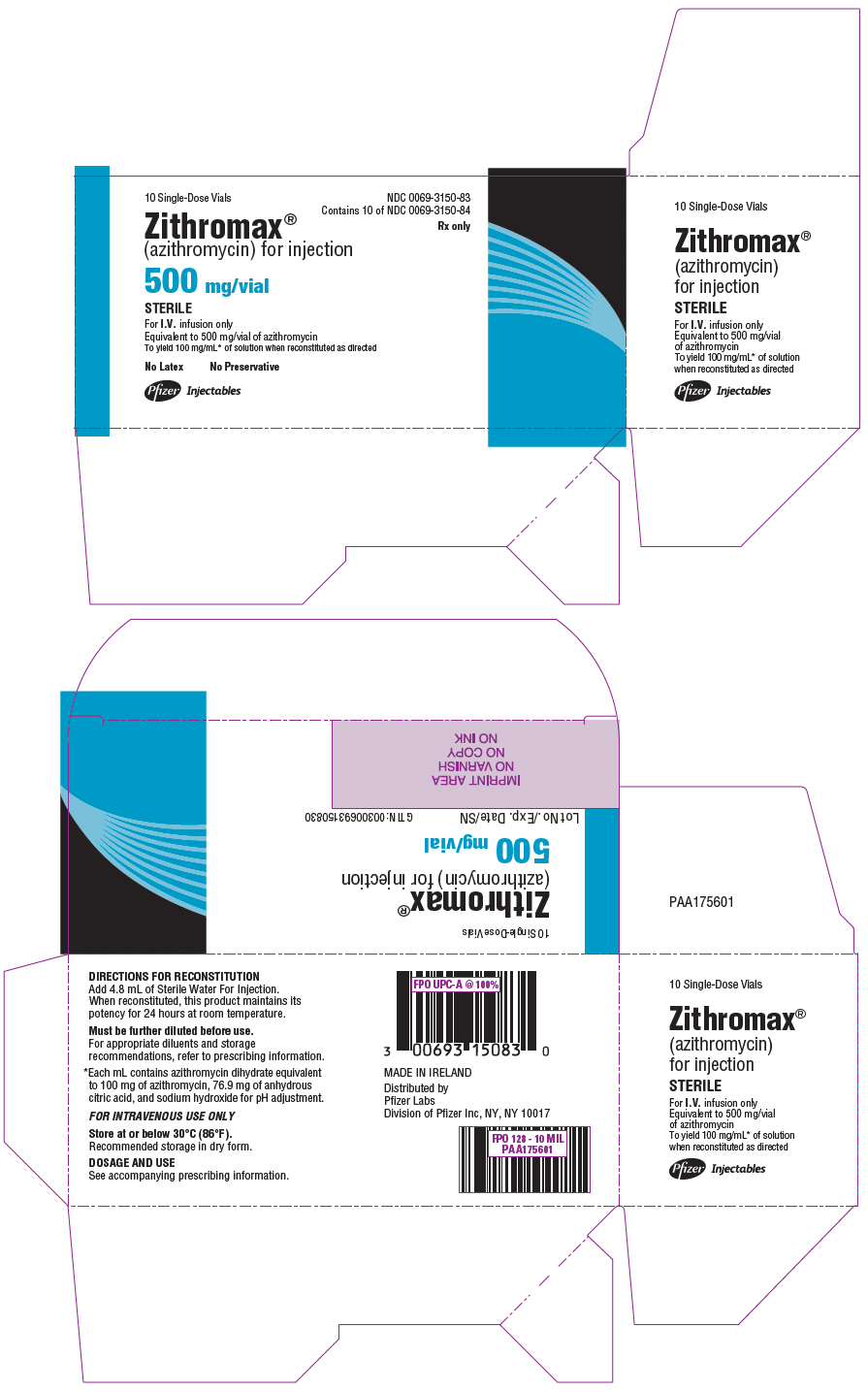
    10PRINCIPAL DISPLAY PANEL - 500 mg Vial Carton
    10 Single-Dose Vials
    NDC 0069-3150-83
    Zithromax
    Rx only
    500 mg/vial
    STERILE
    For I.V. infusion only
    No Latex
    Pfizer Injectables
    PRINCIPAL DISPLAY PANEL - 500 mg Vial Carton
    Zithromax has been selected.