Small Cell Lung Cancer (SCLC) Treatments

Find Small Cell Lung Cancer (SCLC) Treatments

Brand Name

Zepzelca

Generic Name
Lurbinectedin
View Brand Information
FDA approval date: June 15, 2020
Classification: Alkylating Drug
Form: Injection

What is Zepzelca (Lurbinectedin)?

ZEPZELCA is indicated for the treatment of adult patients with metastatic small cell lung cancer with disease progression on or after platinum-based chemotherapy. This indication is approved under accelerated approval based on overall response rate and duration of response. Continued approval for this indication may be contingent upon verification and description of clinical benefit in a confirmatory trial. ZEPZELCA is an alkylating drug indicated for the treatment of adult patients with metastatic small cell lung cancer with disease progression on or after platinum-based chemotherapy. This indication is approved under accelerated approval based on overall response rate and duration of response. Continued approval for this indication may be contingent upon verification and description of clinical benefit in a confirmatory trial.
Save this treatment for later
Sign Up
Not sure about your diagnosis?
Check Your Symptoms
Tired of the same old research?
Check Latest Advances

Related Clinical Trials

A Phase 3 Randomized, Open Label, Multicenter Study to Evaluate the Safety and Efficacy of ABBV-706 Versus Standard of Care in Subjects With Relapsed/Refractory Small Cell Lung Cancer (SCLC)

Summary: Small cell lung cancer (SCLC) is characterized by aggressive and rapid growth and a tendency to develop early spread to distant sites including mediastinal lymph nodes, liver, bones, adrenal glands, and brain. The purpose of this study is to assess safety, tolerability, and change in disease activity of ABBV-706 compared to standard of care (SOC) treatment (topotecan, lurbinectedin, or amrubicin)....

Lurbinectedin in FET-Fusion Tumors (LIFFT)

Summary: The purpose of this study is to find out if a drug called lurbinectedin (the study drug) is safe and effective at treating people with recurrent or relapsed solid tumors, including Ewing sarcoma.

Phase II Study of Lurbinectedin and Irinotecan in Adult and Young Adult Patients With Advanced Desmoplastic Small Round Cell Tumor (DSRCT)

Summary: Patients participating in this study have DSRCT that has spread locally or to other parts of the body and can no longer be surgically removed without causing significant harm. Treatment will continue until the tumor progresses further, severe side effects occur, or either patient or investigator decision. In addition, patients may participate in an optional biological study. The study will analyze...

Brand Information

ZEPZELCA (Lurbinectedin)
1DOSAGE FORMS AND STRENGTHS
For injection: 4 mg of lurbinectedin as a sterile, preservative-free, white to off-white lyophilized powder in a single-dose vial for reconstitution prior to intravenous infusion.
2CONTRAINDICATIONS
None.
3ADVERSE REACTIONS
The following clinically significant adverse reactions are described elsewhere in the labeling:
  • Myelosuppression
  • Hepatotoxicity
  • Extravasation Resulting in Tissue Necrosis
  • Rhabdomyolysis
3.1Clinical Trials Experience
Because clinical trials are conducted under widely varying conditions, adverse reaction rates observed in the clinical trials of a drug cannot be directly compared to rates in the clinical trials of another drug and may not reflect the rates observed in practice.
The safety population described in the WARNINGS AND PRECAUTIONS reflects exposure to ZEPZELCA in combination with intravenous atezolizumab in the IMforte study
Extensive-Stage Small Cell Lung Cancer (IMforte)
The safety of ZEPZELCA in combination with intravenous (IV) atezolizumab was evaluated in IMforte
The median age of patients who received ZEPZELCA in combination with intravenous atezolizumab was 66 years (range: 35 to 85); 62% male; 82% White, 13% Asian, and 0.8% Black or African American.
Serious adverse reactions occurred in 31% of patients receiving ZEPZELCA in combination with atezolizumab. Serious adverse reactions occurring in > 2% were pneumonia (2.5%), respiratory tract infection (2.1%), dyspnea (2.1%), and decreased platelet count (2.1%). Fatal adverse reactions occurred in 5% of patients receiving ZEPZELCA with atezolizumab including pneumonia (3 patients), sepsis (3 patients), cardio-respiratory arrest (2 patients), myocardial infarction (2 patients), and febrile neutropenia (1 patient).
Permanent discontinuation of ZEPZELCA due to an adverse reaction occurred in 5% of patients. The adverse reaction resulting in permanent discontinuation in ≥ 1% of patients who received ZEPZELCA was decreased neutrophil count.
Dosage interruptions of ZEPZELCA due to an adverse reaction occurred in 25%. Adverse reactions which required dosage interruption in ≥ 2% of patients included anemia, fatigue, decreased neutrophil count, and decreased platelet count.
Dose reductions of ZEPZELCA due to an adverse reaction occurred in 15% of patients. Adverse reactions which required dosage reduction in ≥ 2% of patients included decreased platelet count, fatigue, nausea, and vomiting.
Table 3 summarizes the adverse reactions in IMforte.
Clinically relevant adverse reactions in < 10% of patients who received ZEPZELCA in combination with intravenous atezolizumab included pneumonia, phlebitis, extravasation resulting in skin necrosis, hypersensitivity, and increased creatine phosphokinase.
Table 4 summarizes the laboratory abnormalities in IMforte.
3.2Postmarketing Experience
The following adverse reactions have been identified during post-approval use of ZEPZELCA. Because these reactions are reported voluntarily from a population of uncertain size, it is not always possible to reliably estimate their frequency or establish a causal relationship to drug exposure.
General disorders and administration site conditions: Extravasation including tissue necrosis requiring debridement.
Musculoskeletal and connective tissue disorders: Rhabdomyolysis.
Metabolism and nutrition disorders: Tumor lysis syndrome.
4DESCRIPTION
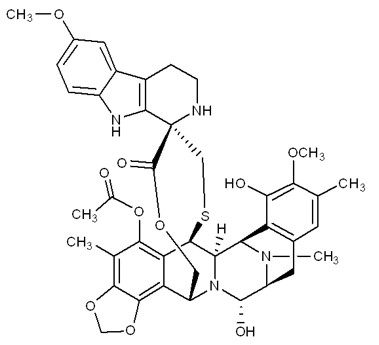
ZEPZELCA is an alkylating drug. The chemical name of ZEPZELCA (lurbinectedin) is (1’R,6R,6aR,7R,13S,14S,16R)-8,14-dihydroxy-6’,9-dimethoxy-4,10,23-trimethyl-19-oxo-2’,3’,4’,6,7,9’,12,13,14,16-decahydro-6aH-spiro[7,13-azano-6,16-(epithiopropanooxymethano) [1,3]dioxolo[7,8]isoquinolino[3,2-b][3]benzazocine-20,1’-pyrido[3,4-b]indol]-5-yl acetate.
The molecular formula is C
chemical structure
ZEPZELCA for injection 4 mg is supplied as a lyophilized powder in a single-dose vial for reconstitution for intravenous use. The ZEPZELCA lyophilized formulation is comprised of 4 mg lurbinectedin, sucrose (800 mg), lactic acid (22.1 mg), and sodium hydroxide (5.1 mg). Before use, the lyophilizate is reconstituted by addition of 8 mL Sterile Water for Injection USP, yielding a solution containing 0.5 mg/mL lurbinectedin (the calculated concentration is 0.47 mg/mL based on the final volume of 8.5 mL).
5REFERENCES
1. "OSHA Hazardous Drugs." OSHA. http://www.osha.gov/SLTC/hazardousdrugs/index.html
6HOW SUPPLIED/STORAGE AND HANDLING
How Supplied
ZEPZELCA (lurbinectedin) for injection is supplied as a sterile, preservative-free, white to off-white lyophilized powder in a single-dose clear glass vial. Each carton (NDC 68727-712-01) contains 4 mg in one single-dose vial.
Storage and Handling
Store refrigerated at 2°C to 8°C (36°F to 46°F).
ZEPZELCA is a hazardous drug. Follow applicable special handling and disposal procedures
7PATIENT COUNSELING INFORMATION
Advise the patient to read the FDA-approved patient labeling (Patient Information).
Myelosuppression
Advise patients that ZEPZELCA can cause myelosuppression. Inform patients about the signs and symptoms of myelosuppression and to immediately contact their healthcare provider if signs or symptoms occur
Hepatotoxicity
Advise patients that ZEPZELCA can cause hepatotoxicity and to contact their healthcare provider immediately if signs or symptoms occur
Extravasation Resulting in Tissue Necrosis
Advise patients that administration of ZEPZELCA through a central venous catheter is recommended because extravasation of ZEPZELCA can cause skin and soft tissue injury, including necrosis requiring debridement. Advise patients to contact their healthcare provider immediately for signs or symptoms of extravasation. The time to onset of necrosis after extravasation may vary
Rhabdomyolysis
Advise patients that rhabdomyolysis has been reported with the use of ZEPZELCA and to contact their healthcare provider immediately for signs and symptoms of rhabdomyolysis
Embryo-Fetal Toxicity
  • Advise pregnant women and females of reproductive potential of the potential risk to a fetus. Advise females to inform their healthcare provider of a known or suspected pregnancy
  • Advise females of reproductive potential to use effective contraception during treatment with ZEPZELCA and for 7 months after the last dose
  • Advise males with female partners of reproductive potential to use effective contraception during treatment with ZEPZELCA and for 4 months after the last dose
Lactation
Advise women not to breastfeed during treatment with ZEPZELCA and for at least 2 weeks after the last dose
Drug Interactions
Advise patients to inform their healthcare providers of all concomitant medications, herbal and dietary supplements. Advise patients to avoid grapefruit products and Seville oranges during treatment with ZEPZELCA


Distributed by:
Jazz Pharmaceuticals, Inc.
Palo Alto, CA 94306
Under license from Pharma Mar, S.A.
Protected by U.S. Patent No. 7,763,615
8Patient Package Insert
This Patient Information has been approved by the U.S. Food and Drug Administration.                                                                                                                                      Revised: 09/2026
9PACKAGE/LABEL PRINCIPAL DISPLAY PANEL
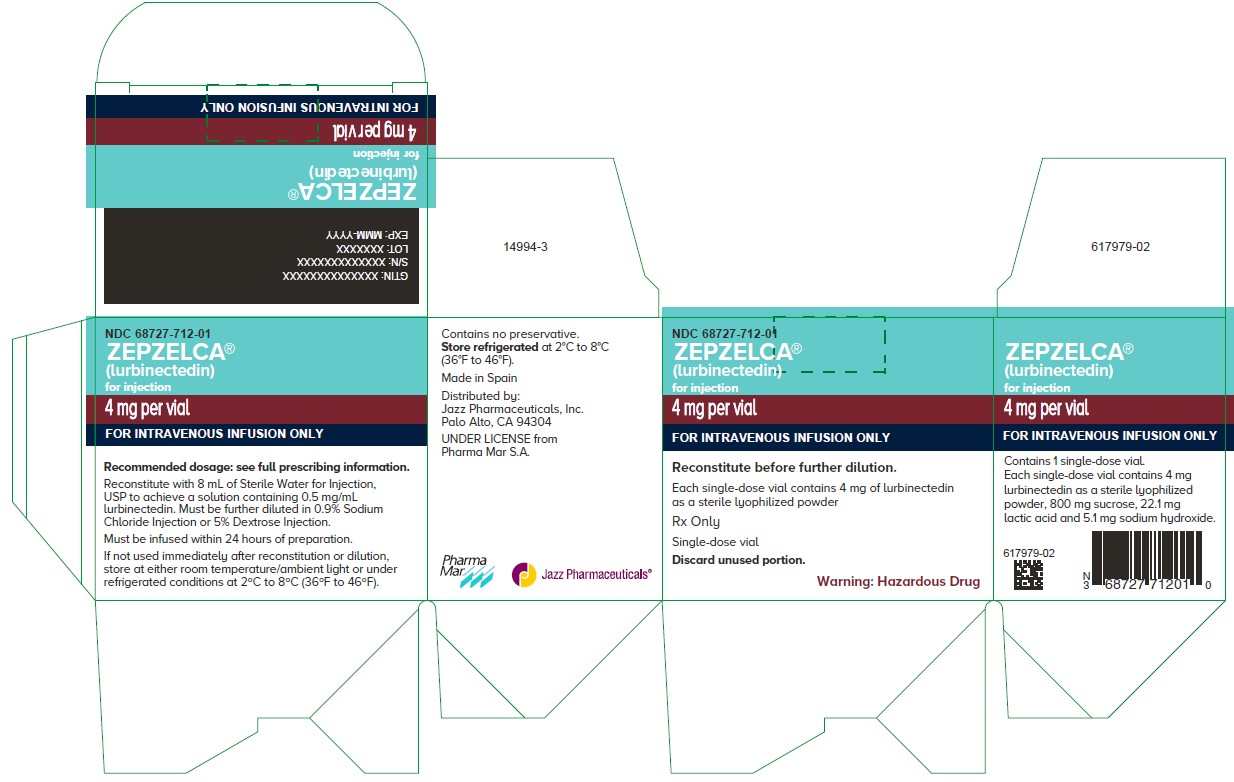
carton
Carton:
NDC 68727-712-01
10Package/Label Display Panel
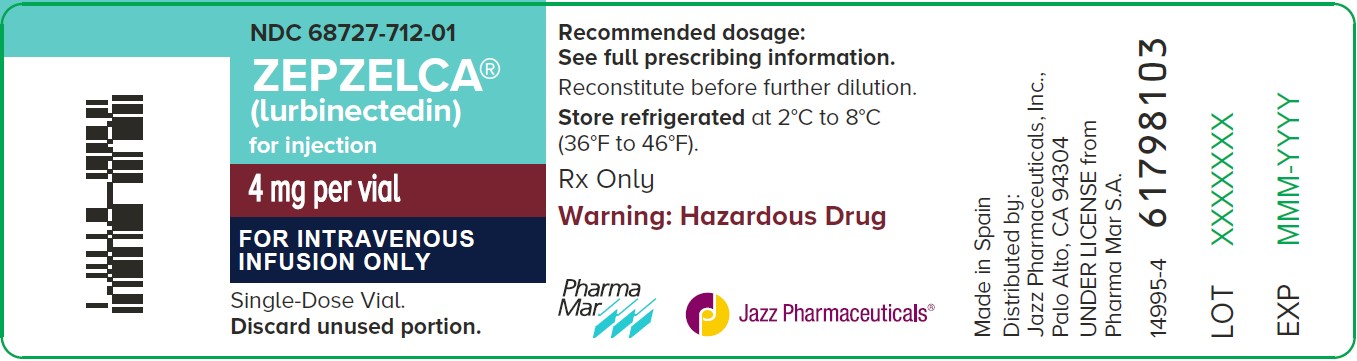
vial
Vial:
NDC 68727-712-01