Swimmer's Ear Treatments

Find Swimmer's Ear Treatments

Generic Name

Fluocinolone Acetonide

Brand Names
Synalar, Flac, Dermotic, Derma-Smoothe, YUTIQ, Neo-Synalar, Iluvien, Retisert
FDA approval date: June 11, 1963
Classification: Corticosteroid
Form: Ointment, Cream, Oil, Implant, Solution

What is Synalar (Fluocinolone Acetonide)?

Fluocinolone Acetonide ointment is indicated for the relief of the inflammatory and pruritic manifestations of corticosteroid-responsive dermatoses.

Top Global Experts

There are no experts for this drug

Save this treatment for later
Sign Up
Not sure about your diagnosis?
Check Your Symptoms
Tired of the same old research?
Check Latest Advances

Related Clinical Trials

A Trial Evaluating Intravitreal Faricimab (6.0 mg) Injections or Fluocinolone Acetonide (0.19 mg Intravitreal Implants vs Observation for Prevention of Visual Acuity Loss Due to Radiation Retinopathy

Summary: This randomized controlled trial will evaluate the effect of intravitreal faricimab or fluocinolone acetonide (FAc) intravitreal implant compared with observation on long-term visual acuity following treatment of choroidal melanoma with iodine-125 plaque brachytherapy.

Efficacy of Lidocaine-Dexmedetomidine Combination Therapy in Reducing Post-Operative Pain, Inflammatory Response, and Oxidative Stress in Patients Undergoing Bariatric Surgery

Summary: The goal of this randomized clinical trial is to find out whether giving an intravenous lidocaine + dexmedetomidine combination (LIDEX) during laparoscopic bariatric surgery can lower post-operative pain, inflammation, and oxidative stress in adults with obesity. The main questions it aims to answer are: * Pain control: Does LIDEX reduce pain 24 hours after surgery, as measured with the Internatio...

Safety and Efficacy of Topical Bacteriotherapy for Atopic Dermatitis Using Staphylococcus Hominis A9

Summary: This is a Phase 1b, randomized, placebo/vehicle-controlled, double-blinded, multi-center trial. It is designed to assess the safety and efficacy of S. hominis A9 (ShA9) topical application as a treatment for atopic dermatitis (AD). The trial will enroll adults and adolescents with atopic dermatitis who are culture positive for S. aureus colonization. The primary safety objective of this study is t...

Brand Information

    Synalar (fluocinolone acetonide)
    1DESCRIPTION
    SYNALAR
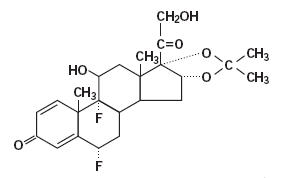
    Chemical Structure
    SYNALAR
    2CLINICAL PHARMACOLOGY
    Topical corticosteroids share anti-inflammatory, anti-pruritic and vasoconstrictive actions.
    2.1Pharmacokinetics
    The extent of percutaneous absorption of topical corticosteroids is determined by many factors including the vehicle, the integrity of the epidermal barrier, and the use of occlusive dressings.
    Topical corticosteroids can be absorbed from normal intact skin. Inflammation and/or other disease processes in the skin increase percutaneous absorption. Occlusive dressings substantially increase the percutaneous absorption of topical corticosteroids. Thus, occlusive dressings may be a valuable therapeutic adjunct for treatment of resistant dermatoses
    Once absorbed through the skin, topical corticosteroids are handled through pharmacokinetic pathways similar to systemically administered corticosteroids. Corticosteroids are bound to plasma proteins in varying degrees. Corticosteroids are metabolized primarily in the liver and are then excreted by the kidneys. Some of the topical corticosteroids and their metabolites are also excreted into the bile.
    3INDICATIONS AND USAGE
    SYNALAR
    4CONTRAINDICATIONS
    Topical corticosteroids are contraindicated in those patients with a history of hypersensitivity to any of the components of the preparation.
    5ADVERSE REACTIONS
    The following local adverse reactions are reported infrequently with topical corticosteroids, but may occur more frequently with the use of occlusive dressings. These reactions are listed in an approximate decreasing order of occurrence:
    6OVERDOSAGE
    Topically applied corticosteroids can be absorbed in sufficient amounts to produce systemic effects
    7DOSAGE AND ADMINISTRATION
    SYNALAR
    Occlusive dressing may be used for the management of psoriasis or recalcitrant conditions. Some plastic films may be flammable and due care should be exercised in their use. Similarly, caution should be employed when such films are used on children or left in their proximity, to avoid the possibility of accidental suffocation.
    If an infection develops, the use of the occlusive dressings should be discontinued and appropriate antimicrobial therapy instituted.
    8HOW SUPPLIED
    SYNALAR
    • 120 g Tube – NDC 43538-900-12
    8.1STORAGE
    Store at room temperature 15-25°C (59-77°F); avoid freezing and excessive heat above 40°C (104°F).
    To report SUSPECTED ADVERSE REACTIONS, contact Medimetriks Pharmaceuticals, Inc. at 1-973-882-7512 or FDA at 1-800-FDA-1088 or www.fda/gov/medwatch.
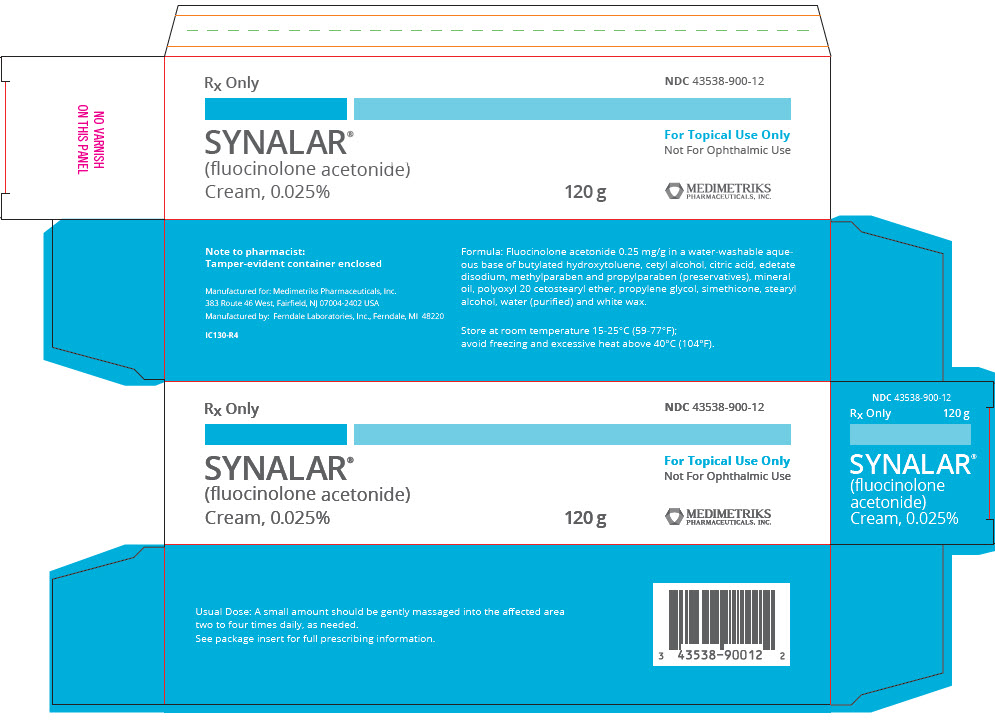
    9PRINCIPAL DISPLAY PANEL - 120 g Tube Carton
    R
    NDC 43538-900-12
    SYNALAR®
    (fluocinolone acetonide)
    Cream, 0.025%
    For Topical Use Only
    Not For Ophthalmic Use
    120 g
    MEDIMETRIKS
    PHARMACEUTICALS, INC.
    PRINCIPAL DISPLAY PANEL - 120 g Tube Carton