Brand Name

Istodax

Generic Name
RomiDEPsin
View Brand Information
FDA approval date: January 04, 2010
Form: Kit

What is Istodax (RomiDEPsin)?

Romidepsin for injection is indicated for the treatment of cutaneous T-cell lymphoma in adult patients who have received at least one prior systemic therapy. Romidepsin for injection is a histone deacetylase inhibitor indicated for the treatment of cutaneous T-cell lymphoma in adult patients who have received at least one prior systemic therapy .
Save this treatment for later
Sign Up
Not sure about your diagnosis?
Check Your Symptoms
Tired of the same old research?
Check Latest Advances

Related Clinical Trials

HERO Trial: Phase I Study Investigating Intravesical HDAC Inhibition to Improve Response to Immuno-Oncology Agents in Localized Bladder Cancer

Summary: In this study, we aim to evaluate the safety and efficacy of neoadjuvant combination using intravesical romidepsin and durvalumab in cisplatin-ineligible patients with muscle invasive bladder cancer (MIBC).

A Randomized, Phase IIB, Multicenter, Trial of Oral Azacytidine Plus Romidepsin Versus Investigator's Choice in Patients With Relapse or Refractory Peripheral T-cell Lymphoma (PTCL)

Summary: The purpose of this study is to find out whether the combination treatment of romidepsin and oral azacytidine is safe and effective in patients with Peripheral T-Cell Lymphoma (PTCL). This study will compare the experimental combination treatment of romidepsin and oral azacytidine to single agent drugs already determined effective in patients with PTCL. For the purposes of this study, the single a...

A Pilot Open Label Phase I Trial to Evaluate the Safety and the Tolerability of a Combination of Two HIV-1 Inducers in HIV+ Sub-type B Patients Under cART With Undetectable Viral Load

Summary: The ANRS 171 SYNACTHIV trial is a monocenter pilot open label phase I trial. This trial will evaluate new procedures in LRA administration in 3 successive cohorts. In case of grade 3 to grade 5 adverse events, the inclusions and treatments will be (but not in a definitive manner) discontinued until the DSMB will conclude that the event was unrelated. Enrolment in cohort 2 then in cohort 3 will sta...

Brand Information

ISTODAX (romidepsin)
1INDICATIONS AND USAGE
ISTODAX is indicated for the treatment of cutaneous T-cell lymphoma (CTCL) in adult patients who have received at least one prior systemic therapy.
2DOSAGE FORMS AND STRENGTHS
For Injection: 10 mg of romidepsin as a lyophilized white powder in a single-dose vial for reconstitution and further dilution.
3CONTRAINDICATIONS
None.
4ADVERSE REACTIONS
The following adverse reactions are described in more detail in other sections of the prescribing information.
  • Myelosuppression
  • Infections
  • Electrocardiographic Changes
  • Tumor Lysis Syndrome
4.1Clinical Trials Experience
Because clinical trials are conducted under widely varying conditions, adverse reaction rates observed in the clinical trials of a drug cannot be directly compared to rates in the clinical trials of another drug and may not reflect the rates observed in practice.
The data in the WARNINGS AND PRECAUTIONS reflect exposure to ISTODAX in four clinical trials involving 363 patients with T-cell lymphoma, including 185 patients with CTCL. ISTODAX was administered as a single agent at a dosage of 14 mg/m
4.1.1Cutaneous T-Cell Lymphoma
The safety of ISTODAX was evaluated in 185 patients with CTCL in 2 single arm clinical studies in which patients received a dosage of 14 mg/m
Common Adverse Reactions
Table 2 summarizes the most frequent adverse reactions (>20%) regardless of causality using the National Cancer Institute-Common Terminology Criteria for Adverse Events (NCI-CTCAE, Version 3.0). Due to methodological differences between the studies, the AE data are presented separately for Study 1 and Study 2. Adverse reactions are ranked by their incidence in Study 1. Laboratory abnormalities commonly reported (>20%) as adverse reactions are included in Table 2.
4.1.2Serious Adverse Reactions
Infections were the most common type of SAE reported in both studies with 8 patients (8%) in Study 1 and 26 patients (31%) in Study 2 experiencing a serious infection. Serious adverse reactions reported in >2% of patients in Study 1 were sepsis and pyrexia (3%). In Study 2, serious adverse reactions in >2% of patients were fatigue (7%), supraventricular arrhythmia, central line infection, neutropenia (6%), hypotension, hyperuricemia, edema (5%), ventricular arrhythmia, thrombocytopenia, nausea, leukopenia, dehydration, pyrexia, aspartate aminotransferase increased, sepsis, catheter related infection, hypophosphatemia and dyspnea (4%).
There were eight deaths not due to disease progression. In Study 1, there were two deaths: one due to cardiopulmonary failure and one due to acute renal failure. There were six deaths in Study 2: four due to infection and one each due to myocardial ischemia and acute respiratory distress syndrome.
4.1.3Discontinuations
Discontinuation due to an adverse event occurred in 21% of patients in Study 1 and 11% in Study 2. Discontinuations occurring in at least 2% of patients in either study included infection, fatigue, dyspnea, QT prolongation, and hypomagnesemia.
4.1.4Other Clinical Trials Experience
The following common adverse reactions have been reported following administration of ISTODAX as a single agent in 178 patients with peripheral T-cell lymphoma, for which ISTODAX is not indicated or recommended. The most common adverse reactions (≥30%) included nausea (63%), fatigue (61%), thrombocytopenia (49%), vomiting (39%), neutropenia (39%), pyrexia (38%), diarrhea (36%) and anemia (35%). Other common (≥10%) clinically significant adverse reactions included dysgeusia (22%), headache (20%), cough (19%), dyspnea (15%), abdominal pain (13%) and stomatitis (10%). Grade 3 and higher adverse reactions in ≥10% were hematologic toxicities (including thrombocytopenia, neutropenia, leukopenia and anemia) and fatigue.
5OVERDOSAGE
No specific information is available on the treatment of overdosage of ISTODAX.
Toxicities in a single-dose study in rats or dogs, at intravenous romidepsin doses up to 2.2-fold the recommended human dose based on the body surface area, included irregular respiration, irregular heartbeat, staggering gait, tremor, and tonic convulsions.
In the event of an overdose, it is reasonable to employ the usual supportive measures, e.g., clinical monitoring and supportive therapy, if required. There is no known antidote for ISTODAX and it is not known if ISTODAX is dialyzable.
6DESCRIPTION
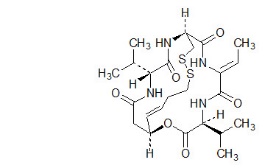
Romidepsin, a histone deacetylase (HDAC) inhibitor, is a bicyclic depsipeptide. At room temperature, romidepsin is a white powder and is described chemically as (1
The molecular weight is 540.71 and the structural formula is:
Chemical Structure
ISTODAX (romidepsin) for injection is intended for intravenous infusion only after reconstitution with the supplied diluent and after further dilution with 0.9% Sodium Chloride, USP.
ISTODAX is supplied as a kit containing 2 vials.
ISTODAX (romidepsin) for injection is a sterile lyophilized white powder and is supplied in a 10 mg single-dose vial containing 11 mg romidepsin, 22 mg povidone, USP, and hydrochloric acid, NF, as a pH adjuster.
Diluent for ISTODAX is a sterile clear solution and is supplied in a single-dose vial containing 2.4 mL (2.2 mL deliverable volume). Diluent for ISTODAX contains 80% (v/v) propylene glycol, USP and 20% (v/v) dehydrated alcohol, USP.
7CLINICAL STUDIES
ISTODAX was evaluated in 2 multicenter, single-arm clinical studies in patients with CTCL (Study 1 [NCT00106431] and Study 2 [NCT00007345]). Overall, 167 patients with CTCL were treated in the US, Europe, and Australia. Study 1 included 96 patients with confirmed CTCL after failure of at least 1 prior systemic therapy. Study 2 included 71 patients with a primary diagnosis of CTCL who received at least 2 prior skin directed therapies or one or more systemic therapies. Patients were treated with ISTODAX at a starting dose of 14 mg/m
In both studies, patients could be treated until disease progression at the discretion of the investigator and local regulators. Objective disease response was evaluated according to a composite endpoint that included assessments of skin involvement, lymph node and visceral involvement, and abnormal circulating T-cells ("Sézary cells").
The primary efficacy endpoint for both studies was overall objective disease response rate (ORR) based on the investigator assessments, and was defined as the proportion of patients with confirmed complete response (CR) or partial response (PR). CR was defined as no evidence of disease and PR as ≥ 50% improvement in disease. Secondary endpoints in both studies included duration of response and time to response.
Baseline Patient Characteristics
Demographic and disease characteristics of the patients in Study 1 and Study 2 are provided in Table 3.
Clinical Results
Efficacy outcomes for CTCL patients are provided in Table 4. Median time to first response was 2 months (range 1 to 6) in both studies. Median time to CR was 4 months in Study 1 and 6 months in Study 2 (range 2 to 9).
8REFERENCES
  1. OSHA Hazardous Drugs.
9HOW SUPPLIED/STORAGE AND HANDLING
How Supplied
ISTODAX is supplied as a kit including a sterile, lyophilized powder in a 10 mg single-dose vial containing 11 mg of romidepsin, 22 mg of the bulking agent, povidone, USP, and hydrochloric acid, NF, as a pH adjuster. In addition, each kit includes a single-dose sterile diluent vial containing 2.4 mL (2.2 mL deliverable volume) of 80% propylene glycol, USP, and 20% dehydrated alcohol, USP.
NDC 59572-984-01: ISTODAX® KIT containing 1 vial of romidepsin and 1 vial of diluent for romidepsin per carton.
Storage and Handling
ISTODAX (romidepsin) for injection is supplied as a kit containing 2 vials in a single carton. The carton must be stored at 20° to 25°C, excursions permitted between 15° to 30°C. (See USP Controlled Room Temperature.)
ISTODAX is a hazardous drug. Follow applicable special handling and disposal procedures.
10PATIENT COUNSELING INFORMATION
Advise the patient to read the FDA-approved patient labeling (
Low Blood Counts
  1. Advise patients that treatment with ISTODAX can cause low blood counts and that frequent monitoring of hematologic parameters is required. Patients should be instructed to report fever or other signs of infection, significant fatigue, shortness of breath, or bleeding
Infections
  1. Advise patients that infections may occur during treatment with ISTODAX. Advise patients to report fever, cough, shortness of breath with or without chest pain, burning on urination, flu-like symptoms, muscle aches, or worsening skin problems. Advise patients to report any previous history of hepatitis B before starting romidepsin
Tumor Lysis Syndrome
  1. Advise patients of the risk of tumor lysis syndrome (especially those with advanced stage disease and/or high tumor burden) to maintain high fluid intake for at least 72 hours after each dose
Nausea and Vomiting
  1. Advise patients that nausea and vomiting are common following treatment with ISTODAX. Prophylactic antiemetics are recommended for all patients. Advise patients to report these symptoms so that appropriate treatment can be instituted
Embryo-Fetal Toxicity
  1. Advise patients that ISTODAX can cause fetal harm when administered during pregnancy
Contraception
  1. Advise females of reproductive potential to use effective contraception during treatment with ISTODAX and for 1 month after the last dose. Advise males with female partners of reproductive potential to use effective contraception during treatment with ISTODAX and for 1 month after the last dose
Lactation
  1. Advise lactating women not to breastfeed during treatment with ISTODAX and for 1 week after the last dose
Infertility
  1. Advise females and males of reproductive potential that ISTODAX may cause infertility
Marketed by:
ISTODAX
ISTBAXPI.011/PPI.011
11PRINCIPAL DISPLAY PANEL - Kit Carton
NDC 59572-984-01
ISTODAX
10 mg/vial
Rx Only
Reconstitution and dilution required.
Each kit contains:
  • — One 10 mg single-dose vial of ISTODAX
  • — One single-dose vial with 2.2 mL of Diluent
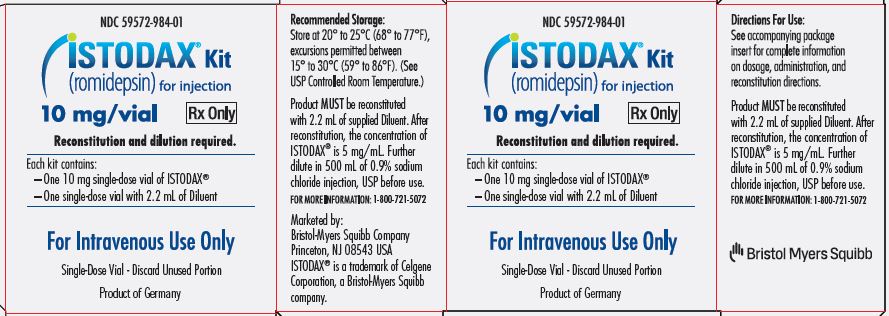
For Intravenous Use Only
Single-Dose Vial - Discard Unused Portion
Product of Germany
Carton
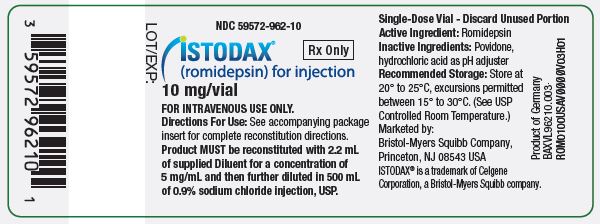
12PRINCIPAL DISPLAY PANEL - 10 mg Vial Label
NDC 59572-962-10
ISTODAX
Rx Only
10 mg/vial
FOR INTRAVENOUS USE ONLY.
Directions For Use: See accompanying package
label
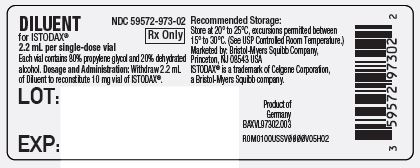
13PRINCIPAL DISPLAY PANEL - 2.2 mL Vial Label
DILUENT
NDC 59572-973-02
Rx Only
2.2 mL per single-dose vial
LOT:
EXP:
diluent