Brand Name

Brilinta

Generic Name
Ticagrelor
View Brand Information
FDA approval date: August 05, 2011
Classification: P2Y12 Platelet Inhibitor
Form: Tablet

What is Brilinta (Ticagrelor)?

Ticagrelor tablets are a P2Y12 platelet inhibitor indicated to reduce the risk of cardiovascular death, myocardial infarction , and stroke in patients with acute coronary syndrome or a history of MI. For at least the first 12 months following ACS, it is superior to clopidogrel. Ticagrelor tablets also reduces the risk of stent thrombosis in patients who have been stented for treatment of ACS.
Save this treatment for later
Sign Up
Not sure about your diagnosis?
Check Your Symptoms
Tired of the same old research?
Check Latest Advances

Related Clinical Trials

One Month Dual Antiplatelet Therapy With Ticagrelor in Coronary Artery Bypass Graft Patients

Summary: The purpose of this study is to compare the effect of ticagrelor plus low-dose aspirin versus low-dose aspirin alone in patients with chronic coronary disease undergoing coronary artery bypass grafting.

Comparison of Anti-coagulation and Anti-Platelet Therapies for Intracranial Vascular Atherostenosis (CAPTIVA)

Summary: The primary goal of the trial is to determine if the experimental arms (rivaroxaban or ticagrelor or both) are superior to the clopidogrel arm for lowering the 1-year rate of ischemic stroke, intracerebral hemorrhage, or vascular death.

EASTYLE (DE-escAlation Strategy for Optimal Ticagrelor Therapy in Acute MYocardiaL Infarction PatiEnts, Prospective, Multicenter, Randomized) Trial

Summary: DAPT de-escalation strategies to reduce bleeding include de-escalation of DAPT intensity (downgrading from potent P2Y12 inhibitor at conventional doses to either clopidogrel or reduced-dose prasugrel) or abbreviation of DAPT duration. The EASTYLE trial will evaluate a hybrid DAPT de-escalation strategy (reduced-dose ticagrelor, followed by aspirin early discontinuation) in AMI patients, compared w...

Brand Information

BRILINTA (Ticagrelor)
WARNING: BLEEDING RISK
  • BRILINTA, like other antiplatelet agents, can cause significant, sometimes fatal bleeding (
  • Do not use BRILINTA in patients with active pathological bleeding or a history of intracranial hemorrhage
  • (
  • Do not start BRILINTA in patients undergoing urgent coronary artery bypass graft surgery (CABG) (
  • 6.1).
  • If possible, manage bleeding without discontinuing BRILINTA. Stopping BRILINTA increases the risk of
  • subsequent cardiovascular events (
1DOSAGE FORMS AND STRENGTHS
BRILINTA (ticagrelor) 90 mg is supplied as a round, biconvex, yellow, film-coated tablet marked with a “90” above “T” on one side.
BRILINTA (ticagrelor) 60 mg is supplied as a round, biconvex, pink, film-coated tablet marked with “60” above “T” on one side.
2ADVERSE REACTIONS
The following adverse reactions are also discussed elsewhere in the labeling:
  • Bleeding
  • Dyspnea
2.1Clinical Trials Experience
Because clinical trials are conducted under widely varying conditions, adverse reaction rates observed in the clinical trials of a drug cannot be directly compared to rates in the clinical trials of another drug and may not reflect the rates observed in practice.
BRILINTA has been evaluated for safety in more than 58,000 patients.
Bleeding in PLATO (Reduction in risk of thrombotic events in ACS)
Figure 1 is a plot of time to the first non-CABG major bleeding event.
Figure 1 - Kaplan-Meier estimate of time to first non-CABG PLATO-defined major bleeding event (PLATO)
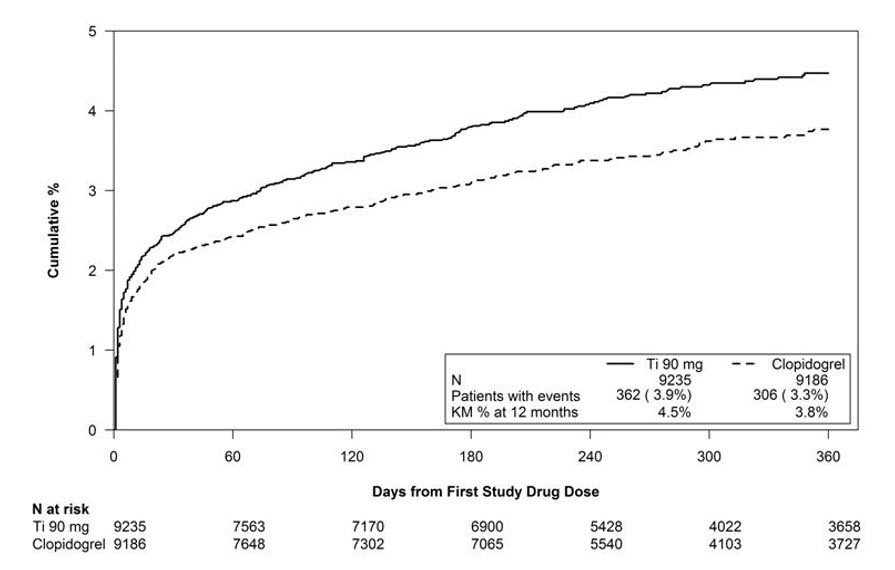
figure_1
Frequency of bleeding in PLATO is summarized in Tables 1 and 2. About half of the non-CABG major bleeding events were in the first 30 days.
No baseline demographic factor altered the relative risk of bleeding with BRILINTA compared to clopidogrel.
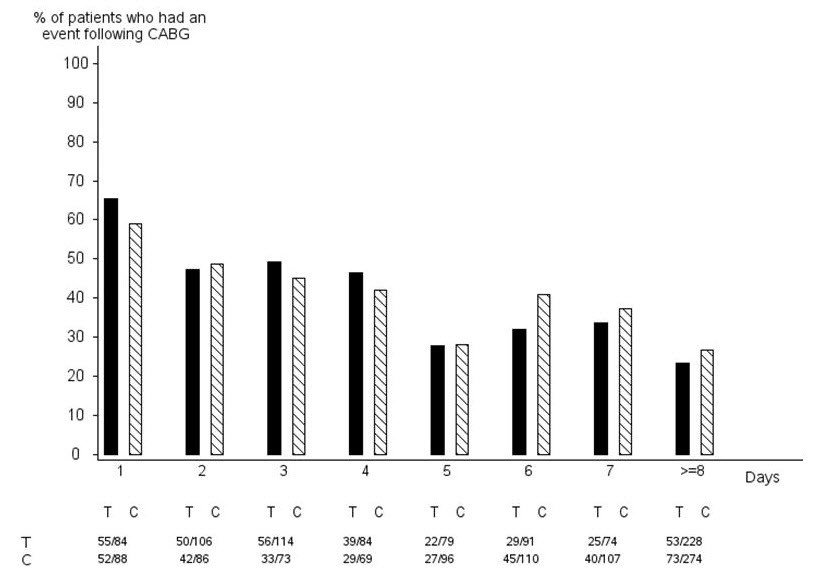
In PLATO, 1584 patients underwent CABG surgery. The percentages of those patients who bled are shown in Figure 2 and Table 2.
Figure 2 - ‘Major fatal/life-threatening’ CABG-related bleeding by days from last dose of study drug to CABG procedure (PLATO)
fiigure_2
X-axis is days from last dose of study drug prior to CABG.
The PLATO protocol recommended a procedure for withholding study drug prior to CABG or other major surgery without unblinding. If surgery was elective or non-urgent, study drug was interrupted temporarily, as follows: If local practice was to allow antiplatelet effects to dissipate before surgery, capsules (blinded clopidogrel) were withheld 5 days before surgery and tablets (blinded ticagrelor) were withheld for a minimum of 24 hours and a maximum of 72 hours before surgery. If local practice was to perform surgery without waiting for dissipation of antiplatelet effects capsules and tablets were withheld 24 hours prior to surgery and use of aprotinin or other hemostatic agents was allowed. If local practice was to use IPA monitoring to determine when surgery could be performed both the capsules and tablets were withheld at the same time and the usual monitoring procedures followed.
T Ticagrelor; C Clopidogrel.
When antiplatelet therapy was stopped 5 days before CABG, major bleeding occurred in 75% of BRILINTA treated patients and 79% on clopidogrel.
Other Adverse Reactions in PLATO
Adverse reactions that occurred at a rate of 4% or more in PLATO are shown in Table 3.
Bleeding in PEGASUS (Secondary Prevention in Patients with a History of Myocardial Infarction)
Overall outcome of bleeding events in the PEGASUS study are shown in Table 4.
The bleeding profile of BRILINTA 60 mg compared to aspirin alone was consistent across multiple pre-defined subgroups (e.g., by age, gender, weight, race, geographic region, concurrent conditions, concomitant therapy, stent, and medical history) for TIMI Major and TIMI Major or Minor bleeding events.
Other Adverse Reactions in PEGASUS
Adverse reactions that occurred in PEGASUS at rates of 3% or more are shown in Table 5.
Bleeding in THEMIS (Prevention of major CV events in patients with CAD and Type 2 Diabetes Mellitus)
The Kaplan-Meier curve of time to first TIMI Major bleeding event is presented in Figure 3.
Figure 3 – Time to first TIMI Major bleeding event (THEMIS)
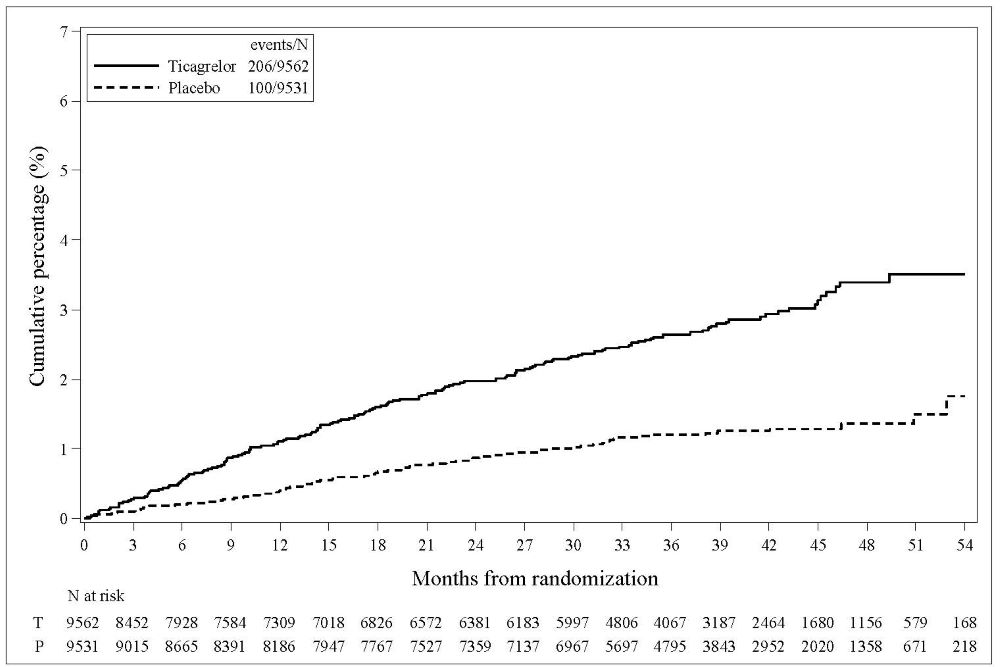
figure_3
T = Ticagrelor; P = Placebo; N = Number of patients
The bleeding events in THEMIS are shown below in Table 6.
Bleeding in THALES (Reduction in risk of stroke in patients with acute ischemic stroke or TIA)
The Kaplan-Meier curve of time course of GUSTO severe bleeding events is presented in Figure 4.
Figure 4 – Time course of GUSTO severe bleeding events
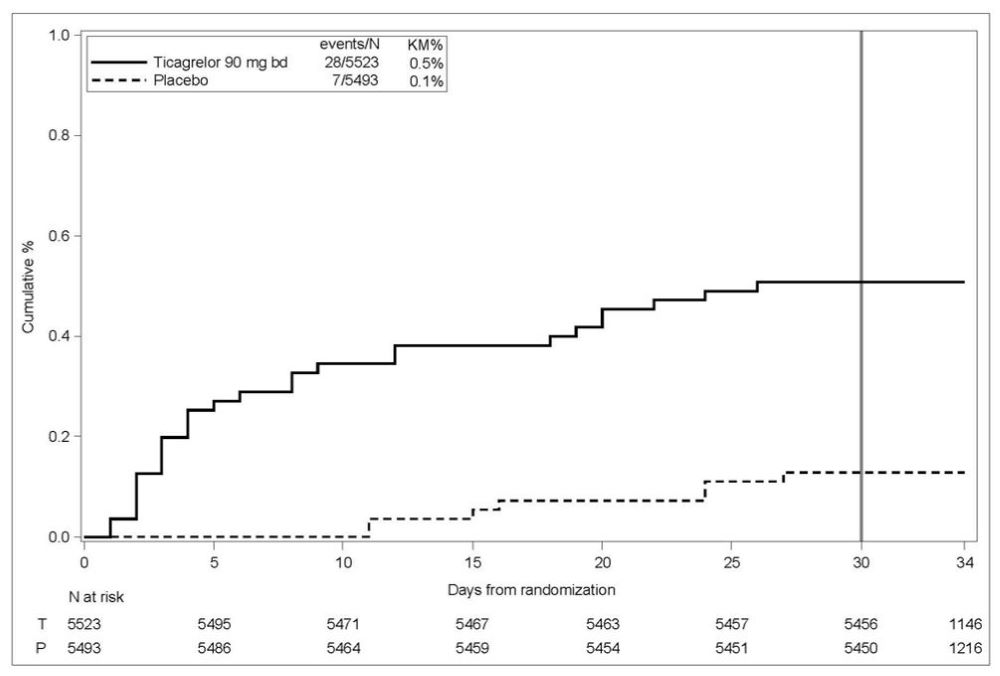
figure_4
KM%: Kaplan-Meier percentage evaluated at Day 30; T = Ticagrelor; P = placebo; N = Number of patients
GUSTO Severe:Any one of the following: fatal bleeding, intracranial bleeding (excluding asymptomatic hemorrhagic transformations of ischemic brain infarctions and excluding microhemorrhages < 10 mm evident only on gradient-echo magnetic resonance imaging), bleeding that caused hemodynamic compromise requiring intervention (eg, systolic blood pressure <90 mmg Hg that required blood or fluid replacement, or vasopressor/inotropic support, or surgical intervention).
Intracranial bleeding and fatal bleeding in THALES:In total, there were 21 intracranial hemorrhages (ICHs) for BRILINTA and 6 ICHs for placebo. Fatal bleedings, almost all ICH, occurred in 11 for BRILINTA and in 2 for placebo.
Bradycardia
In a Holter substudy of about 3000 patients in PLATO, more patients had ventricular pauses with BRILINTA (6.0%) than with clopidogrel (3.5%) in the acute phase; rates were 2.2% and 1.6%, respectively, after 1 month. PLATO, PEGASUS, THEMIS and THALES excluded patients at increased risk of bradycardic events (e.g., patients who have sick sinus syndrome, 2
Lab abnormalities
Serum Uric Acid:
In PLATO, serum uric acid levels increased approximately 0.6 mg/dL from baseline on BRILINTA 90 mg and approximately 0.2 mg/dL on clopidogrel. The difference disappeared within 30 days of discontinuing treatment. Reports of gout did not differ between treatment groups in PLATO (0.6% in each group).
In PEGASUS, serum uric acid levels increased approximately 0.2 mg/dL from baseline on BRILINTA 60 mg and no elevation was observed on aspirin alone. Gout occurred more commonly in patients on BRILINTA than in patients on aspirin alone (1.5%, 1.1%). Mean serum uric acid concentrations decreased after treatment was stopped.
Serum Creatinine:
In PLATO, a >50% increase in serum creatinine levels was observed in 7.4% of patients receiving BRILINTA 90 mg compared to 5.9% of patients receiving clopidogrel. The increases typically did not progress with ongoing treatment and often decreased with continued therapy. Evidence of reversibility upon discontinuation was observed even in those with the greatest on treatment increases. Treatment groups in PLATO did not differ for renal-related serious adverse events such as acute renal failure, chronic renal failure, toxic nephropathy, or oliguria.
In PEGASUS, serum creatinine concentration increased by >50% in approximately 4% of patients receiving BRILINTA 60 mg, similar to aspirin alone. The frequency of renal related adverse events was similar for ticagrelor and aspirin alone regardless of age and baseline renal function.
2.2Postmarketing Experience
The following adverse reactions have been identified during post-approval use of BRILINTA. Because these reactions are reported voluntarily from a population of an unknown size, it is not always possible to reliably estimate their frequency or establish a causal relationship to drug exposure.
Blood and lymphatic system disorders:Thrombotic Thrombocytopenic Purpura (TTP) has been rarely reported with the use of BRILINTA. TTP is a serious condition which can occur after a brief exposure (<2 weeks) and requires prompt treatment.
Immune system disorders:Hypersensitivity reactions including angioedema [see .
Respiratory Disorders:Central sleep apnea, Cheyne-Stokes respiration
Skin and subcutaneous tissue disorders:Rash
3OVERDOSAGE
There is currently no known treatment to reverse the effects of BRILINTA, and ticagrelor is not dialyzable. Treatment of overdose should follow local standard medical practice. Bleeding is the expected pharmacologic effect of overdosing. If bleeding occurs, appropriate supportive measures should be taken.
Platelet transfusion did not reverse the antiplatelet effect of BRILINTA in healthy volunteers and is unlikely to be of clinical benefit in patients with bleeding.
Other effects of overdose may include gastrointestinal effects (nausea, vomiting, diarrhea) or ventricular pauses. Monitor the ECG.
4DESCRIPTION
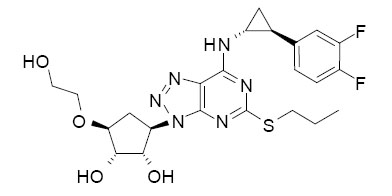
BRILINTA contains ticagrelor, a cyclopentyltriazolopyrimidine, inhibitor of platelet activation and aggregation mediated by the P2Y
chemical structure
Ticagrelor is a crystalline powder with an aqueous solubility of approximately 10 μg/mL at room temperature.
BRILINTA 90 mg tablets for oral administration contain 90 mg of ticagrelor and the following ingredients: mannitol, dibasic calcium phosphate, sodium starch glycolate, hydroxypropyl cellulose, magnesium stearate, hydroxypropyl methylcellulose, titanium dioxide, talc, polyethylene glycol 400, and ferric oxide yellow.
BRILINTA 60 mg tablets for oral administration contain 60 mg of ticagrelor and the following ingredients: mannitol, dibasic calcium phosphate, sodium starch glycolate, hydroxypropyl cellulose, magnesium stearate, hydroxypropyl methylcellulose, titanium dioxide, polyethylene glycol 400, ferric oxide black, and ferric oxide red.
5HOW SUPPLIED/STORAGE AND HANDLING
BRILINTA (ticagrelor) 90 mg is supplied as a round, biconvex, yellow, film-coated tablet with a “90” above “T” on one side:
Bottles of 60 – NDC 0186-0777-60
100 count Hospital Unit Dose – NDC 0186-0777-39
BRILINTA (ticagrelor) 60 mg is supplied as a round, biconvex, pink, film-coated tablet with a “60” above “T” on one side:
Bottles of 60 – NDC 0186-0776-60
Storage and Handling
Store at 25°C (77°F); excursions permitted to 15 to 30°C (59 to 86°F) [see USP controlled room temperature].
6PATIENT COUNSELING INFORMATION
Advise the patient to read the FDA-approved patient labeling (Medication Guide).
Advise patients daily doses of aspirin should not exceed 100 mg and to avoid taking any other medications that contain aspirin.
Advise patients that they:
  • Will bleed and bruise more easily
  • Will take longer than usual to stop bleeding
  • Should report any unanticipated, prolonged or excessive bleeding, or blood in their stool or urine.
Advise patients to contact their doctor if they experience unexpected shortness of breath, especially if severe.
Advise patients to inform physicians and dentists that they are taking BRILINTA before any surgery or dental procedure.
Advise women that breastfeeding is not recommended during treatment with BRILINTA
BRILINTA
Distributed by: AstraZeneca Pharmaceuticals LP, Wilmington, DE 19850
© AstraZeneca 2024