Brand Name

Lunsumio

Generic Name
Mosunetuzumab
View Brand Information
FDA approval date: December 22, 2022
Form: Concentrate

What is Lunsumio (Mosunetuzumab)?

LUNSUMIO is a bispecific CD20-directed CD3 T-cell engager indicated for the treatment of adult patients with relapsed or refractory follicular lymphoma after two or more lines of systemic therapy. This indication is approved under accelerated approval based on response rate. Continued approval for this indication may be contingent upon verification and description of clinical benefit in a confirmatory trial.
Save this treatment for later
Sign Up
Not sure about your diagnosis?
Check Your Symptoms
Tired of the same old research?
Check Latest Advances

Related Clinical Trials

Randomized Phase III Study of Mosunetuzumab vs. Rituximab for Low Tumor Burden Follicular Lymphoma

Summary: This phase III trial compares the effectiveness of rituximab to mosunetuzumab in treating patients with follicular lymphoma with a low tumor burden. Rituximab is a monoclonal antibody. It binds to a protein called CD20, which is found on B cells (a type of white blood cell) and some types of cancer cells. This may help the immune system kill cancer cells. Mosunetuzumab is a monoclonal antibody tha...

A Phase IB Open-Label, Multicenter Study Evaluating the Safety, Efficacy, and Pharmacokinetics of Mosunetuzumab and a Combined Regimen of Mosunetuzumab and Venetoclax in Patients With Relapsed or Refractory Chronic Lymphocytic Leukemia

Summary: This study will assess the safety, tolerability, pharmaokinetics, and preliminary efficacy of mosunetuzumab (Lunsumio) monotherapy in participants with relapsed or refractory (R/R) chronic lymphocytic leukemia (CLL). This study will also allow participants who are currently progressing on a Bruton tyrosine kinase inhibitor (BTKi) and requiring salvage therapy as assessed by the treating physician ...

NORM: Nodular Lymphocyte-Predominant Hodgkin Lymphoma Patients Treated in a Randomized Phase 2 Trial With Either Rituximab or Mosunetuzumab

Summary: This phase II trial compares mosunetuzumab to the usual treatment (rituximab) for improving survival in patients with nodular lymphocyte-predominant Hodgkin lymphoma (NLPHL). Rituximab and mosunetuzumab are monoclonal antibodies. They bind to a protein called CD20, which is found on B cells (a type of white blood cell) and some types of cancer cells. This may help the immune system kill cancer cel...

Brand Information

Lunsumio (Mosunetuzumab)
WARNING: CYTOKINE RELEASE SYNDROME
Cytokine release syndrome (CRS), including serious or life-threatening reactions, can occur in patients receiving LUNSUMIO. Initiate treatment with the LUNSUMIO step-up dosing schedule to reduce the risk of CRS. Withhold LUNSUMIO until CRS resolves or permanently discontinue based on severity
1DOSAGE FORMS AND STRENGTHS
LUNSUMIO is a sterile, colorless solution available as:
  • Injection: 1 mg/mL mosunetuzumab-axgb of solution in a single-dose vial
  • Injection: 30 mg/30 mL (1 mg/mL) mosunetuzumab-axgb of solution in a single-dose vial
2CONTRAINDICATIONS
None.
3ADVERSE REACTIONS
The following adverse reactions are described elsewhere in the labeling:
  • Cytokine Release Syndrome
  • Neurologic Toxicity, including Immune Effector Cell-associated Neurotoxicity Syndrome
  • Infections
  • Hemophagocytic Lymphohistiocytosis
  • Cytopenias
  • Tumor Flare
3.1Clinical Trials Experience
Because clinical trials are conducted under widely varying conditions, adverse reaction rates observed in the clinical trials of a drug cannot be directly compared to rates in the clinical trials of another drug and may not reflect the rates observed in practice.
The pooled safety population described in the WARNINGS AND PRECAUTIONS reflects exposure to LUNSUMIO as a single agent in GO29781 in 218 patients with hematologic malignancies in an open-label, multicenter, multi-cohort study. Patients received step-up doses of 1 mg on Cycle 1 Day 1 and 2 mg on Cycle 1 Day 8, followed by 60 mg on Cycle 1 Day 15, and 60 mg on Cycle 2 Day 1, then 30 mg every 3 weeks in subsequent cycles. A treatment cycle was 21 days. Among 218 patients who received LUNSUMIO, 52% were exposed for at least 8 cycles and 8% were exposed for 17 cycles.
In this pooled safety population, the most common (≥ 20%) adverse reactions were cytokine release syndrome (39%), fatigue (36%), rash (34%), pyrexia (24%), and headache (21%). The most common Grade 3 to 4 laboratory abnormalities (≥ 10%) were decreased lymphocyte count (92%), decreased phosphate (41%), increased glucose (40%), decreased neutrophil count (38%), increased uric acid (15%), decreased white blood cell count (22%), decreased hemoglobin (19%), and decreased platelets (12%).
4DESCRIPTION
Mosunetuzumab-axgb is a bispecific CD20-directed CD3 T-cell engager. It is a humanized monoclonal anti-CD20xCD3 T-cell-dependent bispecific antibody of the immunoglobulin G1 (IgG1) isotype. Mosunetuzumab-axgb is produced in Chinese Hamster Ovary (CHO) cells by recombinant DNA technology. The approximate molecular weight is 146 kDa.
LUNSUMIO (mosunetuzumab-axgb) injection is a sterile, preservative-free, colorless solution for intravenous use.
Each single-dose vial contains a 1 mL solution of mosunetuzumab-axgb (1 mg), acetic acid (0.4 mg), histidine (1.6 mg), methionine (1.5 mg), polysorbate 20 (0.6 mg), sucrose (82.1 mg), and Water for Injection, USP. The pH is 5.8.
Each single-dose vial contains a 30 mL solution of mosunetuzumab-axgb (30 mg), acetic acid (12.8 mg), histidine (46.6 mg), methionine (44.8 mg), polysorbate 20 (18 mg), sucrose (2,462.4 mg), and Water for Injection, USP. The pH is 5.8.
5CLINICAL STUDIES
The efficacy of LUNSUMIO was evaluated in an open-label, multicenter, multi-cohort study (GO29781, NCT02500407) in patients with relapsed or refractory follicular lymphoma (FL) who had received at least two prior therapies, including an anti-CD20 monoclonal antibody and an alkylating agent. The study excluded patients with active infections, history of autoimmune disease, prior allogeneic transplant, or any history of CNS lymphoma or CNS disorders.
Patients received step-up doses of 1 mg on Cycle 1 Day 1 and 2 mg on Cycle 1 Day 8, followed by 60 mg on Cycle 1 Day 15, and 60 mg on Cycle 2 Day 1, then 30 mg every 3 weeks in subsequent cycles. A treatment cycle was 21 days. LUNSUMIO was administered for 8 cycles unless patients experienced progressive disease or unacceptable toxicity. After 8 cycles, patients with a complete response discontinued therapy; patients with a partial response or stable disease continued treatment up to 17 cycles, unless patients experienced progressive disease or unacceptable toxicity.
Among the 90 patients with relapsed or refractory FL, the median age was 60 years (range: 29 to 90 years), 33% were 65 years of age or older, 61% were male, 82% were White, 9% were Asian, 4% were Black or African American, and 8% were Hispanic or Latino. A total of 77% of patients had Stage III-IV disease, 34% had bulky disease, and all patients had an Eastern Cooperative Oncology Group (ECOG) performance status of 0 or 1. The median number of prior therapies was 3 (range: 2 to 10), with 38% receiving 2 prior therapies, 31% receiving 3 prior therapies, and 31% receiving more than 3 prior therapies.
Seventy-nine percent of patients were refractory to prior anti-CD20 monoclonal antibody therapy, 53% were refractory to both anti-CD20 monoclonal antibody and alkylator therapy, 9% received prior rituximab plus lenalidomide therapy, 21% received prior autologous stem cell transplant, and 3% received prior CAR T therapy. Fifty-two percent of patients had progression of disease within 24 months of first systemic therapy.
Efficacy was established on the basis of objective response rate (ORR) and duration of response (DOR) as assessed by an independent review facility according to standard criteria for NHL (Cheson 2007). The median follow-up for DOR was 14.9 months. The efficacy results are summarized in
The median time to first response was 1.4 months (range: 1.1 to 8.9).
6HOW SUPPLIED/STORAGE AND HANDLING
LUNSUMIO (mosunetuzumab-axgb) injection is a sterile, colorless, preservative-free solution supplied as follows:
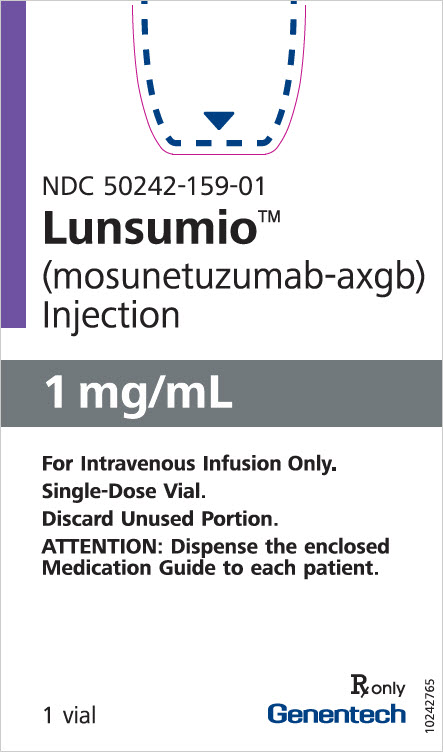
  • One 1 mg/mL single-dose vial in a carton (NDC 50242-159-01)
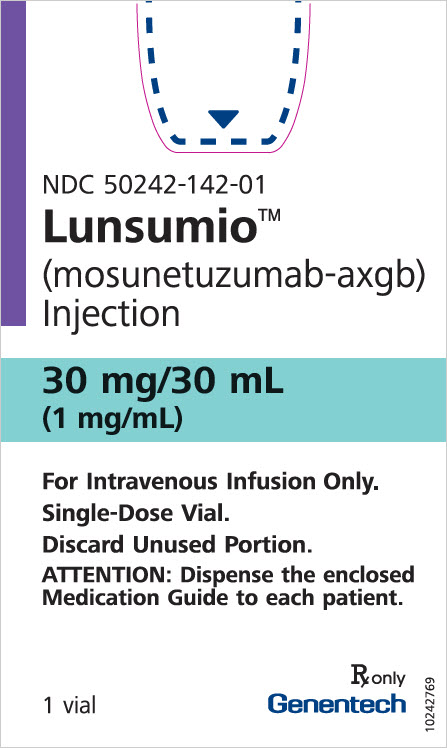
  • One 30 mg/30 mL (1 mg/mL) single-dose vial in a carton (NDC 50242-142-01).
7PATIENT COUNSELING INFORMATION
Advise the patient to read the FDA-approved patient labeling (Medication Guide).
8PRINCIPAL DISPLAY PANEL - 30 mg/30 mL Vial Carton
NDC 50242-142-01
30 mg/30 mL
For Intravenous Infusion Only.
Single-Dose Vial.
Discard Unused Portion.
ATTENTION: Dispense the enclosed
1 vial
Rx only
10242769
PRINCIPAL DISPLAY PANEL - 30 mg/30 mL Vial Carton
9PRINCIPAL DISPLAY PANEL - 1 mg/mL Vial Carton
NDC 50242-159-01
1 mg/mL
For Intravenous Infusion Only.
Single-Dose Vial.
Discard Unused Portion.
ATTENTION: Dispense the enclosed
1 vial
Rx only
10242765
PRINCIPAL DISPLAY PANEL - 1 mg/mL Vial Carton