Brand Name

Terlivaz

Generic Name
Terlipressin
View Brand Information
FDA approval date: September 14, 2022
Classification: Vasopressin Receptor Agonist
Form: Injection

What is Terlivaz (Terlipressin)?

TERLIVAZ is indicated to improve kidney function in adults with hepatorenal syndrome with rapid reduction in kidney function. TERLIVAZ is a vasopressin receptor agonist indicated to improve kidney function in adults with hepatorenal syndrome with rapid reduction in kidney function. Limitation of Use Patients with a serum creatinine >5 mg/dL are unlikely to experience benefit. Limitation of Use Patients with a serum creatinine > 5 mg/dL are unlikely to experience benefit.

Approved To Treat

Save this treatment for later
Sign Up
Not sure about your diagnosis?
Check Your Symptoms
Tired of the same old research?
Check Latest Advances

Related Clinical Trials

A Phase 1 Open Label Single and Multiple Ascending Dose Study to Evaluate the Safety, Tolerability, Pharmacokinetics and Pharmacodynamics of PHIN-214 in Adults With Child Pugh A and B Cirrhosis

Summary: This 2-part study will evaluate PHIN-214 given as a single one-time dose (Part 1) and in multiple doses (given as daily doses for 28-days) (in Part 2). Specifically, this study evaluates PHIN-214, to determine the safety, tolerability, and pharmacokinetic effects of PHIN-214, and to establish the maximum tolerated dose or optimal beneficial dose in patients with Child Pugh A and B Cirrhosis.

Effect of Terlipressin for Intraoperative Blood Pressure Management in Kidney Transplantation, a Double-blind Randomized Controlled Trial

Summary: Prospective double blind randomized controlled trial. By randomizing patients undergoing kidney transplantation into a conventional catecholamine drug (dobutamine) blood pressure maintenance group and a terlipressin-complexed dobutamine group, the investigators compared the effect of intraoperative blood pressure maintenance and the dosage of the vasoactive drug, postoperative graft function, dela...

A Multi-Centre, Randomised, Open-Label, Phase II Study of Ambrisentan in Patients With Hepatorenal Syndrome

Summary: Patients with advanced cirrhosis of the liver develop kidney problems occasionally. This condition is called Hepatorenal Syndrome, requires hospitalization and frequently results in death. The goal of this clinical trial is to test whether the administration of low doses of ambrisentan can help patients with Hepatorenal Syndrome and to determine if it is safe. Ambrisentan is a drug that is approve...

Brand Information

Terlivaz (Terlipressin)
WARNING: SERIOUS OR FATAL RESPIRATORY FAILURE
TERLIVAZ may cause serious or fatal respiratory failure. Patients with volume overload or with acute-on-chronic liver failure (ACLF) Grade 3 are at increased risk
Do not initiate TERLIVAZ in patients experiencing hypoxia (e.g., SpO
1INDICATIONS AND USAGE
TERLIVAZ is indicated to improve kidney function in adults with hepatorenal syndrome with rapid reduction in kidney function.
2DOSAGE FORMS AND STRENGTHS
For injection: TERLIVAZ 0.85 mg is a white to off-white lyophilized powder in a single-dose vial for reconstitution.
3CONTRAINDICATIONS
TERLIVAZ is contraindicated in patients experiencing hypoxia or worsening respiratory symptoms.
TERLIVAZ is contraindicated in patients with ongoing coronary, peripheral or mesenteric ischemia.
4ADVERSE REACTIONS
The following adverse reactions are discussed elsewhere in the labeling:
  • Serious or Fatal Respiratory Failure
  • Ischemic Events
4.1Clinical Trials Experience
Because clinical trials are conducted under widely varying conditions, the adverse reaction rates observed in the clinical trials of TERLIVAZ cannot be directly compared to rates in the clinical trials of another drug and may not reflect the rates observed in practice.
The safety of TERLIVAZ was evaluated in the CONFIRM trial
Treatment discontinuation due to adverse events occurred in 12.0% (24/200) of patients receiving TERLIVAZ and 5.1% (5/99) of patients receiving placebo. The most common adverse reactions that led to TERLIVAZ discontinuation were respiratory failure, abdominal pain, and intestinal ischemia/obstruction.
Table 1 lists adverse reactions that occurred more commonly on TERLIVAZ than on placebo, and in at least 4% of patients treated with TERLIVAZ in the CONFIRM trial. The most commonly observed adverse reactions in TERLIVAZ-treated patients (≥10%) were abdominal pain, nausea, respiratory failure, diarrhea, and dyspnea.
4.2Postmarketing Experience
Adverse reactions reported from the worldwide postmarketing experience with terlipressin include headache, hyponatremia, skin necrosis and gangrene. Because these reactions are reported voluntarily from a population of uncertain size, it is not always possible to reliably estimate their frequency or establish a causal relationship to terlipressin exposure.
5OVERDOSAGE
Manifestations of TERLIVAZ overdose are expected to be similar to the adverse reactions described with therapeutic doses. In case of overdose, initiate close monitoring of vital signs, electrolytes, and potential ischemic events and initiate appropriate symptomatic treatment.
6DESCRIPTION
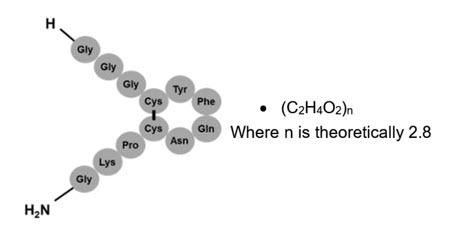
TERLIVAZ contains terlipressin, a vasopressin receptor agonist. Terlipressin is a 12-amino acid peptide with the chemical name
Chemical Structure
Molecular formula: C
Average molecular weight: 1227.38 (as free base)
TERLIVAZ is supplied as a sterile, preservative-free, lyophilized, white-to off-white powder for intravenous administration. Each vial contains 0.85 mg terlipressin, equivalent to 1 mg terlipressin acetate, and 10.0 mg mannitol. Glacial acetic acid and/or sodium hydroxide may be added to adjust pH at the time of manufacture.
7CLINICAL STUDIES
The efficacy of TERLIVAZ was assessed in a multicenter, double-blind, randomized, placebo-controlled study (CONFIRM) (NCT02770716). Patients with cirrhosis, ascites, and a diagnosis of HRS-1 with a rapidly progressive worsening in renal function to a serum creatinine (SCr) ≥2.25 mg/dL and meeting a trajectory for SCr to double over two weeks, and without sustained improvement in renal function (<20% decrease in SCr and SCr ≥2.25 mg/dL) 48 hours after both diuretic withdrawal and the beginning of plasma volume expansion with albumin were eligible to participate. All patients underwent fluid challenge with intravenous albumin (1 g/kg on the first day (maximum 100 g) and 20 g/day to 40 g/day thereafter as clinically indicated). Patients with a baseline serum creatinine level >7.0 mg/dL, shock, sepsis, and/or uncontrolled bacterial infection were excluded from the study. Use of vasopressors was prohibited during the treatment period.
A total of 300 patients were enrolled; the median age was 55 years (range: 23 to 82), 60% were male, and 90% were White. At baseline, 40% had alcoholic hepatitis and 19% had ACLF Grade 3; the mean serum creatinine was 3.5 mg/dL, and the mean MELD score was 33.
Patients were randomized 2:1 to treatment with TERLIVAZ (N=199) or placebo (N=101). Patients received 1 mg terlipressin acetate (equivalent to TERLIVAZ 0.85 mg) or placebo every 6 hours administered as an IV bolus injection over 2 minutes for a maximum of 14 days. On Day 4 of therapy, if SCr decreased by less than 30% from the baseline value, the dose was increased to 2 mg terlipressin acetate (equivalent to TERLIVAZ 1.7 mg) every 6 hours. If SCr was at or above the baseline value on Day 4, then treatment was discontinued. Both treatment groups received albumin therapy during the study (median dose 50 g/day). Concomitant diuretics were used in 26% of patients treated with TERLIVAZ and 13% of patients treated with placebo. Median treatment duration was 5 days for TERLIVAZ-treated patients and 4 days for placebo-treated patients.
The primary efficacy endpoint was the incidence of Verified HRS Reversal, defined as the percentage of patients with 2 consecutive SCr values of ≤1.5 mg/dL, obtained at least 2 hours apart while on treatment by Day 14 or discharge. To be included in the primary efficacy endpoint analysis, patients had to be alive and without intervening renal replacement therapy (e.g., dialysis) at least 10 days after achieving Verified HRS Reversal.
A greater proportion of patients achieved Verified HRS Reversal in the TERLIVAZ arm compared to the placebo arm (Table 2).
8REFERENCES
Jalan R, et al; Development and validation of a prognostic score to predict mortality in patients with acute-on-chronic liver failure. J Hepatol. 2014 Nov;61(5):1038-47.
9HOW SUPPLIED/STORAGE AND HANDLING
TERLIVAZ is supplied as a sterile, preservative-free, white to off-white lyophilized powder in single-dose vials containing 0.85 mg of terlipressin. Each vial is supplied in a carton (NDC 43825-200-01).
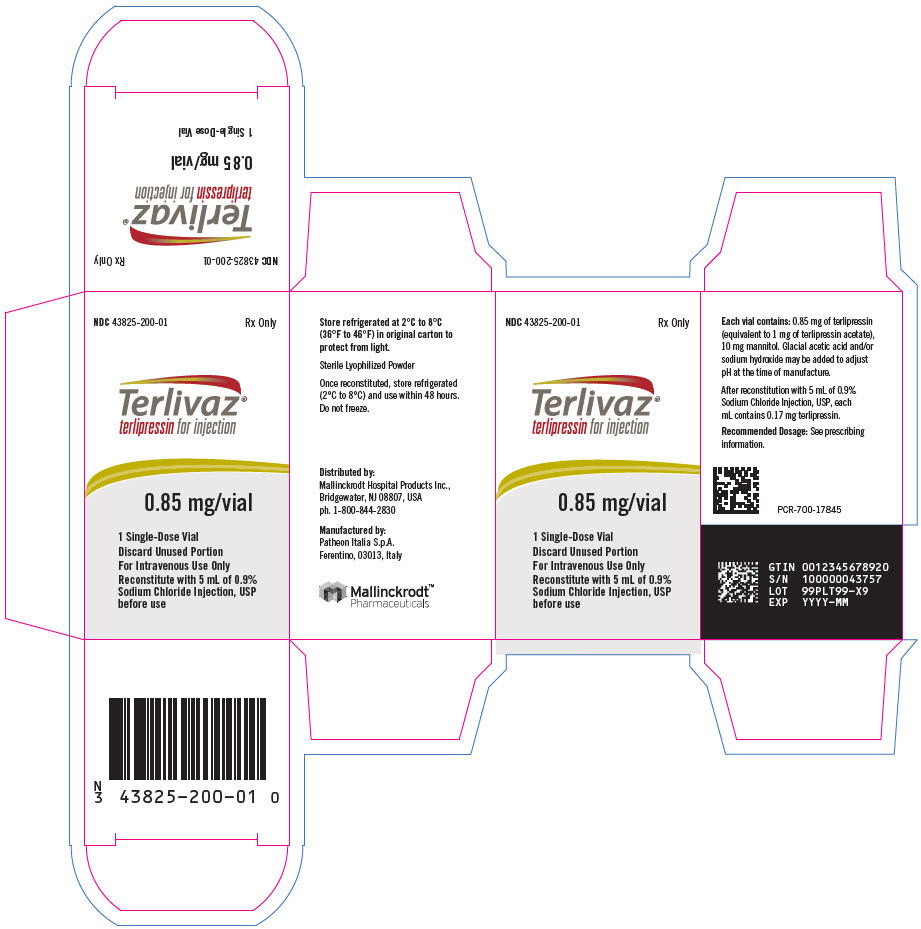
10PRINCIPAL DISPLAY PANEL - 0.85 mg Vial Carton
NDC 43825-200-01
Terlivaz
0.85 mg/vial
1 Single-Dose Vial
Discard Unused Portion
For Intravenous Use Only
Reconstitute with 5 mL of 0.9%
PRINCIPAL DISPLAY PANEL - 0.85 mg Vial Carton