Brand Name

Relenza

Generic Name
Zanamivir
View Brand Information
FDA approval date: September 22, 1999
Classification: Neuraminidase Inhibitor
Form: Powder

What is Relenza (Zanamivir)?

RELENZA, an influenza virus neuraminidase inhibitor , is indicated for: Treatment of acute, uncomplicated influenza type A and B infections in patients aged 7 years and older who have been symptomatic for no more than 2 days.

Approved To Treat

Save this treatment for later
Sign Up
Not sure about your diagnosis?
Check Your Symptoms
Tired of the same old research?
Check Latest Advances

Related Clinical Trials

Zanamivir Treatment of Vascular Permeability in Dengue (ZAP-DENGUE): A Pilot Randomized Controlled Trial

Summary: ZAP-DENGUE is a pilot randomized, double-blind, placebo-controlled evaluation of the safety and efficacy of five days of intravenous zanamivir treatment to treat vascular permeability syndrome which is the main cause of death in dengue fever.

An Open Label, Single Arm Study to Evaluate Single and Multiple Dose Pharmacokinetics, Safety and Tolerability, and to Explore Clinical Outcomes of Treatment With Intravenous (IV) Zanamivir in Neonates and Infants Under 6 Months of Age With Confirmed Complicated Influenza Infection

Summary: Influenza infection is an important public health priority, with seasonal outbreaks and pandemics causing considerable global morbidity and mortality. The PK, pharmacodynamics (PD), safety and efficacy of IV zanamivir have been evaluated in adults, adolescents and infants more than or equal to (\>=) 6 months of age with hospitalized influenza in the IV zanamivir global development program. However...

Influenza Human Challenge Model Using H3N2 (A/Texas/71/2017 (H3N2), Clade 3C3a)

Summary: This study is designed to help us better understand how the immune system responds to the flu and how flu is transmitted in the environment. The ultimate goal is to develop better vaccines and drugs to protect against or fight the flu. This study will describe how the body's immune system responds to the flu virus during and after infection and how the flu virus is transmitted in the environment. ...

Brand Information

RELENZA (zanamivir)
1DOSAGE FORMS AND STRENGTHS
Blister for oral inhalation: 5 mg. Four 5-mg blisters of powder on a ROTADISK for oral inhalation via DISKHALER. Packaged in carton containing 5 ROTADISKs (total of 10 doses) and 1 DISKHALER inhalation device
2CONTRAINDICATIONS
RELENZA is contraindicated in patients with history of allergic reaction to any ingredient of RELENZA, including milk proteins
3ADVERSE REACTIONS
The following adverse reactions are discussed in greater detail in other sections of the labeling:
  • Bronchospasm
  • Safety information in patients with underlying airways disease
  • Allergic-like reactions
3.1Clinical Trials Experience
Because clinical trials are conducted under widely varying conditions, adverse reaction rates observed in the clinical trials of a drug cannot be directly compared with rates in the clinical trials of another drug and may not reflect the rates observed in practice.
The placebo used in clinical trials consisted of inhaled lactose powder, which is also the vehicle for the active drug; therefore, some adverse events occurring at similar frequencies in different treatment groups could be related to lactose vehicle inhalation.
Treatment of Influenza
Clinical Trials in Adults and Adolescents: Adverse events that occurred with an incidence greater than or equal to 1.5% in treatment trials are listed in Table 1. This table shows adverse events occurring in subjects aged 12 years and older receiving RELENZA 10 mg inhaled twice daily, RELENZA in all inhalation regimens, and placebo inhaled twice daily (where placebo consisted of the same lactose vehicle used in RELENZA).
Additional adverse reactions occurring in less than 1.5% of subjects receiving RELENZA included malaise, fatigue, fever, abdominal pain, myalgia, arthralgia, and urticaria.
The most frequent laboratory abnormalities in Phase 3 treatment trials included elevations of liver enzymes and creatine phosphokinase (CPK), lymphopenia, and neutropenia. These were reported in similar proportions of zanamivir and lactose vehicle placebo recipients with acute influenza‑like illness.
Clinical Trials in Pediatric Subjects: Adverse events that occurred with an incidence greater than or equal to 1.5% in children receiving treatment doses of RELENZA in 2 Phase 3 trials are listed in Table 2. This table shows adverse events occurring in pediatric subjects aged 5 to 12 years receiving RELENZA 10 mg inhaled twice daily and placebo inhaled twice daily (where placebo consisted of the same lactose vehicle used in RELENZA).
In 1 of the 2 trials described in
Prophylaxis of Influenza
Family/Household Prophylaxis Trials: Adverse events that occurred with an incidence of greater than or equal to 1.5% in the 2 prophylaxis trials are listed in Table 3. This table shows adverse events occurring in subjects aged 5 years and older receiving RELENZA 10 mg inhaled once daily for 10 days.
Community Prophylaxis Trials: Adverse events that occurred with an incidence of greater than or equal to 1.5% in 2 prophylaxis trials are listed in Table 4. This table shows adverse events occurring in subjects aged 5 years and older receiving RELENZA 10 mg inhaled once daily for 28 days.
3.2Postmarketing Experience
The following adverse reactions have been identified during postapproval use of RELENZA. Because these reactions are reported voluntarily from a population of uncertain size, it is not always possible to reliably estimate their frequency or establish a causal relationship to drug exposure.
Allergic Reactions
Allergic or allergic-like reaction, including oropharyngeal edema
Psychiatric
Delirium, including symptoms such as altered level of consciousness, confusion, abnormal behavior, delusions, hallucinations, agitation, anxiety, nightmares
Cardiac
Arrhythmias, syncope.
Neurologic
Seizures. Vasovagal-like episodes have been reported shortly following inhalation of zanamivir.
Respiratory
Bronchospasm, dyspnea
Skin
Facial edema; rash, including serious cutaneous reactions (e.g., erythema multiforme, Stevens-Johnson syndrome, toxic epidermal necrolysis); urticaria
4DRUG INTERACTIONS
The concurrent use of RELENZA with live attenuated influenza vaccine (LAIV) intranasal has not been evaluated. However, because of potential interference between these products, LAIV should not be administered within 2 weeks before or 48 hours after administration of RELENZA, unless medically indicated. The concern about possible interference arises from the potential for antiviral drugs to inhibit replication of live vaccine virus.
Trivalent inactivated influenza vaccine can be administered at any time relative to use of RELENZA
5OVERDOSAGE
Reports of overdosage from administration of RELENZA have been received during postmarketing experience. The reported clinical signs or symptoms were similar to those observed with therapeutic doses of RELENZA and the underlying disease.
As zanamivir has a low molecular weight, low protein binding, and small volume of distribution, it is expected to be removed by hemodialysis.
6DESCRIPTION
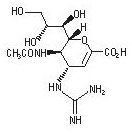
The active component of RELENZA is zanamivir. The chemical name of zanamivir is 5-(acetylamino)-4-[(aminoiminomethyl)-amino]-2,6-anhydro-3,4,5-trideoxy-D-glycero-D-galacto-non-2-enonic acid. It has a molecular formula of C
zanamivir structural formula
Zanamivir is a white to off-white powder for oral inhalation with a solubility of approximately 18 mg/mL in water at 20°C.
RELENZA is for administration to the respiratory tract by oral inhalation only. Each RELENZA ROTADISK contains 4 regularly spaced double-foil blisters with each blister containing a powder mixture of 5 mg of zanamivir and 20 mg of lactose (which contains milk proteins). The contents of each blister are inhaled using a specially designed breath-activated plastic device for inhaling powder called the DISKHALER. After a RELENZA ROTADISK is loaded into the DISKHALER, a blister that contains medication is pierced and the zanamivir is dispersed into the air stream created when the patient inhales through the mouthpiece. The amount of drug delivered to the respiratory tract will depend on patient factors such as inspiratory flow. Under standardized in vitro testing, RELENZA ROTADISK delivers 4 mg of zanamivir from the DISKHALER device when tested at a pressure drop of 3 kPa (corresponding to a flow rate of about 62 to 65 L/minute) for 3 seconds.
7HOW SUPPLIED/STORAGE AND HANDLING
RELENZA is supplied in a circular double-foil pack (a ROTADISK) containing 4 blisters of the drug. Five ROTADISKs are packaged in a white polypropylene tube. The tube is packaged in a carton with 1 blue and gray DISKHALER inhalation device (NDC 0173-0681-01).
Store at 25°C (77°F); excursions permitted to 15° to 30°C (59° to 86°F) (see USP Controlled Room Temperature). Keep out of reach of children. Do not puncture any RELENZA ROTADISK blister until taking a dose using the DISKHALER.
8PATIENT COUNSELING INFORMATION
Advise the patient to read the FDA-approved patient labeling (Patient Information and Instructions for Use).
Bronchospasm
Inform patients of the risk of bronchospasm, especially in the setting of underlying airways disease, and advise patients to stop RELENZA and contact their healthcare provider if they experience increased respiratory symptoms during treatment such as worsening wheezing, shortness of breath, or other signs or symptoms of bronchospasm
Concomitant Bronchodilator Use
Patients scheduled to take inhaled bronchodilators at the same time as RELENZA should be advised to use their bronchodilators before taking RELENZA.
Neuropsychiatric Events
Inform patients with influenza (the flu), particularly children and adolescents, they may be at an increased risk of seizures, confusion, or abnormal behavior early in their illness. These events may occur after beginning RELENZA or may occur when flu is not treated. These events are uncommon but may result in accidental injury to the patient. Therefore, patients should be observed for signs of unusual behavior and a healthcare professional should be contacted immediately if the patient shows any signs of unusual behavior
Risk of Influenza Transmission to Others
Inform patients that the use of RELENZA for treatment of influenza has not been shown to reduce the risk of transmission of influenza to others.
Missed Dose
Instruct patients that if they miss a dose of RELENZA, to take it as soon as they remember. If it is 2 hours or less before their next dose, instruct patients not to take the missed dose and to take the next dose of RELENZA at the next scheduled time. Advise patients not to double their next dose or take more than the prescribed dose.
Instructions for Use
Instruct patients in use of the delivery system. Instructions should include a demonstration whenever possible. For the proper use of RELENZA, the patient should read and follow carefully the accompanying Instructions for Use.
If RELENZA is prescribed for children, it should be used only under adult supervision and instruction, and the supervising adult should first be instructed by a healthcare professional
Trademarks are owned by or licensed to the GSK group of companies.
GlaxoSmithKline
Durham, NC 27701
©2023 GSK group of companies or its licensor.
RLZ:14PI