IgA Nephropathy Treatments
Find IgA Nephropathy Treatments
Brand Name
Filspari
Generic Name
Sparsentan
View Brand Information FDA approval date: February 17, 2023
Classification: Endothelin Receptor Antagonist
Form: Tablet
What is Filspari (Sparsentan)?
FILSPARI is indicated to slow kidney function decline in adults with primary immunoglobulin A nephropathy who are at risk for disease progression. FILSPARI is an endothelin and angiotensin II receptor antagonist indicated to slow kidney function decline in adults with primary immunoglobulin A nephropathy who are at risk for disease progression ( 1, 1.
Approved To Treat

Save this treatment for later
Not sure about your diagnosis?
Tired of the same old research?
Related Clinical Trials
A Multicenter, Open-label Single Arm Study to Evaluate the Safety and Efficacy of Sparsentan in Posttransplant Immunoglobulin A Nephropathy (IgAN) or Focal Segmental Glomerulosclerosis (FSGS) (SPARX)
Summary: To evaluate the safety and efficacy of sparsentan tablets for the treatment of patients with proteinuria after kidney transplantation with once-daily dosing for 36 weeks.
A Phase 2, Open-Label, Single-Arm, Cohort Study to Evaluate the Safety, Efficacy, and Pharmacokinetics of Sparsentan Treatment in Pediatric Subjects With Selected Proteinuric Glomerular Diseases
Summary: To evaluate the safety, efficacy and tolerability of sparsentan oral suspension and tablets, and assess changes in proteinuria after once-daily dosing over 108 weeks.
Related Latest Advances
Brand Information
FILSPARI (sparsentan)
WARNING: HEPATOTOXICITY and EMBRYO-FETAL TOXICITY
Because of the risk of hepatotoxicity, FILSPARI is available only through a restricted program called the FILSPARI REMS. Under the FILSPARI REMS, prescribers, patients, and pharmacies must enroll in the program
Hepatotoxicity
Some Endothelin Receptor Antagonists (ERAs) have caused elevations of aminotransferases, hepatotoxicity, and liver failure. In clinical studies, elevations in aminotransferases (ALT or AST) of at least 3-times the Upper Limit of Normal (ULN) have been observed in up to 3.5% of FILSPARI-treated patients, including cases confirmed with rechallenge.
Measure transaminases and bilirubin before initiating treatment and then every 3 months during treatment. Interrupt treatment and closely monitor patients who develop aminotransferase elevations more than 3-times ULN
FILSPARI should generally be avoided in patients with elevated aminotransferases (>3-times ULN) at baseline because monitoring for hepatotoxicity may be more difficult and these patients may be at increased risk for serious hepatotoxicity
Embryo-Fetal Toxicity
FILSPARI is contraindicated for use during pregnancy because it may cause fetal harm if used by pregnant patients. Therefore, in patients who can become pregnant, exclude pregnancy prior to initiation of FILSPARI.
Advise use of effective contraception before the initiation of treatment, during treatment, and for two weeks after discontinuation of treatment with FILSPARI. When pregnancy is detected, discontinue FILSPARI as soon as possible
Advise use of effective contraception before the initiation of treatment, during treatment, and for two weeks after discontinuation of treatment with FILSPARI. When pregnancy is detected, discontinue FILSPARI as soon as possible
1DOSAGE FORMS AND STRENGTHS
FILSPARI is supplied as film-coated, modified oval, white to off-white tablets debossed on one side and plain on the other in the following strengths:
200 mg debossed with “105”
2CONTRAINDICATIONS
Use of FILSPARI is contraindicated in patients who are pregnant
Do not co-administer FILSPARI with ARBs, ERAs, or aliskiren
3ADVERSE REACTIONS
Clinically significant adverse reactions that appear in other sections of the label include:
- Hepatotoxicity
- Embryo-Fetal Toxicity
- Hypotension
- Acute Kidney Injury
- Hyperkalemia
- Fluid Retention
3.1Clinical Trials Experience
Because clinical trials are conducted under widely varying conditions, adverse reaction rates observed in the clinical trials of a drug cannot be directly compared to rates in the clinical trials of another drug and may not reflect the rates observed in practice.
IgAN
The safety of FILSPARI was evaluated in PROTECT (
The data below reflect FILSPARI exposure in 202 patients with a median duration of 110 weeks.
The most common adverse reactions are presented in
FSGS
The safety of FILSPARI was evaluated in DUPLEX (
The data below reflects FILSPARI exposure in adult (n=168) and pediatric patients 9 years and older (n=16) with FSGS who received FILSPARI at the recommended dosing regimens for a median duration of 108 weeks
The most common adverse reactions reported in adult and pediatric patients 9 years of age and older are presented in
Laboratory Tests
The incidence of a hemoglobin decrease >2 g/dL compared to baseline and below the lower limit of normal was greater for the FILSPARI arm compared to the irbesartan arm (19% vs 13% in PROTECT; 45% vs 18% in DUPLEX). This decrease is thought to be in part due to hemodilution. There were no treatment discontinuations due to anemia or hemoglobin decrease in the PROTECT or DUPLEX clinical studies.
4OVERDOSAGE
There is no experience with overdose with FILSPARI. Sparsentan has been given in doses up to 1600 mg/day in healthy volunteers, or up to 800 mg/day in patients. Overdose of FILSPARI may result in decreased blood pressure. In the event of an overdose, standard supportive measures should be taken, as required. Dialysis is unlikely to be effective because sparsentan is highly protein-bound.
5DESCRIPTION
FILSPARI (sparsentan) is an endothelin and angiotensin II receptor antagonist. The chemical name of sparsentan is 2-[4-[(2-butyl-4-oxo-1,3-diazaspiro[4.4]non-1-en-3-yl)methyl]-2-(ethoxymethyl)phenyl]-N-(4,5-dimethyl-1,2-oxazol-3-yl)benzenesulfonamide.
Sparsentan is a white to off-white powder, which is practically insoluble in water. Sparsentan has pH-dependent solubility, with intrinsic solubility of 1.48 and 0.055 mg/mL under pH 1.2 and 6.8, respectively. Sparsentan has a molecular weight of 592.76 g/mol, a molecular formula of C

FILSPARI is available as film-coated 200 mg and 400 mg strength immediate release tablets for oral administration.
The inactive ingredients in FILSPARI are colloidal silicon dioxide, lactose anhydrous, magnesium stearate, silicified microcrystalline cellulose, and sodium starch glycolate. Film-coating is composed of macrogol/polyethylene glycol, polyvinyl alcohol-partially hydrolyzed, talc, and titanium dioxide.
6HOW SUPPLIED/STORAGE AND HANDLING
FILSPARI is supplied in bottles of 30 film-coated tablets.
- 200 mg tablets are film-coated, modified oval, white to off-white, debossed with “105” on one side and plain on the other side, available in bottles of 30 tablets with child-resistant caps (NDC 68974-200-30).
- 400 mg tablets are film-coated, modified oval, white to off-white, debossed with “021” on one side and plain on the other side, available in bottles of 30 tablets with child-resistant caps (NDC 68974-400-30).
Storage
Store at 20°C to 25°C (68°F to 77°F), excursions permitted to 15°C to 30°C (59°F to 86°F). Store FILSPARI in its original container.
7PATIENT COUNSELING INFORMATION
Advise patients to read the FDA-approved patient labeling (Medication Guide).
Restricted Access
Advise the patient that FILSPARI is only available through a restricted access program called the FILSPARI REMS because of the risk of hepatotoxicity, and that FILSPARI is available only from certified pharmacies that are enrolled in the FILSPARI REMS.
As a component of the FILSPARI REMS, prescribers must review the contents of the FILSPARI Medication Guide with the patient before initiating FILSPARI and patients must sign the FILSPARI REMS Patient Enrollment Form to confirm that they understand the risks of FILSPARI.
Instruct patients of the risk of hepatotoxicity associated with FILSPARI.
Hepatotoxicity
Advise patients with symptoms suggesting hepatotoxicity (nausea, vomiting, right upper quadrant pain, fatigue, anorexia, jaundice, dark urine, fever, or itching) to immediately stop taking FILSPARI and seek medical attention
Discuss with the patient the requirement to measure serum aminotransferases every 3 months
Embryo-Fetal Toxicity
Counsel patients who can become pregnant about the need to use effective methods of contraception prior to treatment with FILSPARI, during treatment, and for two weeks after treatment discontinuation. Patients who can become pregnant should have a negative pregnancy test prior to initiation of treatment with FILSPARI
Patients should be instructed to immediately contact their physician if they suspect they may be pregnant. Patients should seek additional contraceptive advice from a gynecologist or similar expert as needed.
Educate and counsel patients who can become pregnant on the use of emergency contraception in the event of unprotected sex or contraceptive failure.
Advise pre-pubertal females and/or their guardian(s) of the fetal risk and the need to use effective contraception once they reach reproductive potential.
Lactation
Advise patients not to breastfeed during treatment with FILSPARI
Drug Interactions
Advise patients to inform their healthcare provider of all concomitant medications, including prescription medications, over-the-counter drugs, vitamins/supplements, herbal products, and grapefruit
Other Risks Associated with FILSPARI
Inform patients of other risks associated with FILSPARI, including:
- Hypotension: Advise patients to remain hydrated
- Hyperkalemia: Advise patients not to use potassium supplements or salt substitutes that contain potassium without consulting their healthcare provider
Dosing
Advise patients to take the full daily dose with water prior to the morning or evening meal. Patients who cannot swallow whole tablets can crush and suspend the tablet(s) in half cup of water, mix and orally administer the entire prepared suspension immediately after preparation. If any portion of the tablet is left in the cup, add a small amount of additional water, swirl to mix and swallow immediately. Do not store the solution for later use
Distributed by Travere Therapeutics, Inc., San Diego, CA 92130
FILSPARI is a registered trademark of Travere Therapeutics, Inc.
v5
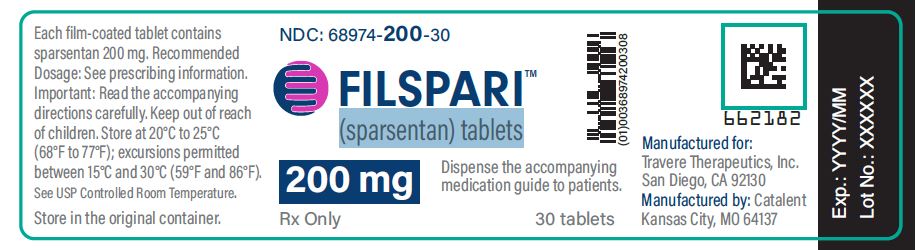
8PRINCIPAL DISPLAY PANEL - 200 mg Tablet Bottle Label
NDC 68974-200-30
FILSPARI
200 mg
Rx Only
Manufactured for:
Manufactured by:
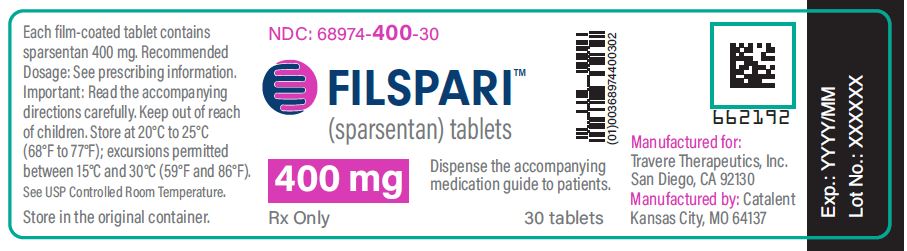
9PRINCIPAL DISPLAY PANEL - 400 mg Tablet Label
NDC 68974-400-30
FILSPARI
400 mg
Rx Only
Manufactured for:
Manufactured by: